But starting a business here is not simple. Mexico's civil law system is formal, document-heavy, and sequential — and many foreign entrepreneurs underestimate how different it is from what they know at home.
This guide walks you through every stage: choosing the right business structure, completing registration, and staying compliant once you're operational.
Key Takeaways
- Foreigners can own 100% of most Mexican businesses, with no local partner required in most sectors
- The two main entity types for foreign investors are the S.A. and S. de R.L., both offering limited liability
- Full registration typically takes 4–12 weeks across federal, state, and municipal registration steps
- Compliance obligations — taxes, payroll, IMSS — begin the moment operations start
- Mexico's civil law system requires qualified legal and accounting support from day one — the regulatory framework is not self-navigable without local expertise
Why Start a Business in Mexico?
Mexico is not a guaranteed win, but the structural advantages are concrete.
Scale and market access:
- GDP of $1.86 trillion — among the world's 15 largest economies
- Consumer base of 130+ million people
- U.S.-Mexico goods trade reached approximately $840 billion in 2024, making USMCA preferential access commercially significant
Three structural advantages driving foreign investment:
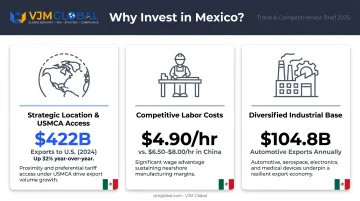
- Strategic location and USMCA access — preferential trade terms with the U.S. and Canada make Mexico an ideal manufacturing and distribution hub. Mexico surpassed mainland China as the largest exporter to the U.S., with imports reaching $422 billion — up 32% from pre-pandemic levels
- Competitive labor costs — average hourly manufacturing wages in Mexico run approximately $4.90, compared to $6.50–$8.00 in China, making it attractive for nearshoring and production operations
- Diversified industrial base — Mexico's automotive sector alone generated $104.8 billion in light-vehicle exports in 2024, with additional strength in agriculture, IT, and tourism
These numbers tell only part of the story. Operational complexity — regulatory requirements, entity structuring, tax obligations — remains real and requires preparation. For companies with a clear rationale, whether nearshoring production, tapping U.S. supply-chain proximity, or reaching 130 million domestic consumers, that preparation is worth making.
Business Structures Available to Foreign Entrepreneurs in Mexico
Choosing the right structure is one of the earliest consequential decisions. It shapes liability, tax treatment, management requirements, and how easily you can bring in foreign capital.
The Two Main Options for Foreign Investors
| Entity | Description | Key Constraints |
|---|---|---|
| Sociedad Anónima (S.A.) | Similar to a corporation; shareholders' liability limited to share contributions; shares are transferable | Minimum 2 shareholders; requires a statutory auditor (comisario) |
| Sociedad de Responsabilidad Limitada (S. de R.L.) | Similar to an LLC; partners liable only for their contributions; simpler management | Maximum 50 partners; equity interests are not negotiable instruments |
The S.A. works better for larger operations or those expecting multiple investors. The S. de R.L. suits smaller, more tightly held businesses where ownership flexibility is less critical.
Beyond these two core formats, Mexico offers several lighter-weight alternatives worth knowing before you commit.
Newer and Alternative Formats
- Sociedad por Acciones Simplificada (S.A.S.) — A streamlined option introduced for startups and individual entrepreneurs. Allows a single shareholder, no notary required for incorporation, but carries an annual income cap of MXN 7,678,849.94 (updated December 2025). Not suitable for businesses expecting rapid growth or significant foreign capital.
- Representative Offices: Cannot generate income — permitted only for market research or liaison activities.
- Branch Offices: Operate as an extension of the foreign parent with no separate legal identity in Mexico.
- Joint Ventures or Franchise Agreements: Enable market collaboration or brand licensing without full incorporation.
Foreign Ownership Restrictions
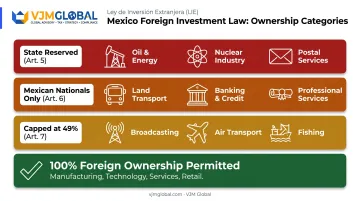
Under Mexico's Foreign Investment Law (LIE), Article 4 allows foreign investment in any proportion by default. Restrictions apply only to specific sectors:
- Article 5 (State-reserved): Oil/hydrocarbons, national electricity system, nuclear energy, radioactive minerals, postal service, coin minting
- Article 6 (Mexican nationals only): Domestic land transport for passengers and freight, development banking, certain professional services
- Article 7 (Capped at 49%): Broadcasting, domestic air transport, inland shipping, freshwater fishing, explosives, and national newspapers
Most industries — manufacturing, technology, services, retail, agriculture — are fully open to 100% foreign ownership.
What Every Foreigner Should Know Before Starting
Mexico Operates Under Civil Law
Unlike the common law systems familiar to U.S., UK, and Australian entrepreneurs, Mexico's legal framework is civil law — more formal, more procedural, and far heavier on documentation. Many legal acts require physical presence. Amendments to corporate documents must be processed in the same formal manner as the original incorporation.
The Role of the Notary Public (Notario Público)
This is not a notary in the common law sense: someone who simply witnesses a signature. In Mexico, the Notario Público is a legally empowered professional invested with public faith (fe pública) by the state. Under LGSM Article 5, most business types must be constituted before a fedatario público (a notary or equivalent). The founding deed, any amendments, and key corporate decisions all pass through this office.
Choosing a reliable notary early matters. Their competence affects how quickly your incorporation moves.
Practical Realities That Trip Up First-Time Entrants
- All submissions are in Spanish — foreign documents must be translated
- Handwritten signatures are still required across many official processes
- Government appointment timelines are fixed and cannot be rushed or fast-tracked
- The SAT (tax authority) requires in-person visits for RFC registration and e.firma
- Virtual office addresses face scrutiny — the tax code requires your fiscal address to reflect where the principal administration actually occurs
A local advisor who knows these pressure points can mean the difference between a 6-week incorporation and a 6-month one.
How to Start a Business in Mexico: Step-by-Step
Step 1: Choose Your Business Structure and Reserve a Company Name
Select your entity type based on ownership structure, growth plans, and capital requirements (see the section above). Restructuring after incorporation triggers notary fees, tax re-registrations, and potential delays — so get this decision right upfront.
Once you've decided, submit proposed company names to the Secretaría de Economía via the MUA portal for availability review. The official response time is within 48 hours. Names cannot duplicate existing trademarks or registered entities. In practice, advisors commonly submit three ranked options to allow for rejections.
Step 2: Gather Shareholder and Beneficial Owner Information
Collect full identification, passport copies, and proof of address for all shareholders. If shareholders are foreign legal entities rather than individuals, additional apostilled (internationally certified) corporate documents are required — notarized, legalized, and translated into Spanish.
UBO (Beneficial Owner) Requirement: Under CFF Article 32-B Ter, effective January 1, 2022, all legal entities must identify and document the individuals who ultimately own or control the company. Fines for non-compliance are significant:
- Failure to obtain/keep records: MXN 1,686,750 – 2,249,000 per beneficial owner
- Failure to update records: MXN 899,600 – 1,124,500 per beneficial owner
- Incomplete or inaccurate information: MXN 562,250 – 899,600 per beneficial owner
Notaries are cautious about complex ownership structures for this reason. Have your UBO documentation in order before Step 3 — it directly affects how smoothly the notary can proceed.
Step 3: Formalize Incorporation Before a Notary Public
Work with your appointed notary to draft the Acta Constitutiva (constitutive deed). This document must include:
- Company name, purpose, and domicile
- Founder names, nationalities, and addresses
- Capital structure and shareholder contributions
- Management structure and administrator appointments
- Profit/loss distribution rules and dissolution provisions
All founders must sign in person — or be represented by a notarized, apostilled Power of Attorney if signing from abroad. The completed deed is the foundational legal document of your Mexican company.
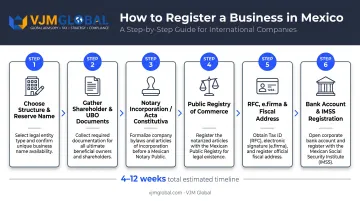
Step 4: Register with the Public Registry of Commerce
Your notary files the registration with the Registro Público de Comercio (RPC) after incorporation. This gives your company legal standing for contracts, banking, and third-party verification. The RPC operates at the state level, so registration applies in the state where your fiscal address is located. Branches in other states can be added later without re-registering the entity.
Step 5: Obtain a Fiscal Address, Tax ID (RFC), and Electronic Signature
Your company needs a physical fiscal address — one where the principal administration genuinely occurs. SAT accepts utility bills, bank statements, property tax receipts, or office/workspace contracts of at least six months as proof. Private registered address providers in Mexico City advertise plans from around MXN 949/month, though rates vary.
The legal representative must then visit a SAT office in person to obtain:
- RFC (Registro Federal de Contribuyentes) — the company's tax ID (pre-registration via SAT Ficha 43 is available online, but must be completed in person within 10 days)
- e.firma — the electronic signature needed for all tax filings and government transactions
If the legal representative is a foreigner, they must first obtain their own personal RFC, CURP, and a valid immigration document before they can act on behalf of the company.
Step 6: Open a Corporate Bank Account and Register with IMSS
Bank account: Required documents typically include the Acta Constitutiva, RFC, proof of fiscal address, assembly minutes, and the legal representative's ID. Timelines vary by bank. Major Mexican banks — including Banorte, BBVA, and Santander — each have their own document requirements for business accounts.
IMSS registration: If you plan to hire even one employee, you must register as an employer with the Instituto Mexicano del Seguro Social (IMSS) within five business days of the first hire. This triggers social security contributions and connects the employer to INFONAVIT (the national housing fund) through the SUA calculation system. IMSS contributions vary by risk premium, which runs 0.5%–15% of base contribution salary depending on industry risk classification.
Key Compliance Obligations After Registration
Incorporation is not the finish line — Mexican businesses carry ongoing obligations that begin the moment operations start.
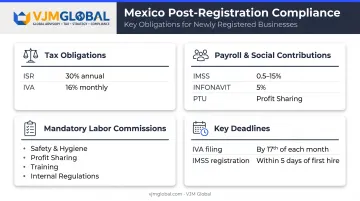
Tax Obligations
| Tax | Rate | Filing Frequency |
|---|---|---|
| Corporate income tax (ISR) | 30% | Annual return within 3 months of year-end; monthly provisional payments |
| VAT (IVA) | 16% | Monthly, by the 17th of the following month |
Payroll and Social Contributions
- IMSS employer contributions — varies by risk premium (0.5%–15%)
- INFONAVIT — employer contribution of 5% of base contribution salary per worker
- PTU (profit sharing) — employees are entitled to a share of annual profits; a mixed employer-employee commission determines individual entitlements
Mandatory Labor Committees
Mexican labor law requires companies to establish several joint employer-employee commissions:
- Safety and hygiene commission — investigates accidents and proposes preventive measures (LFT Article 509)
- Profit-sharing commission — determines worker PTU participation
- Training, apprenticeship, and productivity commission — required for companies with more than 50 workers
- Internal work-regulations commission — required where internal work regulations are adopted
Non-compliance carries real cost: failure to establish required commissions can result in administrative sanctions during labor inspections, with fines up to 5,000 UMA for safety and hygiene violations alone. These aren't theoretical risks — Mexican labor inspectors actively audit documentation during routine inspections.
Conclusion
Starting a business in India is structured — the legal framework is demanding, but it's entirely navigable when approached in the right order. The most common failure point isn't the rules themselves; it's underestimating how formal the system is and how much documentation it requires from foreign entities.
Before you file anything, get these three foundations in place:
- Confirm your entry structure (subsidiary, branch, LLP, or liaison office) based on your ownership and repatriation needs
- Prepare your UBO and KYC documentation before approaching the Registrar of Companies
- Build your GST, TDS, and annual compliance calendar before your first invoice or hire
Engage qualified local legal and accounting support early. The civil law environment, India-specific tax regulations, and in-person RBI or MCA processes are not areas where self-service works well for foreign entrepreneurs.
India's market offers real commercial advantages for businesses that invest in getting the setup right. The cost of fixing a poorly structured entry — restructuring equity, repatriating funds improperly classified, or correcting non-compliant filings — consistently exceeds the cost of doing it correctly from the start.
Frequently Asked Questions
Can a foreigner open a business in Mexico?
Yes. Under LIE Article 4, foreigners can own 100% of most Mexican businesses with no requirement for a local partner. A small number of sectors — including domestic transport, broadcasting, and certain professional services — have foreign ownership restrictions, but the vast majority of industries are fully open.
How much does it cost to start a business in Mexico?
Private service providers quote basic incorporation packages starting from around $2,000–$3,500 USD, covering notary fees, name reservation, and registry filing. Additional costs apply for RFC setup, professional advisory fees, registered address services, and ongoing compliance.
What kind of business can I start in Mexico?
Mexico is open to most business types — manufacturing, technology, services, retail, agriculture, hospitality, and more. Foreigners can choose from multiple legal structures depending on their size of operations and ownership structure. Restrictions apply only to a defined list of sectors under the Foreign Investment Law.
How long does it take to register a company in Mexico?
The full process typically takes 4–12 weeks, depending on document readiness, notary availability, SAT appointment timelines, and bank processing. The process cannot be significantly accelerated — it is formal and appointment-based by design.
Do I need a Mexican business partner to start a company in Mexico?
No. A Mexican partner is not required for most businesses. The legal representative, who acts on behalf of the company in official processes, can be a foreigner — provided they hold appropriate immigration status, their own RFC, and a CURP.
What ongoing taxes and compliance obligations apply to businesses in Mexico?
Core obligations include:
- 30% corporate income tax (ISR) filed annually
- 16% VAT (IVA) filed monthly
- Payroll tax declarations and IMSS employer contributions
- INFONAVIT contributions (5% of base salary) and annual shareholders' meeting
Specifics vary by business type, revenue level, and industry classification.