Introduction
Singapore remains one of the world's most attractive destinations for foreign entrepreneurs. ACRA recorded 628,081 registered business entities as of April 2026, with thousands of new formations each month—evidence of the city-state's continued appeal. The IMD World Competitiveness Ranking 2025 placed Singapore second globally, just behind Switzerland, a ranking that reflects its low corruption levels, strong contract enforcement, and predictable regulatory environment.
If you're considering Singapore, you likely have specific questions: Can I own the company fully? Do I need to be physically present? What are the rules around directors and compliance?
This guide answers all of those directly — covering eligibility, business structure options, the registration process, and post-incorporation obligations, whether you plan to relocate or register entirely from overseas.
Key Takeaways
- Foreigners can own 100% of a Singapore company without needing a local shareholder
- Every company needs at least one locally resident director—most overseas founders hire a nominee director to satisfy this requirement
- The Private Limited Company (Pte Ltd) offers limited liability, full foreign ownership, and access to tax incentives
- Registration takes 1–3 business days via ACRA's BizFile+; corporate bank account approval typically adds several weeks
- Ongoing requirements include annual filings, tax submissions, and a mandatory company secretary appointment
Why Singapore? The Case for Foreign Entrepreneurs
Few jurisdictions make it this straightforward for foreigners to build and own a business outright. Singapore's combination of regulatory clarity, low taxes, and open ownership rules is why it consistently ranks among the world's top destinations for international entrepreneurs.
Business Environment
Singapore isn't just well-regarded — it's ranked 2nd globally in the IMD World Competitiveness Ranking 2025, reflecting real structural advantages:
- Transparent regulatory framework with minimal bureaucracy
- Gateway to Southeast Asia and broader Asian markets
- Strong intellectual property protections and enforceable contracts
Tax Advantages
Singapore's tax structure is one of the most competitive in Asia — and it actively rewards new businesses:
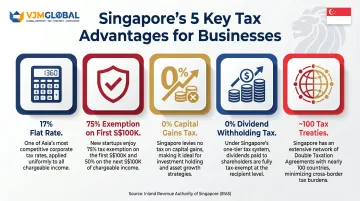
- Corporate tax capped at a 17% flat rate
- Startup Tax Exemption Scheme: 75% exemption on the first S$100,000 and 50% on the next S$100,000 for the first three years
- No capital gains tax on property, shares, or financial instruments
- No dividend withholding tax under Singapore's one-tier system
- Around 100 double taxation agreements in force
Foreign-Friendly Incorporation
The mechanics of setting up are equally accessible — no residency, no large capital outlay, no drawn-out paperwork:
- 100% foreign ownership permitted
- Fully digital incorporation process
- Government fees total just S$315
- No minimum capital requirement beyond S$1
What Foreigners Need to Know Before Starting
Before registering, understand these five non-negotiable legal requirements:
Core Legal Requirements:
| Requirement | Details |
|---|---|
| Locally resident director | At least one director must be a Singapore citizen, PR, or holder of Employment Pass, Personalised Employment Pass, or ONE Pass |
| Registered Singapore address | Physical address required—P.O. boxes not accepted |
| Corporate Service Provider (CSP) | Foreigners must engage a licensed CSP to file with ACRA |
| Minimum paid-up capital | S$1 minimum (no upper limit) |
| Company secretary | Must be appointed within 6 months of incorporation |
Three Routes for Foreign Founders:
- Relocate to Singapore : Run the business yourself via an EntrePass or Employment Pass
- Register from overseas : Appoint a nominee director through a CSP (most common for remote founders)
- Partner locally : Work with a Singapore-based co-founder who serves as the resident director
Visa Options for Those Relocating:
- EntrePass: For innovative or venture-backed startups; must meet MOM eligibility criteria including at least S$100,000 in funding or IP ownership
- Employment Pass: For founders who hire themselves as directors; requires minimum monthly salary of S$5,600 (S$6,200 for financial services), increasing to S$6,000/S$6,600 from January 2027
- Letter of Consent: For Dependant's Pass holders
Important: You don't need a visa to register the company—only to work in Singapore.
The Bank Account Challenge:
Incorporation takes days. Corporate bank account approval, however, can take weeks. Banks apply strict KYC checks for non-residents — sometimes requiring video verification or in-person visits. Prepare detailed business documentation before you start and build the extra time into your launch timeline.
Choosing the Right CSP:
Not all Corporate Service Providers offer the same level of support. Errors during incorporation — incomplete documents, wrong structure — cost more to fix later than to get right the first time. Look for a CSP with proven cross-border experience, not just incorporation filing. The right firm will guide you through compliance, tax structure, and ongoing reporting requirements from day one.
Choosing the Right Business Structure in Singapore
Private Limited Company (Pte Ltd)
The Pte Ltd is the recommended structure for most foreign founders:
- 100% foreign ownership allowed
- Personal liability limited to invested capital
- Eligible for Startup Tax Exemption Scheme
- Credible to banks and investors
- 1–50 shareholders permitted
Two other structures exist but suit foreigners poorly. A Sole Proprietorship carries unlimited personal liability. A Limited Liability Partnership requires a locally resident partner and is better suited to professional services firms with existing local ties.
Structures for Foreign Companies Expanding to Singapore
If you already run an established company overseas and want a Singapore footprint, the choice depends on how committed you are to generating revenue here:
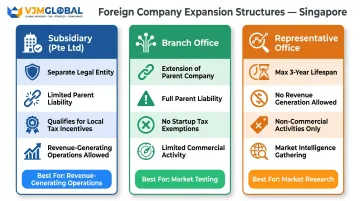
| Structure | Legal Entity | Parent Liability | Tax Benefits | Best For |
|---|---|---|---|---|
| Subsidiary (Pte Ltd) | Separate legal entity | Limited to subsidiary | Qualifies for local tax incentives | Revenue-generating operations |
| Branch Office | Extension of parent | Parent fully liable | Not eligible for startup exemptions | Testing market with parent backing |
| Representative Office | Non-commercial only | N/A | N/A | Market research (max 3 years) |
Representative Office Requirements:
- Parent company must have turnover exceeding US$250,000
- At least 3 years in operation
- Cannot generate revenue in Singapore
Which structure fits your situation?
- Individual launching a new business → Choose Pte Ltd
- Existing company testing the market → Consider Representative Office first
- Ready to generate revenue as a foreign company → Register a Subsidiary
How to Register a Business in Singapore as a Foreigner – Step by Step
Registration is fully digital through ACRA's BizFile+ platform. Foreigners cannot self-register and must work through a licensed Corporate Service Provider.
Step 1 – Decide How You Will Operate
Determine upfront whether you will:
- Manage from overseas — Requires a nominee director arrangement
- Relocate to Singapore — Requires a work pass before acting as a director or employee
Common mistake: Assuming you can act as the local resident director immediately upon incorporation without a valid work pass. Being a shareholder and acting as a director are legally distinct roles.
Step 2 – Choose Your Business Structure and Reserve Your Company Name
File a name reservation through BizFile+:
- Approval typically takes a few hours to one business day
- Applications requiring additional review can take up to 15 working days
- Approved names are reserved for 120 days
The name must not infringe existing trademarks, include restricted words, or closely resemble existing entities. Check ACRA's BizFile+ directory before committing.
Step 3 – Prepare Your Required Documents
Essential Documents:
- Passport copies and overseas residential address proof for all shareholders and directors
- Share capital and shareholding structure details
- Company's SSIC code (business activity classification)
- Registered Singapore address (most founders use a CSP's registered address service)
- Company constitution (ACRA's standard template is acceptable)
Step 4 – Appoint a Local Resident Director
This is a hard legal requirement. The director must be:
- Singapore citizen, permanent resident, or
- Valid holder of Employment Pass, Personalised Employment Pass, or ONE Pass
If you're overseas, appoint a nominee director through your CSP. Ensure a proper nominee director agreement is in place that:
- Limits the nominee to an administrative capacity
- Excludes signing authority over bank accounts
- Prevents involvement in business operations
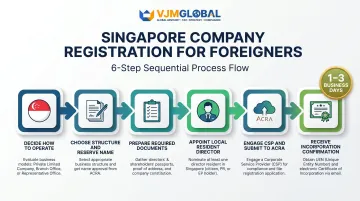
Step 5 – Engage a CSP and Submit to ACRA
A licensed CSP submits the registration application through BizFile+. Government fees are fixed; CSP service fees vary by provider.
Government Fees (Fixed):
- Name reservation: S$15
- Incorporation: S$300
- Total: S$315
Combined service packages typically include nominee director, company secretary, and registered address services. When evaluating CSPs, look for providers who also cover post-incorporation compliance — accounting setup, corporate secretarial obligations, and tax registration — so your business is operational, not just incorporated.
Step 6 – Receive Incorporation Confirmation
Once approved (typically 1–3 business days for standard applications), ACRA sends an email confirmation including:
- Certificate of Incorporation
- Unique Entity Number (UEN) — required for all government transactions
- Free ACRA business profile (BizFile extract) for sharing with banks and stakeholders
After Incorporation: Obligations Foreign Founders Cannot Ignore
Immediate Post-Incorporation Actions
Within 6 months:
- Appoint a company secretary (mandatory under Companies Act)
Within 3 months:
- Appoint an auditor unless exempt (most startups qualify for small company exemption)
As soon as possible:
- Open a corporate bank account (DBS, OCBC, UOB, or digital alternatives like Aspire or Airwallex)
- Register for Corppass to transact with Singapore government agencies
Note on bank accounts: Non-resident founders should prepare detailed business documentation and expect longer approval timelines. Some banks require video verification or an in-person visit.
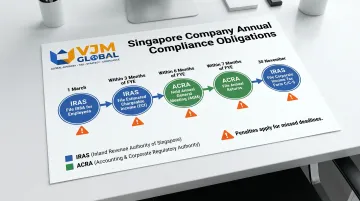
Once your accounts are in order, you'll face a fixed calendar of recurring filings. Missing any of these carries financial penalties and risks the company being struck off.
Recurring Annual Obligations
| Deadline | Obligation | Authority |
|---|---|---|
| 1 March | File IR8A for employees | IRAS |
| Within 3 months of FYE | File Estimated Chargeable Income (ECI) | IRAS |
| Within 6 months of FYE | Hold Annual General Meeting | ACRA |
| Within 7 months of FYE | File Annual Returns | ACRA |
| 30 November | File corporate income tax (Form C/C-S) | IRAS |
GST Registration
Mandatory if annual taxable turnover exceeds S$1 million (or is expected to in the next 12 months). Voluntary registration is possible below the threshold.
Small Company Audit Exemption:
Qualify if you meet at least 2 of these 3 criteria:
- Revenue ≤ S$10 million
- Total assets ≤ S$10 million
- Employees ≤ 50
Most early-stage foreign-owned companies clear all three thresholds and qualify — but it's worth confirming with a local accountant before your first financial year closes.
Frequently Asked Questions
How much does it cost to start a business in Singapore?
Government fees total S$315 (S$15 name reservation + S$300 incorporation). Total costs for foreigners are higher when adding CSP fees, nominee director services, registered address, and company secretary—typically ranging from S$1,500–S$3,000 depending on the provider and package.
Can I move to Singapore to start a business?
Yes, but you must obtain the appropriate work pass before you can legally work in the business. The two main options are the EntrePass (for innovative or venture-backed startups) and the Employment Pass (for founders with a qualifying background and minimum salary of S$5,600). Work pass approval must be secured before you take on any active role in the company.
Is it hard to start a business in Singapore as a foreigner?
The registration process itself is straightforward and fast (1–3 days). However, foreigner-specific requirements—local director, CSP engagement, bank account KYC, and ongoing compliance—add layers that make professional guidance worth the cost.
What is the 60-90 day rule in Singapore?
There is no single "60-90 day rule" in Singapore law. The actual timelines are: company secretary must be appointed within 6 months of incorporation, name reservations are valid for 120 days, and EntrePass applications must be filed before incorporation or within 12 months of the company's registration date.
Can I own 100% of a Singapore company as a foreigner?
Yes. Singapore places no restriction on foreign shareholding. A foreigner can hold 100% equity in a Private Limited Company without needing a local shareholder, while still requiring at least one locally resident director.
Do I need to be physically present in Singapore to register a company?
No. Foreigners can register a Singapore company entirely from overseas through a licensed Corporate Service Provider, without visiting Singapore, as long as a local resident director is appointed and all required documents are in order. Physical presence may be needed later for bank account opening or work pass applications.
Final Considerations:
Singapore consistently ranks among the top jurisdictions globally for ease of doing business, backed by a 17% corporate tax rate, zero capital gains tax, and an extensive network of tax treaties. Incorporation is fast—but the post-incorporation compliance calendar and banking requirements demand careful planning from day one.
For businesses expanding across Southeast Asia or structuring operations that touch multiple jurisdictions, the complexity compounds quickly. Firms like VJM Global, which specialize in cross-border tax compliance, international accounting, and business setup, can help foreign entrepreneurs manage Singapore's compliance requirements alongside their broader regional obligations—without gaps between incorporation and ongoing operations.