That momentum isn't limited to large corporates. German Mittelstand firms, engineers-turned-founders, and consultants are increasingly asking the same question: how do you actually register and run an Australian company while based in Germany?
This guide walks through eligibility, structure choice, registration, tax obligations, and realistic costs, step by step.
Key Takeaways
- Germans can own 100% of an Australian company, but at least one director must live in Australia
- Pty Ltd is the go-to structure, offering limited liability and full foreign ownership in most industries
- Secure an ACN, ABN, and TFN at setup; register for GST once turnover exceeds AUD 75,000
- The Germany-Australia DTA prevents profits and dividends from being taxed twice
- Registration is mostly online; non-residents need extra steps for banking and director ID
What German Entrepreneurs Must Know Before Starting
For German founders, the requirement that most often stalls Australian registration is the resident director rule. Miss it, and the process stops before it starts.
The Resident Director Requirement
Under the Corporations Act 2001, a proprietary company needs at least one director who normally lives in Australia (ASIC). A secretary is optional, but if you appoint one, that person must also normally reside in Australia.
Your practical options:
- Nominee director services: a professional acts as the resident director on your behalf
- A trusted local contact: a business partner, relative, or associate already living in Australia
- Relocating a founder: moving one person to Australia to fulfil the role directly
Whichever route you choose, directors carry real legal responsibility for compliance. Choose someone who understands that weight.
Germany-Side Considerations
Setting up abroad doesn't remove your German reporting obligations. The Bundesbank requires German residents to report cross-border payments above certain thresholds.
Separate rules also apply to outbound direct-investment stock where ownership exceeds 10% in a foreign enterprise with assets over EUR 3 million (Bundesbank). These reporting rules were updated in January 2025, so confirm current thresholds with a German tax advisor before you file anything.
The Germany-Australia Double Taxation Agreement, in force since December 2016, prevents your business profits and dividends from being taxed twice. Dividend withholding tax at source is capped at 5% where a company holds 10%+ voting power for six months. Otherwise the cap is 15% (Agreement text via APH).
Two Operating Models
| Model | How it works | Best for |
|---|---|---|
| Remote Setup | Register and operate from Germany using a local director/agent | Testing the market, e-commerce, remote services |
| Relocate & Operate | Move to Australia via a Business Innovation and Investment visa | Founders wanting hands-on daily operations |
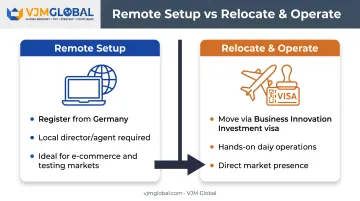
Most German entrepreneurs start with the remote model and relocate later if the business justifies it.
Why Australia Makes Strategic Sense for German Businesses
German business culture values legal certainty, transparent regulation, and enforceable contracts. Australia delivers all three, ranking 17th out of 70 economies in the IMD World Competitiveness Booklet 2026 (IMD).
Beyond legal stability, Australia offers practical trade advantages:
- Free Trade Agreement network spanning AANZFTA, CPTPP, PACER Plus, RCEP, and bilaterals with Japan, Korea, Singapore and China, useful as an Asia-Pacific springboard
- R&D Tax Incentive with a refundable offset of roughly 43.5% for eligible companies under AUD 20 million turnover, a real draw for German engineering and tech founders
- Flat 25% corporate tax rate for base rate entities with aggregated turnover under AUD 50 million (ATO)
None of this removes compliance obligations. But it does mean the rules, once you learn them, stay predictable, something German founders tend to appreciate.
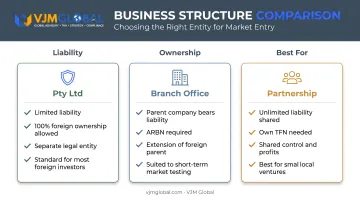
Business Structures Available to German Entrepreneurs
Your structure choice shapes liability exposure, tax treatment, and how easily you can raise capital later.
Pty Ltd (Recommended for Most Founders)
A Proprietary Limited company gives you limited liability and, in most sectors, allows 100% foreign ownership. ASIC's registration process requires:
- Your share structure and number/type of shares
- Member names and home addresses
- Officeholder names, addresses, and place/date of birth
FIRB screening applies separately from company registration itself. For most private investors without an FTA carve-out, the substantial-interest threshold is AUD 347 million, well beyond typical SME setups.
Sensitive sectors and national-security businesses face lower or zero thresholds (Foreign Investment Review Board).
Branch Office
Registering as a foreign company branch means your German parent company bears full liability for Australian operations. ASIC assigns an ARBN (Australian Registered Body Number), and you'll need:
- A registered Australian office and local agent
- Public display of your name and ARBN
- Annual financial statements filed at least once every 15 months
This model suits companies testing the Australian market before committing to a standalone entity.
Partnership
If two or more German co-founders are launching together, a partnership is worth considering. Partners generally share unlimited liability for the business’s debts. The partnership needs its own Tax File Number, applied for via the ABR or a registered tax agent. Each partner then declares their share of partnership income on their own tax return.
How to Register a Business in Australia from Germany — Step by Step
Registration itself runs largely online. The friction comes from coordinating documents across two jurisdictions: German notifications on one side, Australian requirements on the other.
Step 1 – Choose Your Structure and Business Name
Before locking in a name, check ASIC's business name register for availability and search the IP Australia trademark database to avoid future disputes. Registering a name typically clears within 24 hours once payment is processed.
Step 2 – Appoint a Local Director and Obtain Director IDs
Every proprietary company needs at least one director who ordinarily resides in Australia. Each director also needs a Director Identification Number through the Australian Business Registry Services (ABRS) before appointment.
Non-residents often hit a snag here: if you can't verify identity through the standard myID system, you'll need the paper application route.
That requires certified copies of:
- One primary document (foreign passport) plus one secondary document (foreign government ID), or
- Two primary documents
A notary or Australian embassy/consulate can certify these. Originals should never be mailed.
Step 3 – Register with ASIC and Obtain ACN and ABN
Once documents are ready, ASIC registration issues your Australian Company Number (ACN), a unique nine-digit identifier. The process itself takes around 15 minutes to submit, with confirmation typically within two business days if everything's in order.
Your Australian Business Number (ABN) application usually returns results immediately. If manual review is needed, the ABR aims to complete it within 20 business days (Australian Business Register).
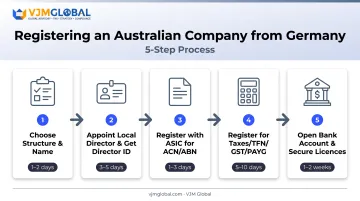
Step 4 – Register for Taxes
Three registrations typically apply:
- Tax File Number (TFN): required for your company as a separate taxpayer
- GST registration: compulsory once GST turnover reaches AUD 75,000; you have 21 days to register once that threshold is crossed
- PAYG withholding: register before your first payment to employees subject to withholding
Step 5 – Open a Business Bank Account and Secure Licences
Remote account opening is possible through traditional banks or fintech platforms, though verification requirements vary. Before trading, check the Australian Business Licence and Information Service (ABLIS) to confirm which industry-specific licences your business needs. This step gets skipped more often than it should.
Costs and Ongoing Compliance
Setting up a Pty Ltd involves several fixed government charges plus optional professional support.
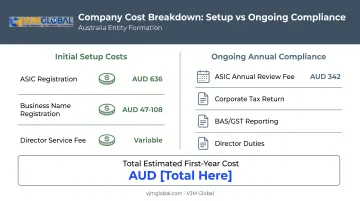
Initial setup costs:
- ASIC company registration (Pty Ltd with share capital): AUD 636
- Business name registration: AUD 47 for one year or AUD 108 for three years
- Registered agent/local director service: varies by provider
Ongoing annual compliance:
- ASIC annual review fee: AUD 342, plus a solvency resolution and any required detail updates
- Corporate tax return, filed annually
- BAS/GST reporting, if registered
- Director duties under the Corporations Act (records, solvency checks, no insolvent trading)
Missing the annual review fee or letting company details go stale are common triggers for ASIC penalties, so build these dates into your calendar early.
Coordinating this from Germany, on top of German-side tax and reporting, is where VJM Global helps.
The firm covers German structures (GmbH, UG, AG) and Australian formation (Pty Ltd, ACN/ABN), so founders get one contact for cross-border tax, accounting, and compliance instead of separate advisors in each country.
Frequently Asked Questions
What business can I start in Australia with AUD 10,000?
Service-based businesses, e-commerce, and consulting work well at this budget since they avoid heavy inventory or premises costs. Allocate most of it to registration fees, a director service, and initial marketing.
Is it easy to set up a business in Australia?
The online registration process itself is streamlined and fast. The main friction for foreign founders is the resident director requirement, which needs solving before anything else moves forward.
What are common business mistakes to avoid in Australia?
Founders often underestimate the ongoing compliance load, miss GST or PAYG registration deadlines, or skip licence checks through ABLIS. Each of these creates penalties or delays that are avoidable with early planning.
Do I need a local director to start a company in Australia?
Yes. The Corporations Act requires at least one Australia-resident director for any proprietary company. Nominee director services solve this for founders without an existing local contact.
Can I register a company in Australia from Germany without visiting?
Yes, registration itself can be completed entirely online. Banking is the main exception: some institutions still prefer in-person verification for non-resident account holders.
What taxes does an Australian company pay?
Most base rate entities pay a flat 25% corporate tax rate, plus GST once turnover crosses AUD 75,000. The Germany-Australia DTA ensures profits repatriated to Germany aren't taxed twice.