The interest isn't limited to one type of founder. Solo consultants, e-commerce brands, import-export operators, and US small businesses eyeing an EU foothold are all exploring Italian incorporation right now.
This guide walks through entity types, costs, registration steps, and compliance requirements specifically for a US-based founder setting up shop in Italy.
TL;DR
- Form an S.r.l. (most US founders’ pick), register with the Business Registry, get a VAT number; residency only if relocating
- Plan on 7-20 business days once documents are ready; costs run from a few hundred to several thousand euros
- Use a notary, accountant, or cross-border formation partner—Italy’s process is document-heavy
Can a US Citizen Start a Business in Italy?
Yes, and there's no nationality-based bar. US citizens can form an Italian company without needing an Italian resident director or shareholder, based on CMS's Italy legal guide for company directors.
One distinction matters:
- Forming the company remotely — no visa needed, just proper documentation and a power of attorney
- Relocating to actively manage it — this triggers visa and work permit requirements
Italy also applies reciprocity in international trade. Italy's Ministry of Foreign Affairs notes that foreigners generally enjoy civil rights, subject to treaties and country-specific rules.
US investors can face limits in highly specialized or sensitive strategic sectors. For most standard businesses that screen does not apply, but confirm sector rules before you assume full ownership rights.
What to Know Before You Start a Business in Italy from the USA
US founders routinely underestimate how paperwork-heavy this process is. Multiple agencies, notarized documents, and translation requirements stack up fast.
Documentation and Timing Realities
Before you file anything, expect to handle:
- Notarization and apostille of US documents (Italy requires a Hague Apostille for US paperwork to be valid)
- Translation into Italian for any foreign-executed power of attorney
- A properly formatted power of attorney if you're not traveling to Italy yourself
Getting your bank account, VAT number, and daily operations active takes longer than the registration itself. Budget extra time beyond the initial filing window for banking setup, especially as a non-resident.
Remote Setup and Ongoing Management
You don't have to fly to Italy. Since December 2021, Italian notaries can execute S.r.l. incorporation deeds electronically, with the founder participating online. A compliant power of attorney can also let a representative sign on your behalf.
Running the business from the US carries no immigration requirement. Moving to Italy to manage it day-to-day is different: you need a business or startup visa (covered below).
Choosing the Right Business Structure in Italy
Your entity choice sets liability exposure, minimum capital, and how you’re taxed. For US founders entering Italy, it’s the first major decision to lock in.
| Structure | Minimum Capital | Best For |
|---|---|---|
| S.r.l. | As little as €1 | Most US founders; no EU residency required for directors |
| S.r.l.s. | €1–€9,999 | Solo founders wanting speed and lower cost, using standard bylaws |
| S.p.A. | €50,000 (25% paid at incorporation) | Larger investments, complex ownership structures |
| Branch/Rep Office | Varies | US companies not wanting a separate Italian legal entity |
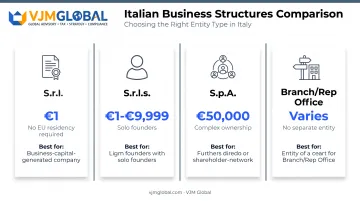
S.r.l. (limited liability company) is the default for most American founders. It’s flexible, does not require EU-resident directors, and can be formed with minimal capital, based on guidance from Italy’s National Notarial Council.
S.r.l.s. (simplified S.r.l.) fits solo founders who want a faster, cheaper setup on standardized bylaws. Use it when you don’t need custom governance and capital stays under €10,000.
S.p.A. (joint-stock company) only makes sense for larger operations or complex ownership. The €50,000 minimum—with at least €12,500 paid upfront—puts it out of reach for most early-stage US founders.
Branch and representative offices give a US company an Italian presence without a fully separate legal entity. They’re useful for testing the market before full incorporation.
Match the structure to liability needs, how much capital you can lock up, investor expectations, and whether you’re market-testing or building a long-term Italian company—not to whichever option is most common. VJM Global supports cross-border entity formation in 100+ countries and can walk US founders through these trade-offs before they commit capital to one path.
How to Register a Business in Italy from the USA – Step by Step
This is the practical sequence a US founder follows. Common mistakes here include skipping the Codice Fiscale early on and underestimating how long document translation actually takes.
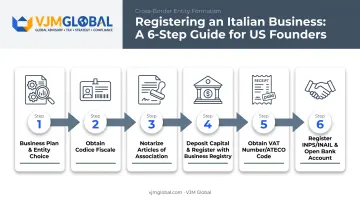
Step 1 – Draft a Business Plan and Choose Your Entity Type
Nail down your target market, budget, and structure decision (S.r.l. vs. S.r.l.s. vs. branch office) before touching any paperwork. This shapes every downstream step.
Step 2 – Obtain an Italian Tax Code (Codice Fiscale)
Every director and shareholder, including US citizens, needs this before proceeding. Italy's Revenue Agency confirms that people living abroad can request it through an Italian consulate, or delegate someone to apply on their behalf.
Step 3 – Prepare and Notarize the Articles of Association
This involves:
- Drafting articles that meet Italian Civil Code requirements
- Notarization in person, via the electronic route available since 2021, or through a compliant power of attorney
- Translating US-issued documents into Italian with proper legalization
Step 4 – Deposit Share Capital and Register with the Business Registry
Capital requirements depend on entity type (see table above). Once the deed is signed, Italy's current official guidance requires filing with the Registro delle Imprese within 10 days, tighter than many founders expect.
Step 5 – Obtain a VAT Number and Register for Taxes
Apply to the Italian Revenue Agency for a Partita IVA (VAT number). You'll also select an ATECO code, Italy's activity classification system, now updated as ATECO 2025.
Step 6 – Register with INPS/INAIL and Open a Corporate Bank Account
If you're hiring, register with INPS (social security) and INAIL (workplace insurance). Both run through Italy's unified ComUnica system alongside your registry and tax filings.
Banking comes next and typically requires more documentation from foreign-owned entities than from Italian residents.
For context on scale, Italy's Companies Register recorded 659,709 foreign-owned enterprises as of December 2023, according to Italy's official immigration portal. Foreign ownership is a normal part of the Italian market.
Visas, Permits, and Costs for US Founders
Two questions dominate every founder conversation: can I legally stay and manage this in Italy, and what will it actually cost?
Visa Options
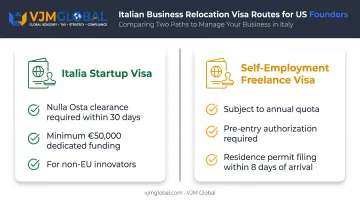
If you're relocating to actively run the business, two routes apply:
- Italia Startup Visa: For non-EU innovators. Requires Nulla Osta clearance (often within 30 days) and at least €50,000 in dedicated funding
- Self-Employment Freelance Visa: Subject to an annual quota. Needs pre-entry authorization and a residence permit filing within eight days of arrival
Note: VJM Global does not provide immigration or visa services. This section is for informational context only — consult a licensed immigration attorney for your specific visa strategy.
Cost Breakdown
| Expense | Details |
|---|---|
| Notary/incorporation fees | Varies by entity type and notary |
| Annual Chamber of Commerce fee (S.r.l.) | ~€120 for headquarters; €24 per local unit |
| Trademark registration | Separate filing fee |
| Ongoing annual compliance | Bookkeeping, tax filings, chamber dues |
Costs vary meaningfully by entity type and region, so treat any flat figure with caution.
Remote Founders Skip the Visa Requirement
If you're not physically working in Italy, you generally don't need a visa at all. Ownership and remote management don't trigger the same requirements as active, in-country operation.
Conclusion
Starting a business in Italy from the US is a structured, document-heavy process, but it remains fully open to American founders—no nationality restriction blocks you.
Success comes down to picking the right entity type early and leaning on local expertise for notarization, tax registration, and ongoing compliance. Missteps here cost time, and in Italy's system, time often means money.
VJM Global supports US founders with entity formation and multi-jurisdiction compliance work as they build a presence across borders, including within the broader EU landscape. If you're still weighing entity types or mapping tax and compliance obligations, lock that plan in before you file—so the first filing is the one that sticks.
Frequently Asked Questions
What is an LLC called in Italy?
The closest equivalent is the S.r.l. (Società a Responsabilità Limitata), Italy's limited liability structure. Solo founders often use the simplified version, the S.r.l.s.
How do I register my business in Italy?
Choose an entity type, notarize your articles of incorporation, register with the Business Registry, obtain a VAT number (Partita IVA), and register with INPS/INAIL if you're hiring employees.
Do I need to live in Italy to own a business there?
No. Ownership doesn't require residency. However, actively managing day-to-day operations inside Italy triggers visa and permit requirements.
How much does it cost to start a business in Italy as a US citizen?
Costs include notary fees, incorporation charges, and annual chamber registration fees, varying by entity type. An S.r.l. can start with as little as €1 in capital, though total setup costs run higher once fees are included.
How long does it take to register a company in Italy?
Expect roughly 7-20 business days, depending on entity type and how quickly your documents (translations, apostilles) are ready. The legal filing deadline after signing is 10 days.
Can I open an Italian business bank account without living in Italy?
It's possible, but often requires in-person appointments or extra documentation. Non-resident founders should expect a longer process than Italian residents typically face.