from the USA](https://file-host.link/website/vjmglobal-l8s6go/assets/blog-images/fd0658c9-1178-454f-acd3-75c887adcd10/1787502552874095_0cc1535dadcb4b85a0f5a7b4731ab187/360.webp)
Introduction
US entrepreneurs are increasingly looking at Kenya as their entry point into East Africa. The reasons are straightforward: a growing consumer base, EAC and AfCFTA trade access, and a regulatory environment that's grown friendlier to tech and export businesses.
This interest isn't limited to solo founders testing a new market. SMEs exploring African expansion and larger companies building a regional base hit the same wall: forming a Kenyan entity, opening local banking, and staying compliant without relocating.
This guide walks through the legal and practical steps a US-based founder needs to start a business in Kenya remotely—entity choice, registration, banking, and ongoing compliance—without moving there.
TL;DR
- Choose a Private Limited Company, Branch Office, or Representative Office and file remotely via eCitizen
- No mandatory minimum capital for most structures; roughly $100,000 is typical for an investor permit
- Registration can finish in days to a few weeks; banking and permits usually take longer
- Ongoing tax, payroll, and compliance are what most US founders underestimate
What Starting a Business in Kenya from the USA Actually Involves
Starting a business in Kenya from the USA means legally registering and operating a Kenyan entity while you stay based in, or run operations from, the US. You don't need to relocate to own or run the business.
A US founder can hold 100% ownership of most Kenyan business structures without ever setting foot in Nairobi. The common formats include:
- A fully-owned Kenyan subsidiary (private limited company)
- A branch office of your existing US company
- A representative or liaison office for market testing before committing capital
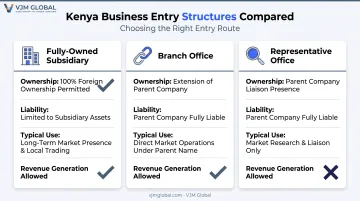
Each structure carries different tax, compliance, and liability obligations. Picking the wrong one early creates headaches later.
What to Know Before You Start
Many US founders underestimate the remote coordination this takes. Registration is digital, but banking, notarization, and local documentation still require patience and, often, local help. Build these constraints into your plan before you lock timelines or capital.
Key areas to plan for:
- Timeline reality: Registration through eCitizen can complete in 3-5 days per Business Registration Service targets. Banking and permits stretch this to weeks, not days.
- Local representation: A private company needs at least one director (need not live in Kenya); without a resident director or secretary, you must appoint a natural person permanently resident in Kenya as local contact.
- Local agents matter: Filing CR1, CR2, and CR8 forms and handling KYC document submission is far smoother with a local lawyer or agent coordinating the paperwork on the ground.
- The opportunity is real: Kenya pulled in $1.5 billion in FDI inflows in 2024, per UNCTAD data—a clear signal of foreign-capital confidence even as older ease-of-doing-business rankings have gone stale.
Why Start a Business in Kenya from the USA (When It Makes Sense)
Kenya makes sense when your business benefits from regional trade access, a young consumer base, or tax incentives tied to export or tech activity. Outside those conditions, the case is weaker.
The case for Kenya, when the fit is right:
- Access to a large, youthful consumer market plus EAC and AfCFTA trade corridors
- Tax incentives for tech, export, and SEZ/EPZ businesses — EPZ enterprises get 0% corporate tax for 10 years, then 25% for the next 10
- No local Kenyan director required in most private company structures
- Full ownership and profit repatriation rights in most sectors
- A growing economy with expanding US commercial ties
The World Bank projects 4.63% GDP growth for Kenya in 2025, and USTR estimates put US-Kenya trade at $3.4 billion in 2025, up 7.2% from the prior year. That is an established commercial relationship, not a speculative bet.
Early Decisions That Matter From the US Side
Underestimating cross-border complexity is the most common early mistake. It usually hits your bank account or tax bill before you expect it.
Areas that trip up US founders most often:
- Choosing between full incorporation, branch registration, or a representative office without a clear plan for what "success" looks like at each stage
- Underestimating the true cost of remote incorporation: agent fees, notarization, translation, and permit costs add up beyond the base registration fee
- Missing sector-specific foreign ownership caps: insurance caps foreign ownership at 66.6%; aviation requires Kenyans to hold at least 51%; the former 30% ICT local-equity rule was repealed in 2023
- Ignoring double taxation exposure: there is no US-Kenya income tax treaty on the IRS list, so don't assume treaty-reduced withholding rates apply
- Underestimating banking KYC delays, which hit non-resident directors especially hard
How to Start a Business in Kenya from the USA – Step by Step
These six stages cover market entry from your desk in the US through registration, banking, tax, and local hiring. Common mistakes at this stage: skipping local legal review, assuming you'll never need any physical presence, and pricing your product like you're still selling to US customers.
Step 1 – Validate the Kenyan Market Remotely
Research demand, competitors, and regulatory restrictions before you commit capital. Check whether your sector requires minimum local shareholding — telecom, insurance, and engineering all have specific rules.
Where this goes wrong: assuming your US market fit translates directly. Kenyan consumer behavior, price sensitivity, and distribution channels often look nothing like what you're used to.
Step 2 – Choose the Right Business Structure
Compare your three main options based on what you're actually trying to do:
| Structure | Best for | Local presence rule |
|---|---|---|
| Private Limited Company | Full operations, hiring, revenue generation | Resident contact person if no resident director/secretary |
| Branch Office | Extending an existing US company's operations | Local representative mandatory |
| Representative Office | Market testing without revenue generation | Depends on foreign company registration |
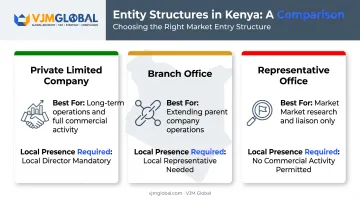
Pitfall: picking a representative office when revenue generation is actually the goal. That structure is meant for market research, not sales.
Step 3 – Handle Registration and Documentation Remotely
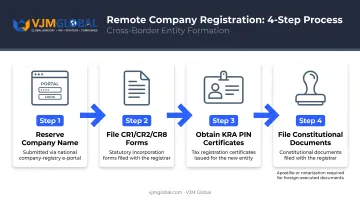
- Reserve your company name through the eCitizen portal
- File CR1 (incorporation application), CR2 (model memorandum), and CR8 (director's residential address) forms
- Obtain KRA PIN certificates for all directors using passport copies
- Prepare and file constitutional documents
Common miss: underestimating notarization and authentication requirements for US-issued paperwork. Kenya joined the Hague Apostille Convention (in force since February 2024), so many US public documents can carry an apostille instead of full embassy legalization. Confirm what your receiving bank or agent still requires before you ship originals—some counterparties are slow to update their checklists.
VJM Global handles this kind of entity formation work for Kenya, including name reservation, CR1/CR2/CR8 filings, drafting the Memorandum and Articles of Association, and obtaining the Certificate of Incorporation for both private limited companies and branch offices.
Step 4 – Open a Kenyan Bank Account and Set Up Cross-Border Payments
Prepare your KYC documents well in advance. Non-resident accounts face stricter checks than local ones.
Banks like Equity Bank offer diaspora business accounts built for this scenario. Expect notarized director passports, tax PINs, board resolutions, and—for US clients specifically—a FATCA W-9 form.
Consider a multi-currency account to handle USD-KES transactions without losing money on every conversion.
Common miss: waiting until incorporation is fully done before starting the bank application. That sequencing costs weeks. Start gathering KYC documents in parallel with registration.
Step 5 – Get Compliant on Tax, Permits, and Immigration
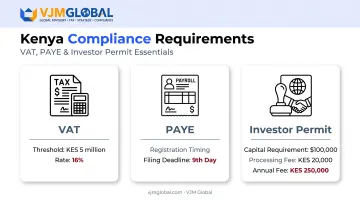
- VAT: Register once annual taxable supplies reach KES 5 million (roughly $39,000). The rate is 16%.
- PAYE: Set this up before your first local hire. Returns are due by the ninth day of the following month.
- Class G Investor Permit: Needed if you'll actively manage the business in Kenya. Expect documentary capital of at least $100,000, a KES 20,000 nonrefundable processing fee, and a KES 250,000 annual issuance fee.
Often overlooked: branch profits face a separate repatriation tax on top of ordinary income tax. The exact current rate should be confirmed with KRA directly, since published figures vary by source and year.
Step 6 – Build Local Operations Without Relocating
Decide early whether you'll hire directly (which triggers full payroll registration), use an Employer of Record, or appoint a local contact person for compliance purposes only.
VJM Global's Employer of Record service lets US businesses hire staff in Kenya — covering compliant employment contracts, payroll processing, and statutory contributions like NSSF, SHIF, the Affordable Housing Levy, and NITA training levy — without setting up a local entity first.
Common miss: hiring before payroll and compliance systems exist. Kenyan statutory deductions are specific and unforgiving of late filings.
Conclusion
Starting a business in Kenya from the US is achievable without relocating, as long as you plan structure, compliance, and banking early rather than reactively. Speed matters less than clarity on entity type and tax obligations.
Getting registered is the easy part. Staying compliant on VAT, PAYE, and permit renewals over time is what actually determines whether the business survives its first two years. Staying compliant on VAT, PAYE, and permit renewals over time is what actually determines whether the business survives its first two years. If you want help with Kenyan entity setup and ongoing filings, VJM Global can handle formation, tax, and payroll compliance while you stay focused on the US side of the business.
Frequently Asked Questions
How much does it cost to register a company in Kenya as a foreigner?
Base registration fees through the Business Registration Service (BRS) run around KES 10,650 for a private company. Agent fees, notarization, and translation add more. If pursuing an investor permit, expect to demonstrate roughly $100,000 in capital separately from registration costs.
What businesses can I start in Kenya with $50,000 as a foreigner?
Most consulting, e-commerce, trading, and professional service businesses don't require the $100,000 threshold, since that figure applies to investor permits, not general incorporation. A private limited company can be formed with far less documented capital.
What are the easiest businesses to start in Kenya as a foreigner?
Consulting, e-commerce, and trade-focused businesses face the fewest foreign ownership caps. Regulated sectors like insurance, telecom, banking, and aviation carry specific local-ownership requirements that limit foreign control.
Do I need to travel to Kenya to register a business there?
No. Registration runs through the eCitizen platform and can be completed remotely with a local agent or lawyer handling filings. Bank account opening, however, often needs extra verification steps for non-resident applicants.
Can a US citizen own 100% of a Kenyan company?
Yes, in most sectors. Regulated industries are the exception: insurance caps foreign ownership at 66.6%, and aviation requires at least 51% Kenyan shareholding.
How long does it take to register and open a business bank account in Kenya from the US?
Registration itself often completes in 3-5 days per BRS targets. Banking KYC for non-resident directors typically adds several additional weeks, since banks don't publish a fixed approval timeline.