
Why? It combines a stable financial ecosystem with a corporate tax structure that rewards small and mid-sized profits, plus direct access to the EU's single market of 450 million consumers via its central location.
IT services firms, fund managers, holding company promoters, and SME exporters are all part of this trend — not just large corporates. Names like TCS, Infosys, and Wipro already have a footprint there, according to the Embassy of India's bilateral brief.
This guide walks Indian founders through entity types, costs, the incorporation process, and ongoing compliance obligations, step by step.
Key Takeaways
- Luxembourg allows 100% foreign ownership; SARL (€12,000) and SA (€30,000) are the main structures
- Business permit, notarised incorporation, RCS filing, and tax/social security registration are mandatory
- India-Luxembourg tax treaty and EU access suit holding companies, funds, and IT/FinTech setups
- Setup takes a few weeks to a couple of months, depending on entity type, banking, and permits
- Specialists can handle notarial, tax, and RCS steps so Indian founders need not relocate
What Is a Business Setup in Luxembourg for Indian Entrepreneurs?
Starting a business in Luxembourg from India means forming a locally recognised legal entity—typically an SARL, SA, or branch office—as a non-resident promoter. You don't need to live in Luxembourg to own the company.
You do need a business permit, a registered office, and registration with the Trade and Companies Register (RCS).
Three structures dominate:
- SARL (private limited company): Flexible, capped at 100 shareholders, minimum €12,000 capital. Ideal for SMEs and holding structures.
- SA (public limited company): Suited for larger operations or those planning capital markets access, minimum €30,000 capital.
- Branch office: An extension of your Indian parent company, with no separate legal personality and no independent minimum capital requirement.
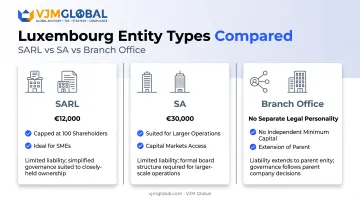
Each path carries different liability, governance, and audit obligations. Match the structure to your scale and funding plans from the start.
What to Know Before You Start a Business in Luxembourg from India
Many Indian founders assume Luxembourg's incorporation process mirrors India's: file some forms, get a certificate, start trading. It doesn't. Luxembourg's administrative rigor and documentation requirements run deeper.
Before you begin, get clarity on these five points:
- Residence permit needs: Non-EU/EFTA nationals relocating for self-employment need an authorisation to stay, followed by a residence permit, according to official Guichet.lu guidance.
- Local presence: A qualified manager who is physically and effectively present in Luxembourg is usually required, even if you remain based in India.
- Notarial timelines: SARL and SA formation require a notarised deed; a branch office is simpler.
- Capital intensity: Fund and finance businesses need more upfront capital planning than service-led IT or consulting setups.
- Realistic timeline: Business permit applications alone can take up to three months to process.
Underestimating any of these is the single biggest cause of delay for Indian founders.
Why Start a Business in Luxembourg from India? (When It Makes Sense)
Luxembourg isn't the right EU entry point for every Indian business. It makes the most sense under specific conditions.
The tax structure favours smaller taxable profits. For 2025, Luxembourg City's combined effective corporate rate is 23.87%, per PwC's Worldwide Tax Summaries. That figure combines 16% corporate income tax, a 7% solidarity surtax on CIT, and 6.75% municipal business tax. Businesses with more modest taxable profits often gain more from this structure than large-profit groups.
Beyond tax, consider these factors:
- Strategic geography: Bordering Belgium, France, and Germany, Luxembourg puts you at the crossroads of Western Europe
- Established IT/FinTech presence: TCS, Wipro, Infosys, Tech Mahindra, Syncordis, and Damco Solutions all operate there already
- Fund administration ecosystem: Luxembourg-domiciled funds held €8.2 trillion in assets at end-2025, per Luxembourg for Finance
- Treaty protection: The India-Luxembourg double tax avoidance agreement, in force since 2010, smooths cross-border profit repatriation
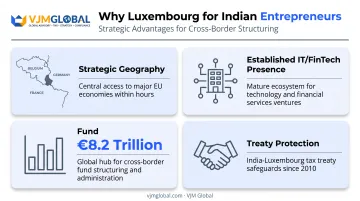
If your business is asset management, fund administration, holding structures, or IT/FinTech services with EU ambitions, Luxembourg deserves serious consideration.
Early Decisions That Matter When Setting Up in Luxembourg
Most delays Indian founders face come from underestimating notarial and banking timelines, or misjudging permit documentation requirements.
Get your true costs mapped out early. Budget for share capital deposit, notary fees, RCS registration, and the €50 business-permit stamp duty. Notary fees don't have a published fixed rate, so get a quote before committing to a structure.
Choose your entity deliberately. SARL, SARL-S, SA, and branch office each carry different liability and growth implications:
| Entity | Minimum Capital | Best For |
|---|---|---|
| SARL | €12,000 | SMEs, holding companies |
| SARL-S | €1 | Solo founders, natural persons only |
| SA | €30,000 (25% paid up) | Larger operations, capital markets access |
| Branch | None (parent liable) | Extension of Indian parent company |
Other early considerations:
- Permit eligibility — Professional qualifications, a clean criminal record, and proof of local management are non-negotiable
- Currency remittance — Converting Indian rupees to euros for share capital involves FEMA compliance on the Indian side
- Bank dependency — Notaries need a capital-deposit certificate before incorporation; non-resident account opening often takes longer than founders expect
How to Start a Business in Luxembourg from India – Step by Step
Here's the process broken into practical stages. Watch for these common mistakes:
- Choosing an SA when an SARL would do
- Skipping permit eligibility checks early
- Underestimating how long capital-blocking bank procedures take
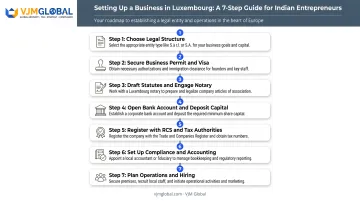
Step 1 – Choose the Right Legal Structure and Business Activity
Match your structure to your capital, liability tolerance, and growth plans. An SARL suits most SMEs and holding structures; an SA makes sense only if you need public capital access. Identify your sector (IT/FinTech, fund administration, trading, or consulting) and check whether it needs a specific licence.
Common miss: Picking SA for a small operation and getting stuck with €30,000 capital and audit obligations you didn't need.
Step 2 – Secure Business Permit Eligibility and Visa/Residence Requirements
Confirm early whether you need a residence permit for self-employment. Gather proof of qualifications, a solid business plan, and a clean criminal record for the Ministry of Economy's permit application. Applications are typically decided within three months of a complete submission.
Common miss: Assuming a remote, service-based business run from India doesn't need a permit. It usually still does.
Step 3 – Draft Statutes, Reserve Company Name, and Engage a Notary
Check name availability through Luxembourg Business Registers (LBR). Note that this only confirms availability; it doesn't reserve the name, so file promptly. Then draft your articles of association with a notary, covering shareholding, governance, and registered office details.
Common miss: Waiting to engage a notary until after attempting to open a bank account. Do it the other way round.
Step 4 – Open a Corporate Bank Account and Deposit Share Capital
Open a Luxembourg corporate account and deposit your minimum capital (€12,000 fully paid up for an SARL; €30,000 for an SA, with at least 25% paid up). The bank issues a deposit certificate your notary needs before incorporation can proceed.
Common miss: Underestimating how long non-resident account opening takes without local support on the ground.
Step 5 – Register with RCS, Tax Authorities, and VAT (if applicable)
Complete RCS registration, register with Luxembourg's tax authority (ACD), and register for VAT if your turnover exceeds €50,000 (the current small-enterprise exemption threshold). If hiring, register with the social security centre (CCSS) within eight days of a new hire.

Common miss: Missing the VAT registration deadline, which is 15 days from the start of business activity.
Step 6 – Set Up Local Compliance, Accounting, and Ongoing Reporting
Establish PCN-compliant bookkeeping and understand your annual RCS filing obligations. Plan for corporate income tax, municipal business tax, and net wealth tax filings from year one.
This is where cross-border complexity often catches founders off guard. VJM Global supports Indian founders with entity formation, accounting, and tax compliance across the markets where they expand, so you don't have to build Luxembourg regulatory expertise in-house from day one.
Step 7 – Plan Operations, Local Management, and Hiring
Decide whether you'll run operations remotely from India or need a locally based manager. Identify early hires needed purely for compliance: an accountant, company secretary, or registered agent.
Common miss: Appointing an all-non-resident board without addressing the "reasonable proximity" management requirement Luxembourg's permit authority expects.
Conclusion
Starting a business in Luxembourg from India is achievable when entity choice, permit timing, and notarial procedures are sequenced correctly from the start. Each step has its own timeline; getting that order right upfront prevents costly delays later.
Clear structure and compliance decisions from day one keep incorporation on track. VJM Global supports Indian founders with entity formation and cross-border compliance so you can focus on EU expansion strategy instead of administrative back-and-forth.
Frequently Asked Questions
What business can I start in Luxembourg?
Financial services, ICT/FinTech, logistics, and specialised R&D are popular sectors for foreign investors. Some activities, particularly regulated financial services, need sector-specific licensing beyond the standard business permit.
Can an Indian citizen open a company in Luxembourg?
Yes. Non-EU/EFTA nationals can incorporate a company in Luxembourg, but founders relocating for self-employment need a residence permit alongside the standard business permit.
What is the minimum capital required to start a company in Luxembourg?
SARL requires €12,000 minimum capital, SARL-S needs just €1 (natural persons only), and SA requires €30,000, with at least 25% paid up at incorporation.
How long does it take to register a business in Luxembourg?
A simple sole proprietorship registers faster than a notarised SARL or SA. Business permit processing alone can take up to three months, plus notary and banking time.
Do I need to be a resident of Luxembourg to start a business there?
Physical residence isn't mandatory, but you need a locally accessible qualified manager and a registered office in Luxembourg. Permit authorities expect genuine, permanent local management.
What taxes will my Luxembourg company need to pay?
Companies face corporate income tax, municipal business tax, and net wealth tax, plus VAT at 17% if turnover exceeds the €50,000 exemption threshold. Combined effective corporate tax in Luxembourg City reaches 23.87% for 2025.