But Brexit changed the maths. Before 2020, a UK founder could set up shop in Luxembourg with barely more paperwork than a local citizen. Now, UK nationals are treated as third-country nationals, which means visas, residence permits, and dual compliance obligations UK founders never had to think about before.
This guide walks through the entity types, visa process, tax rules, and registration steps you'll need to know before setting foot in Luxembourg.
Key Takeaways
- Most commercial activities need a Luxembourg business permit; it is not a tax haven
- Post-Brexit, UK nationals need a residence permit as non-EU citizens to run a business there
- SARL (€12,000 minimum capital) and SA (€30,000 minimum) are the main company forms
- Notary deeds, a local bank account, and RCS filing add steps most founders outsource
Why UK Businesses Choose Luxembourg
Luxembourg's appeal isn't accidental. It sits at the centre of the EU single market, offers one of Europe's densest financial ecosystems, and attracts substantial foreign capital.
Foreign-controlled enterprises made up 27.9% of Luxembourg's market-producer businesses in 2023 — the highest share anywhere in the EU, according to Eurostat's foreign-controlled enterprises statistics. That's a strong signal of how open the market is to outside ownership, even if UK-specific registration figures aren't separately tracked.
A few other practical draws:
- Tax treaty coverage: Luxembourg has 88 double-tax treaties in force, including one with the UK, reducing the risk of being taxed twice on the same income
- Workforce: Nearly 280,000 resident workers, 59.2% of them foreign nationals, with French used at work by 69.2%, a genuinely international, multilingual talent pool
- Location: Central European positioning puts you within a short flight or drive of Paris, Brussels, and Frankfurt
None of this removes the compliance burden. It just explains why so many companies decide the burden is worth carrying.
Visa and Residency Requirements for UK Citizens (Post-Brexit)
This is the section most UK founders underestimate. As a non-EU national, you can no longer just move to Luxembourg and start trading.
The self-employed residence route
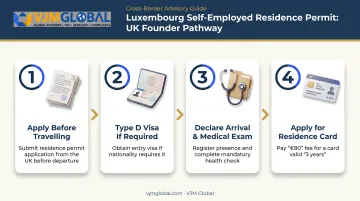
The process for the self-employed/owner-manager permit runs roughly like this:
- Apply before travelling — submit temporary authorisation to the Ministry of Home Affairs with your passport, criminal-record extract, CV, qualifications, and business and financing plan
- Type D visa (if required) — only necessary if you're subject to Luxembourg's entry-visa requirement; not every UK applicant needs one
- Declare arrival — once in Luxembourg, register with your commune and complete the required medical examination
- Apply for the residence card — the biometric self-employed permit costs €80 and is valid for up to three years, renewable
Your project needs to demonstrate genuine economic, social, or cultural benefit to Luxembourg, and your personal presence must be necessary for the business to run day-to-day.
Important: the residence permit covers your right to stay and work, but it doesn't replace the separate business permit you'll still need for the activity itself.
Bringing your family
Spouses, registered partners, and unmarried children under 18 can join you with fewer formalities. You will need to show:
- Stable income
- Suitable housing
- Health cover
Their permits also carry the €80 fee.
Choosing the Right Legal Structure
Luxembourg offers several structures, and picking the wrong one early tends to cause headaches later.
| Structure | Minimum Capital | Best For | Trade-off |
|---|---|---|---|
| Sole proprietorship | None | Very small, low-risk ventures | Unlimited personal liability |
| SARL-S | €1–€12,000 | First-time founders, low-budget startups | Weaker credibility with banks |
| SARL | €12,000 | Most SMEs | Share transfers are restricted |
| SA | €30,000 | Larger businesses, frequent ownership changes | More formal governance |
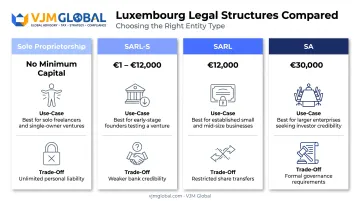
SARL-S (simplified private limited company) suits first-time or low-budget UK founders who want limited liability with minimal capital. It can later convert into a full SARL once the business scales.
SARL (private limited company) is the default choice for most UK founders. It's flexible, requires a notarial deed, and works well for businesses with one to 100 shareholders.
SA (public limited company) suits businesses that expect to raise capital or change ownership frequently, since shares transfer freely. At least a quarter of the €30,000 must be paid up at formation.
If full incorporation feels premature, you can still establish a Luxembourg presence through your existing UK company:
- Branch — an extension of the UK entity, not a separate legal person; quicker to open for market testing, but the UK company remains fully liable
- Subsidiary — a new Luxembourg company (often an SARL) owned by the UK parent, with its own limited liability and local governance
A branch is usually the faster test route; a subsidiary fits once you want ring-fenced risk and a clearer local profile.
Step-by-Step Process to Register a Company
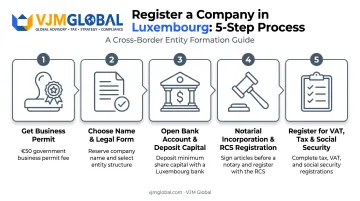
Follow these steps in order:
- Get your business permit: apply via the Ministry of the Economy (MyGuichet.lu). You must show professional qualification and integrity, including a criminal-record check and non-bankruptcy declaration. Issuance costs €50.
- Choose your name and legal form: draft the Articles of Incorporation. SARL and SA need a notarial deed; SARL-S can use a private deed.
- Open a Luxembourg bank account: deposit the share capital. Non-resident applicants often face stricter due diligence, so allow extra time before funds must be available.
- Complete notarial incorporation: register with the Trade and Companies Register (RCS) and the Register of Beneficial Owners. Anyone holding more than 25% of shares or voting rights is typically a beneficial owner and must be declared.
- Register for VAT, corporate tax, and social security with the relevant Luxembourg authorities.
Coordinating a notary, a bank, and multiple registries from the UK is not trivial, especially when documents need translating or apostilling.
A cross-border firm such as VJM Global can help UK founders organise documentation and keep those moving parts aligned. For the Luxembourg formation filings themselves, specialist local counsel and notaries should lead. VJM Global’s EU entity-formation work is concentrated in Germany, the Netherlands, and Ireland, which remain practical alternative EU entry points if you need an adviser already in place.
Understanding Luxembourg Taxation for UK-Owned Businesses
Luxembourg's tax rates changed for 2025, so double-check any older sources you find online.
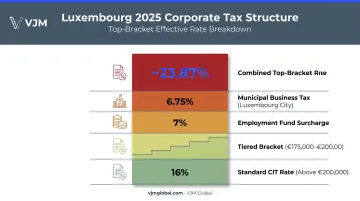
Corporate income tax (from tax year 2025):
- 16% standard rate on income above €200,000
- Tiered rate on income between €175,000 and €200,001: €24,500 plus 30% of the amount above €175,000
- 7% employment fund surcharge on top of CIT
- 6.75% municipal business tax in Luxembourg City
- ~23.87% combined top-bracket rate once CIT, surcharge, and municipal tax are stacked
VAT sits at 17% standard, the lowest in the EU, with reduced rates of 14%, 8%, and 3% for specific goods and services.
The UK-Luxembourg double tax treaty, in force since November 2023 and effective for withholding taxes from January 2024, generally allows 0% withholding on dividends, interest, and royalties between the two countries. Beneficial-ownership and treaty-eligibility conditions still have to be met.
Some property-investment vehicle distributions can still face up to 15% source-country withholding. Anti-abuse rules, including a principal-purpose test, can deny relief if the structure looks purely tax-motivated.
Ongoing obligations include annual accounts, tax returns, and, for larger companies, statutory audits. Getting bookkeeping and year-end reporting right early avoids expensive catch-up work later.
VJM Global's back-office teams handle bookkeeping, reconciliations, and year-end reporting across several EU markets, even where Luxembourg-specific filing is not yet part of our direct service line.
Costs and Practical Considerations
Beyond the headline share capital, budget for:
- Business permit fee: €50
- Residence card: €80 per applicant
- Notary and legal fees: no official flat rate—costs scale with structure complexity and capital contributions
- RCS/RBE filing: check the current Luxembourg Business Registers tariff; fees update periodically
You'll also need a genuine registered office in Luxembourg. If you're not renting physical premises immediately, a domiciliation agent operating under Luxembourg's domiciliation rules can provide a compliant administrative address.
Most UK founders bring in local professional support early, given the notarial, banking, and regulatory sign-offs involved. VJM Global can support accounting and compliance once your Luxembourg entity is formed, working alongside local Luxembourg counsel for work that requires Luxembourg-qualified lawyers.
Frequently Asked Questions
What are the requirements to start a company in Luxembourg?
You'll need a business permit proving professional qualification and integrity, a chosen legal structure with the correct minimum share capital, and registration with the Trade and Companies Register.
Is Luxembourg a good place to start a business?
Yes, particularly for EU market access, financial infrastructure, and tax treaty coverage. Balance this against higher formation costs and a genuinely bureaucratic process.
Is Luxembourg still a tax haven?
No. Luxembourg isn't on the EU's non-cooperative jurisdictions list or blacklisted by the OECD. It does offer legitimate tax structures like SOPARFI, but these operate within standard EU and OECD rules.
Which business is most profitable in Luxembourg?
Finance, investment funds, and holding company structures dominate, supported by over 70,000 direct and indirect financial-sector jobs. High-value professional services also perform well.
Do UK citizens need a visa to set up a business in Luxembourg after Brexit?
UK nationals now need a residence permit as non-EU citizens to run a business there. A type D visa is only required if you're separately subject to Luxembourg's entry-visa rules.