from the Netherlands](https://file-host.link/website/vjmglobal-l8s6go/assets/blog-images/4f47d861-74b7-46ca-90e1-d0debfd613fe/1786997156153335_7aa00d19aa9c4aa49cde84249f25260e/360.webp)
Introduction
Dutch exports to Mexico reached €3.2 billion in 2023, with Mexican imports into the Netherlands totalling €2.3 billion, according to a 2025 Dutch government trade report.
That trade lane is still growing as Mexico becomes a nearshoring gateway into the USMCA market—a shift the World Bank ties directly to the 2026 USMCA review.
Remote setup is where many Dutch founders hit friction. Common frustrations include:
- Spanish-only government portals and legal documents
- Coordinating with Mexican authorities from a seven-hour time difference
- Bureaucracy that doesn't map to Dutch or EU norms
- The legal requirement for a Mexico-resident representative to handle tax registrations
This guide covers entity types, registration steps, realistic costs, and the tax obligations Dutch-owned companies face in Mexico—and where a cross-border partner like VJM Global can handle local formation, representation, and compliance.
Key Takeaways
- Dutch citizens can own 100% of most Mexican company types without a local partner.
- Entity choice (S.A., S. de R.L., S.A.S., or branch) shapes liability, shareholder rules, and revenue limits.
- Incorporation takes 8-12 weeks and requires a Mexico-resident legal representative with a valid e.firma.
- Netherlands-Mexico tax treaty can cut dividend withholding tax to 5% for qualifying shareholders.
- Local formation support prevents delays from handling bilingual paperwork alone.
Business Structures for Foreign-Owned Companies in Mexico
Mexican law allows full foreign ownership in most sectors under Article 4 of the Foreign Investment Law. What it doesn't allow is skipping incorporation altogether. A Dutch BV has zero legal recognition in Mexico, so founders always need to form a distinct Mexican entity, even if it's wholly owned by the Dutch parent.
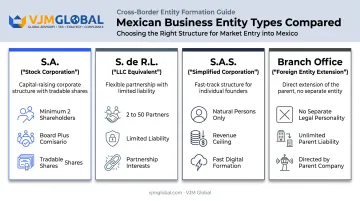
Sociedad Anónima (S.A.)
The S.A. is Mexico's stock corporation, and it needs at least two shareholders, each subscribing to a minimum of one share. Governance runs through a board or sole administrator, plus a statutory examiner (comisario) who reviews the company's finances.
Shares are freely negotiable, which makes this structure the natural fit for larger Dutch subsidiaries planning significant investment or a longer growth runway.
Sociedad de Responsabilidad Limitada (S. de R.L.)
Think of this as Mexico's LLC equivalent. It requires between 2 and 50 partners, each shielded by limited liability, with one or more managers handling day-to-day administration. The partners' meeting remains the supreme decision-making body. Ownership sits as partnership interests rather than tradable shares, which suits Dutch SMEs testing the Mexican market before scaling up.
Sociedad por Acciones Simplificada (S.A.S.)
This is the fully digital, fast-to-form option, but it comes with real restrictions:
- Only natural persons may be shareholders (a Dutch BV or holding company cannot own an S.A.S.)
- Every shareholder needs a valid e.firma
- A sole shareholder automatically becomes the administrator
- Revenue above the 2026 ceiling of MXN 7,678,849.94 forces conversion to another structure
This route fits an individual Dutch founder going solo, not a corporate group.
Branch Office
A branch has no separate legal personality. It's simply an extension of the Dutch parent, which means the parent carries unlimited liability for whatever happens in Mexico. Because the Netherlands has been a WTO member since 1995, Dutch companies can often file a simplified establishment notice with the Ministry of Economy rather than pursuing full authorisation. The liability exposure does not change either way.
Branches work for established Dutch corporations that want a direct presence without creating a fresh legal entity.
Choosing between these four comes down to liability tolerance, growth ambitions, and whether the founder or shareholder can access Mexican legal residency. Lock those three factors in before you file; reversing a structure later costs far more than getting the choice right first.
Step-by-Step Process to Start Your Business in Mexico from the Netherlands
Most of this process can happen without boarding a flight. Here's how it typically unfolds:
- Reserve the company name. File through the Ministry of Economy's MUA portal. The procedure is free and fully remote, so Dutch founders can complete it from home.
- Draft and apostille your documents. Since both the Netherlands (member since 1965) and Mexico (member since 1995) belong to the Hague Apostille Convention, Dutch founders can appoint a proxy through an apostilled power of attorney instead of travelling to sign in person.
- Notarise the Articles of Incorporation. A Mexican notary or commercial broker formalises the bylaws and foreign-investment clauses (the S.A.S. route uses an electronic process instead).
- Register with the Public Registry of Commerce (RPC). This step gives the company legal existence and makes its formation enforceable against third parties.
- Obtain the RFC and e.firma from SAT. The legal representative must be registered with SAT and hold a valid e.firma, which is issued at a SAT office by appointment. This in-person step is where most Dutch founders need a Mexico-based representative to bridge the gap.
- Register with the RNIE. Foreign-owned entities must register with the National Registry of Foreign Investments within 40 business days of foreign participation starting.
- Open a Mexican bank account. Banks typically require the legal representative to appear in person, often the single biggest bottleneck for remote founders.
- Register with IMSS if you hire staff. Complete IMSS registration within 5 business days of the first hire.
Costs, Documents & Timeline You Need to Prepare
Formation costs in Mexico vary by state and capital amount. Treat the figures below as a planning checklist, not fixed quotes.
| Item | What to expect |
|---|---|
| Name reservation (MUA) | Free — no government charge |
| RPC registration | Set by each state; confirm current local fees before budgeting |
| Notary fees | Varies by state, capital amount, and document complexity |
| Formation agent/consultant | Quoted per scope — request an itemised split of fees, translations, apostilles, and statutory charges |
Core documents to prepare:
- Valid Dutch passport
- Apostilled and Spanish-translated power of attorney
- Proof of address
- Draft Articles of Incorporation and shareholder details
Because the Netherlands is a party to the Hague Apostille Convention, the apostille step is simpler than for a non-member country, with no separate legalisation process.
Realistic timeline:
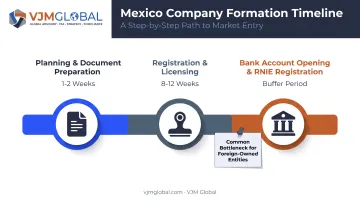
- Planning and document preparation: roughly 1–2 weeks
- Registration and licensing: roughly 8–12 weeks
- Build buffer for bank account opening and RNIE registration — these cause most delays for foreign-owned entities
Tax & Compliance Obligations for Dutch-Owned Businesses in Mexico
Corporate Tax and VAT
Mexican tax-resident companies pay corporate income tax (ISR) at a flat 30% of net profits, calculated on a worldwide income basis. Value-added tax (IVA) sits at a standard 16%.
Every taxable transaction requires an electronic invoice (CFDI) generated and certified through SAT's system. Non-compliant invoices aren't deductible, so getting the CFDI process right from day one matters more here than most Dutch founders expect.
Dividend Withholding and Treaty Relief
When profits flow back to a Dutch parent, withholding tax applies to the dividend. Under Article 10 of the Netherlands-Mexico tax treaty, that rate drops to 5% if the Dutch parent is the beneficial owner and holds at least 10% of the Mexican company's capital (treaty text, Mexico's Ministry of Foreign Affairs).
Claiming the reduced rate requires a valid Dutch tax-residency certificate plus evidence of beneficial ownership. Keep that documentation current rather than scrambling for it at year-end.
Digital and Ongoing Compliance
- Obtain an e.firma for every legal representative and taxpayer
- Maintain electronic accounting under SAT's format requirements
- File regular SAT reports throughout the company's life, not only at formation
Dutch parent companies do themselves a favour by keeping bookkeeping structured consistently across both jurisdictions. It supports consolidated group reporting and makes treaty-relief claims far less painful when the numbers already line up.
How VJM Global Supports Dutch Businesses Expanding into Mexico
Coordinating a Mexican notary, a local accountant, and separate compliance contacts from Amsterdam or Rotterdam gets complicated fast.
VJM Global handles cross-border entity formation, accounting, tax, and payroll compliance for Dutch founders entering Mexico, using each market's own regulators and statutory instruments. You work with one coordinated point of contact instead of juggling multiple providers.
The firm's relevant capabilities include:
- Entity formation and structuring guidance across S.A., S. de R.L., S.A.S., and branch options
- RFC and e.firma coordination support
- Ongoing accounting, tax compliance, and payroll assistance in Mexico
- Corporate bank account opening support as part of end-to-end entity formation
That support draws on 30+ years of advisory experience and a 100+ member team serving clients across 100+ countries, with delivery capability in both the Netherlands and Mexico.
For Dutch companies not ready to commit to full incorporation, VJM Global's Employer of Record service allows hiring in Mexico and 100+ other countries without setting up a local entity first. It's a practical way to test the market with local staff before deciding whether a full Mexican subsidiary makes sense.
Frequently Asked Questions
Can I start a business in Mexico as a foreigner?
Yes. Dutch citizens can own 100% of most Mexican entity types without a local partner. You still need a Mexico-based legal representative for tax registration and related filings.
How much money do I need to start a business in Mexico?
There's no mandated minimum capital for most structures. Plan for notary fees, RPC registration, and optional formation-agent fees. These vary by state and complexity, not a fixed national rate.
Which business is most profitable in Mexico?
Nearshoring and manufacturing, e-commerce, tourism, and professional services tend to perform well. Actual profitability depends far more on market research and execution than on which entity type you choose.
Can I live on $3,000 a month in Mexico?
Yes, for most founders. A $3,000 monthly budget generally supports a comfortable lifestyle in cities like Mexico City, Guadalajara, or Querétaro while you set up and oversee operations.
Do I need to be a resident of Mexico to own a company?
No. Dutch shareholders can own a Mexican company without living in Mexico. Only your appointed legal representative must be Mexico-based for tax and notarial filings.
Is there a tax treaty between the Netherlands and Mexico?
Yes, the treaty is in force and helps prevent double taxation on dividends, interest, and royalties flowing between the two countries, including the reduced 5% dividend withholding rate for qualifying shareholders.