The catch: many founders assume expanding into Mexico works like setting up in Singapore or the US, mostly digital, mostly remote. It doesn't. Mexico runs on civil law, most incorporation steps demand in-person notarization, and every filing happens in Spanish. Add the distance and time-zone gap, and a straightforward registration turns into a logistics puzzle.
This guide covers the entity types open to Singaporean owners, the registration sequence in order, realistic costs and timelines, and how local expert support closes the gap that pure remote setup can't.
Key Takeaways
- Singapore–Mexico ties already include CPTPP and a DTAA; PASFTA still awaits Mexico’s ratification.
- Most foreign owners pick an S.A., S. de R.L., or S.A.P.I.; an S.A.S. is impractical without a Mexican tax ID.
- Paper incorporation can be quick; full readiness, including a bank account, often takes several months.
- Every entity needs a resident legal representative and a real physical address—virtual offices fail SAT and banks.
- Monthly SAT filings start immediately, even before you earn a single peso.
Why Singapore Businesses Should Consider Expanding to Mexico
Trade and Tax Advantages
The Singapore-Mexico Double Tax Avoidance Agreement, in force since 1995, prevents the same income from being taxed twice. For Singaporean shareholders holding at least 10% of a Mexican entity's voting shares, the treaty allows foreign-tax credits that account for the underlying corporate tax already paid in Mexico. This matters directly when you're structuring dividend flows back to Singapore.
Both countries also belong to the CPTPP. Enterprise Singapore notes that the agreement removes tariffs on 94% of Singapore's exports across CPTPP markets collectively.
PASFTA would extend preferential access to the wider Pacific Alliance bloc—Mexico, Colombia, Chile, and Peru—but only once Mexico completes ratification. Until then, CPTPP remains the operative framework for Singapore-Mexico trade.
Market Opportunity and Risk Factors
Scale is the other draw. Mexico's population sits above 131.9 million with a GDP of roughly $1.83 trillion, making it one of the largest consumer and industrial markets accessible through a single treaty relationship with Singapore.
Nearshoring adds momentum. As global manufacturers relocate supply chains closer to the US market, Mexico has absorbed a wave of new foreign investment in electronics assembly, logistics, and industrial supply chain services—sectors where Singaporean firms already have deep expertise.
The risks are real too:
- Mexico scored 27 out of 100 and ranked 141st of 182 countries on Transparency International's 2025 Corruption Perceptions Index.
- The USMCA's 2026 joint review has already produced friction, with US trade officials signalling they won't renew the agreement in its current form.
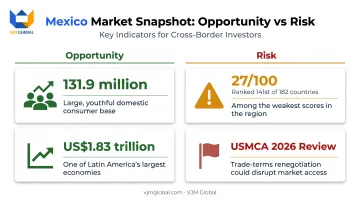
These issues are not grounds to skip Mexico. They are grounds to build compliance and legal structuring in from day one.
Choosing the Right Business Entity in Mexico
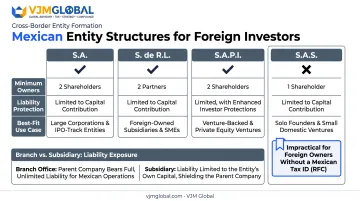
Four structures dominate the landscape, but only three are realistically available to a Singapore-based founder.
| Entity | Minimum owners | Liability | Best fit |
|---|---|---|---|
| S.A. | 2 shareholders | Limited to unpaid shares | Outside investment, multiple share classes |
| S. de R.L. | 2 partners (max 50) | Limited to contributions | Smaller subsidiaries, closely held ventures |
| S.A.P.I. | 2 shareholders (S.A. base) | Limited, with investor protections | Venture capital, private equity, real estate |
| S.A.S. | 1+ natural persons | Limited to contributions | Mexican residents only, in practice |
Sociedad Anónima (S.A.)
The S.A. is Mexico's standard stock corporation. It needs at least two shareholders and can be managed by a single administrator or a board of owners or hired professionals.
There's no fixed peso minimum in the current law, but capital must be fully subscribed, with at least 20% paid on cash contributions and 100% on any in-kind shares. It suits Singapore founders who plan to bring in outside investors or issue different share classes.
Sociedad de Responsabilidad Limitada (S. de R.L.)
Think of this as Mexico's closest equivalent to an LLC. It caps membership at 50 partners and requires a minimum of two, with liability limited to each partner's contribution. Management can sit with one or more partners, or outside managers.
At least 50% of each ownership interest must be paid up, and there's no statutory capital floor. That makes it the lower-friction choice for a straightforward Singapore-owned subsidiary that isn't planning a complex investor structure.
Sociedad Anónima Promotora de Inversión (S.A.P.I.)
Built on the S.A.'s legal base, the S.A.P.I. adds bylaws flexibility that pure S.A.s don't get: transfer restrictions, veto rights, non-voting shares, and defined exit or deadlock terms. A board is mandatory.
This structure is used heavily for private equity, venture capital, and real estate deals where minority shareholders want contractual protection beyond a standard S.A.
Sociedad por Acciones Simplificada (S.A.S.)
Mexican corporate law doesn't explicitly bar foreign shareholders from this structure. In practice, every shareholder needs a current RFC (tax ID) and e.firma (digital signature).
Both are difficult to obtain without Mexican tax residency. For most Singapore founders, that makes the S.A.S. a non-starter regardless of what the statute technically permits.
Branch Versus Subsidiary
A branch has no separate legal personality, so your Singapore parent remains directly liable for whatever the branch does in Mexico. A subsidiary, by contrast, is its own legal person.
Losses, contracts, and lawsuits stop at the subsidiary's door rather than travelling back to Singapore. For most first-time entrants, that liability separation alone justifies a subsidiary over a branch.
Step-by-Step Process to Register a Business in Mexico from Singapore
Registering a Mexican company from Singapore follows a fixed sequence. Most steps can run remotely once you appoint a local legal representative with a properly apostilled power of attorney.
Reserve your company name. File through Mexico's Ministry of Economy portal (MUA). Approval typically comes within two business days, and the reservation holds for 180 calendar days, giving you room to finish the rest of the paperwork.
Prepare and apostille your Power of Attorney. Singapore joined the Hague Apostille Convention in 2021 and Mexico in 1995, so a POA notarized in Singapore and apostilled by the Singapore Academy of Law works directly in Mexico. Your appointed legal representative can then act on your behalf without you flying in.
Draft and execute the Articles of Incorporation. These must be in Spanish and signed before a Mexican notary (fedatario), who is legally required to reject bylaws that don't comply with the Ley General de Sociedades Mercantiles. Your representative can sign on your behalf, provided the POA is properly executed.
Register with the Public Registry of Commerce, then file your foreign investment notice. Registry filing gives your company its own legal personality, separate from you as owner. The Registry of Foreign Investment (RNIE) filing is due within 40 working days of the relevant trigger date, and the filing itself is free of charge.
Obtain your RFC, e.firma, and digital seal (CSD) from SAT. Your legal representative books an in-person SAT appointment to complete this. It's sequential, not instant, so build buffer time into your plan rather than assuming a fixed 30-day turnaround.
If hiring locally, register with IMSS and INFONAVIT, then open a corporate bank account. Bank onboarding follows RFC issuance. Per TMF Group's 2024 benchmark, it commonly takes six weeks to three months, done in person with original documents. Budget banking as its own phase, not an afterthought.
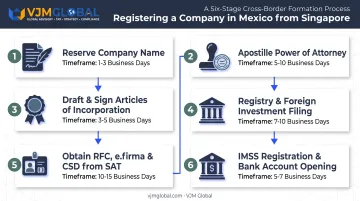
End-to-end timelines stretch into several months when local hiring and a corporate bank account are in scope, not just the incorporation filings.
Costs, Timeline & Ongoing Compliance
Costs
Notary and Public Registry fees vary by state and by the complexity of your bylaws, so treat any figure quoted online as a rough guide. RNIE filing has no fee.
Beyond that, budget for:
- Name reservation processing
- Notary drafting and execution
- Translation where needed
- Your legal representative's ongoing retainer
Ask for a fixed quote before you commit. Local pricing swings too much for a single national average to be useful.
Timeline
Legal incorporation itself can move quickly, sometimes under 10 business days once your documents are complete, according to TMF Group's 2024 benchmark.
What stretches the calendar is everything downstream: apostille processing from Singapore, sequential SAT appointments, and bank KYC. A realistic end-to-end window runs closer to two to three months once banking is included, not the under-two-week stretch that incorporation paperwork alone might suggest.
Ongoing Compliance
This is where many Singapore founders get caught out:
- Estimated corporate income tax payments are due by the 17th of every month, according to PwC's current tax summary, regardless of whether you've generated revenue yet
- Mexico's federal corporate tax rate sits at 30%
- An annual corporate income tax return is due by 31 March the following year
None of this can be handled from a Singapore finance desk. SAT filings require a Mexico-based accountant who understands local e-invoicing (CFDI) requirements and filing portals.
Common Challenges for Singapore Entrepreneurs & How to Overcome Them
Singapore founders usually hit the same three friction points when incorporating in Mexico. Each has a practical fix.
Language and distance. Every incorporation document must be filed in Spanish, and most steps still require original wet-ink signatures. Video calls and scanned PDFs won't satisfy a Mexican notary or SAT official. Use a bilingual partner on the ground to prepare Spanish filings and handle wet-ink execution locally.
The local representative requirement. Without a Mexico-based team, you'll need to appoint someone to sign contracts, apply for your RFC, and deal directly with authorities on your behalf. This isn't optional paperwork; it's the mechanism that makes remote ownership possible. Appoint a trusted local representative, or use a formation firm that includes this role in setup.
The registered address rule. Virtual offices don't cut it. SAT and Mexican banks both require a genuine physical address before they'll issue a tax ID or open an account. Secure that address through a local partner before you file—mailbox services alone get rejected.
Coordinating apostilles, a representative, and a compliant address from Singapore is where solo founders stall. VJM Global delivers entity formation and compliance support across both Singapore and Mexico, so you work with one team instead of separate vendors on each side of the Pacific.

Frequently Asked Questions
How much money do I need to start a business in Mexico?
There's no fixed statutory minimum capital for the S.A., S. de R.L., or S.A.P.I. under current law. Your real budget covers notary fees, name reservation, registration costs, and a compliant registered address, all of which vary by state.
Can I start a business in Mexico from Singapore?
Yes. An apostilled Power of Attorney lets a Mexico-based legal representative handle signing, filing, and SAT registration on your behalf, so you don't need to be physically present for every step.
What's a good business to start in Mexico from Singapore?
Sectors linked to nearshoring and Singapore-Mexico trade ties tend to perform well, including electronics, logistics, tech services, and manufacturing-adjacent supply chain businesses.
How long does it take to register a company in Mexico?
Legal incorporation can happen in under two weeks once documents are complete, but full operational readiness, including a working bank account, commonly takes two to three months.
Do I need to travel to Mexico to set up a business?
Not for most steps; a resident legal representative can handle incorporation and SAT filings. Bank account opening, however, often requires in-person attendance at the branch.
What is the best business structure for a foreign-owned company in Mexico?
The S.A. and S. de R.L. are the most accessible for foreign owners. Your choice depends on shareholder count, investment plans, and how much bylaws flexibility you need.