Introduction
German founders expanding abroad often struggle with the same trade-off: they want a stable, high-purchasing-power market without learning an entirely foreign operating system. Norway is a strong fit. It combines EEA-linked market access, strong purchasing power, and very low corruption with growing oil, tech, and maritime demand.
For a country outside the EU, Norway still feels familiar. It sits close to Germany, keeps deep bilateral trade ties, and participates in the EEA without full EU membership friction.
That path is not reserved for large corporates. German SMEs, freelancers, and consultants are entering Norway as actively as bigger companies opening branches.
This guide covers the legal structures, registration steps, tax obligations, and compliance requirements German founders need before entering the Norwegian market.
TL;DR
- Foreign ownership is allowed; AS directors need no Norway residency if board EEA residency rules are met
- AS (private limited company) is the standard structure, with NOK 30,000 minimum share capital
- File at the Brønnøysund Register Centre; simple registrations often move within ~10 working days
- Budget for separate VAT registration, 22% corporate tax, and Norway-specific payroll rules
- Local help speeds banking setup, tax IDs, and Germany–Norway compliance handoffs
What Does Starting a Business in Norway from Germany Involve?
It means establishing a legally registered entity or branch in Norway while you remain based in Germany. Relocation is not required.
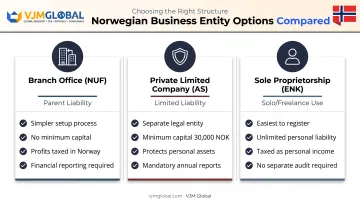
The core decision is structural: incorporate a new Norwegian company (AS) or register a branch (NUF) of your existing German business. Both routes lead to legal operation in Norway, but the liability and reporting implications differ significantly.
Common formats German founders choose include:
- Branch office (NUF) — an extension of an existing German company
- Private limited company (AS) — a standalone Norwegian entity
- Sole proprietorship (ENK) — typically used by freelancers and solo consultants
What to Know Before You Start a Business in Norway as a German Entrepreneur
Many German founders assume EEA ties mean Norwegian bureaucracy mirrors Germany's. It doesn't. Expect different registers, banking gates, and language rules even when the path is fully open to EEA nationals.
Timing and Presence
Registration, banking, and tax setup together often take 2-6 weeks end-to-end, though the Brønnøysund Register Centre's queue-based processing means exact timing varies. NUF (Norskregistrert utenlandsk foretak) filings typically start processing within 10 working days.
You don't need to be physically present. EEA nationals can manage a Norwegian company remotely, provided local representation and a Norwegian address are in place.
Language and Documentation
- Filings and day-to-day communication: usually fine in English
- AS (Aksjeselskap) attachments, including Articles of Association: must be in Norwegian
- NUF documentation: English, Danish, Swedish, or Norwegian
Banking Reality
A German business bank account cannot substitute for a Norwegian one. Most models need a Norwegian account before you can take revenue, so start banking setup early—not after registration.
Why Germans Are Choosing Norway for Business Expansion
Norway makes sense under specific conditions, not as a universal win. Here's what's driving German interest right now.
Stability and access:
- Norway holds an AAA credit rating from Fitch (affirmed June 2026), attracting risk-averse German investors
- EEA membership provides market access without full EU regulatory burden
- Norway ranks 5th globally on the EF English Proficiency Index with a score of 613, reducing communication friction
Sector alignment:
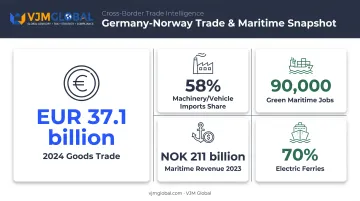
Norway's green maritime industry employed nearly 90,000 people and generated NOK 211 billion in revenue in 2023. Over 70% of Norwegian ferries are now electric. That growth in maritime and green tech matches German industrial and engineering strengths.
Trade ties:
Germany-Norway goods trade totaled roughly EUR 37.1 billion in 2024, according to the German-Norwegian Chamber of Commerce. Machinery and vehicles made up 58% of Norwegian imports from Germany in 2023, showing where German companies already have footholds.
Early Decisions That Matter When Expanding from Germany to Norway
Most friction in these expansions comes from underestimating dual-country compliance complexity, not from a lack of capital. A few decisions get overlooked repeatedly.
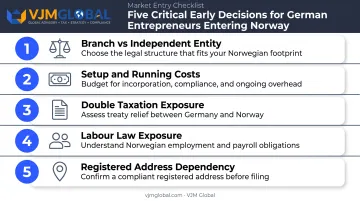
Branch versus independent entity. A NUF keeps the German parent legally responsible for the Norwegian operation. An AS limits liability to contributed share capital. Choosing NUF for simplicity can expose the parent company more than founders expect.
True setup and running costs. Beyond the NOK 30,000 share capital, expect banking fees and ongoing accounting services. Monthly compliance work adds up faster than most founders budget for.
Double taxation exposure. Where a Norwegian permanent establishment exists, Skatteetaten taxes the related business income under PE rules. Treaty provisions usually prevent the same profits being taxed twice.
Labour law exposure. Hiring Norwegian staff means engaging with Norwegian labour law and collective agreements, not German equivalents.
Registered address dependency. An AS business address must be a Norwegian street address, meaning correspondence flows through a local point of contact whether or not the founder is present.
How to Start a Business in Norway from Germany – Step by Step
The most common mistakes are delaying VAT registration, underestimating banking KYC timelines, and skipping proper NUF representative requirements when they apply.
Step 1 – Choose Your Entry Structure
Decide between an AS (independent company), a branch/NUF (extension of the German parent), or an ENK (sole proprietorship), based on liability tolerance and growth ambitions.
Common miss: picking a branch for speed while underestimating that the German parent stays fully liable for the Norwegian business's obligations.
Step 2 – Reserve a Name and Prepare Documentation
Check name availability through Brønnøysund's Namesearch tool and prepare your Articles of Association.
Common miss: submitting German-language documents where Norwegian (for AS) or accepted alternatives like English (for NUF) are required instead.
Step 3 – Deposit Share Capital and Open a Bank Account
Deposit the NOK 30,000 minimum capital for an AS, often routed through a lawyer's client account before incorporation completes.
Common miss: assuming an existing German business account can handle Norwegian transactions. It can't. You need a Norwegian account, and setting one up takes real lead time.
Step 4 – Register with Brønnøysund and the Tax Administration
Complete company registration to obtain an organisation number, then register for VAT once taxable turnover crosses NOK 50,000 in a 12-month period.
Common miss: delaying VAT registration after crossing the threshold, which creates compliance gaps that are painful to unwind later.
Step 5 – Set Up Payroll and Compliance Systems
Register as an employer with Skatteetaten, set up advance tax withholding, and file the monthly a-melding report covering income, employment, and contributions.
Common miss: applying German payroll assumptions, like minimum wage structures or contribution rates, to a Norwegian system that runs on entirely different rules.
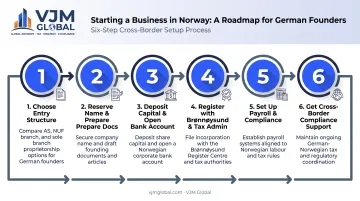
Step 6 – Get Professional Support for Cross-Border Compliance
Most German founders benefit from a firm that understands both regulatory environments, not just one.
VJM Global supports companies expanding across jurisdictions with entity formation, tax registration, and ongoing bookkeeping for foreign-owned businesses entering EEA and EU markets. For a German parent, that means tracking German reporting obligations and Norwegian local rules at the same time.
Common miss: relying solely on a Norway-only advisor with no visibility into how the setup must be reported back in Germany, leaving blind spots on both sides of the border.
Conclusion
Starting a business in Norway from Germany is achievable within weeks when structure and documentation are right from the outset. Speed matters less than clarity on a few core choices:
- AS or NUF as the entity path
- VAT and payroll obligations in Norway
- Realistic timelines for banking and registration
Long-term success depends on compliance in both jurisdictions, not a fast launch alone. Treat the German and Norwegian sides as two ongoing obligations, not one initial task.
For help with entity formation, tax registration, or ongoing multi-country compliance, VJM Global supports companies setting up and operating across European markets.
Frequently Asked Questions
How much does it cost to start a business in Norway?
An AS requires NOK 30,000 minimum share capital plus a Brønnøysund registration fee (around NOK 6,825 digitally). Add banking setup and monthly accounting services on top, which vary by transaction volume and entity complexity.
What are the best businesses to do in Norway?
Green maritime, offshore wind, tech, and health and life sciences are established growth sectors. These align well with German engineering and industrial expertise, making them natural entry points.
Which jobs are in demand in Norway?
Western Norway showed significantly more job vacancies per unemployed person than the national average, according to OECD 2024 data. Tech, engineering, and skilled trades remain consistently strong.
Can a German citizen own 100% of a Norwegian company?
Yes. There's no nationality-based ownership restriction for EEA nationals, including Germans, in Norwegian company law. Board residency rules apply separately from ownership.
Do I need to relocate to Norway to run my business?
No. EEA nationals can manage a Norwegian AS remotely, though the company needs a Norwegian registered address and, for the board, at least half its members resident in Norway, an EEA country, the UK, or Switzerland.
How is a German company taxed if it opens a branch in Norway?
A Norwegian branch (NUF) isn't a separate taxpayer. The German parent remains the taxable entity, but Norway taxes income generated through the branch's Norwegian activity, with treaty provisions preventing double taxation.