Start-up costs here don't follow a single price tag. They swing wildly based on your business structure, your industry, foreign ownership limits, and even which city you register in.
This guide breaks down registration fees, capital requirements, hidden costs, and the budgeting decisions US entrepreneurs need to make before wiring a single dollar.
TL;DR
- Small, Filipino-owned or export-oriented ventures can launch for under PHP 100,000
- Fully foreign-owned domestic firms generally need $200,000 paid-up capital (~PHP 12.36M, Aug 2026 BSP rate)
- Costs rise fastest when your industry is on the Foreign Investment Negative List
- Export enterprises (60%+ revenue) and PEZA businesses can skip the $200,000 threshold
How Much Does It Cost to Start a Business in the Philippines?
A 100% Filipino-owned sole proprietorship and a US-owned corporation live in two different financial universes. The gap comes from the Foreign Investment Negative List, which restricts or caps foreign equity in specific sectors.
Common mistakes US founders make:
- Assuming the $200,000 capital rule applies universally (it doesn't for export enterprises)
- Misjudging which industries allow full foreign ownership
- Ignoring recurring compliance costs after the registration dust settles
Typical Cost Ranges
- Small online/local venture (Filipino-owned or export enterprise): PHP 20,000 – PHP 100,000
- Standard domestic corporation with a US minority partner: PHP 100,000 – PHP 500,000+ in registration and compliance
- Foreign-owned domestic market enterprise: $200,000 minimum paid-up capital (about PHP 12.4 million at roughly PHP 62/USD)
Price Range 1: Sole Proprietorship / Small Local Setup
This route typically covers the core local registrations:
- DTI name registration (PHP 200–PHP 2,000 by territorial scope, plus PHP 30 documentary stamp tax)
- Barangay and Mayor's permits
- BIR registration
Best for: US entrepreneurs partnering with a local co-founder or running a lean online business without heavy capital needs.
Price Range 2: Domestic Corporation (Partial Foreign Ownership)
Expect SEC incorporation fees tied to authorized capital, notarization, BIR registration, and local permits. Costs scale with your capitalization amount rather than a flat rate.
Best for: US entrepreneurs entering under the 40% foreign equity cap common in sectors like land ownership.
Price Range 3: 100% Foreign-Owned Corporation or Export Enterprise
This tier includes either the $200,000 paid-up capital requirement or export-enterprise exemption, SEC filing fees calculated on capital, and legal/professional fees for cross-border structuring.
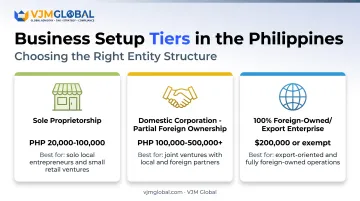
Best for: US entrepreneurs who want full ownership or are building an export-oriented business.
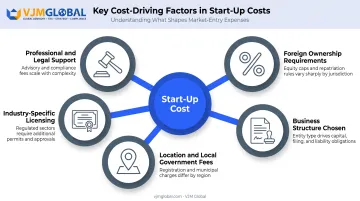
Key Factors That Affect Start-Up Costs
There's no fixed fee schedule here. Cost is driven by ownership structure, industry classification, and how much compliance your business triggers.
Foreign Ownership Requirements
The 13th Regular Foreign Investment Negative List (issued under Executive Order 113 in April 2026) restricts or caps foreign equity in specific sectors, including land ownership, mass media, and certain retail categories.
Paid-up capital floors under the Foreign Investments Act:
- $200,000: Standard minimum for domestic market enterprises
- $100,000: Reduced floor if you use advanced technology, qualify as a startup or startup enabler, or employ at least 15 Filipino workers directly
- Exempt: Export enterprises shipping 60% or more of output (or meeting the equivalent purchase threshold)
Business Structure Chosen
Sole proprietorships and partnerships are cheaper to set up but leave you personally liable. Corporations and One Person Corporations (OPCs) cost more but separate your personal assets from business risk.
- Sole proprietorship/partnership: Lower upfront cost, unlimited personal liability
- Domestic corporation: No general minimum capital under Philippine corporate law, unless FIA rules apply
- One Person Corporation: Same liability protection as a corporation, single owner
- Branch office: No separate Philippine entity; assigned capital and licensing fees still apply
Location and Local Government Fees
Mayor's Permit and barangay clearance fees vary by city. Quezon City, Cebu City, and Davao City each set their own assessments based on business activity, premises size, and declared capital or receipts.
There's no single flat rate you can budget against. Get a location-specific assessment before committing to a space.
Industry-Specific Licensing
Regulated sectors carry extra costs:
- BPO/IT export: PEZA fees of PHP 3,600 (application) + PHP 6,000 (registration) when at least 70% of revenue is from foreign clients
- Fintech/e-money: BSP capital requirements of PHP 100 million (small-scale) to PHP 200 million (large-scale)
- Food: FDA License to Operate required; fees vary by establishment type
- Real estate: Foreign ownership capped at 40% for land-owning corporations
Professional and Legal Support
Hiring a local lawyer or accountant to navigate SEC and BIR requirements isn't optional if you're unfamiliar with Philippine bureaucracy. Fees are typically quoted per engagement and scope rather than as a flat retainer, so get a specific quote tied to your structure before budgeting.
Cost Breakdown: Where the Money Actually Goes
Registration fees are just the entry point. Here's the fuller picture.
| Cost Item | Type | What It Covers |
|---|---|---|
| DTI/SEC registration | One-time | Name search, articles of incorporation, filing fees tied to capitalization |
| Local permits (Mayor's/Barangay) | One-time, renewed annually | Varies by LGU and business classification |
| BIR registration & compliance | One-time + recurring | TIN, Certificate of Registration, official receipts, books of accounts |
| Minimum paid-up capital | One-time (deposited, not spent) | $200,000 unless exempted as export enterprise |
| Ongoing compliance/accounting | Recurring | Income tax filings, VAT, SSS/PhilHealth/Pag-IBIG if hiring staff |
| Professional/advisory fees | One-time or recurring | Legal and accounting support for cross-jurisdiction compliance |
The paid-up capital line often trips up US founders. That amount is retained capital your business can use, not a government fee. It still must sit in a Philippine bank account before you operate as a foreign-owned domestic market enterprise.
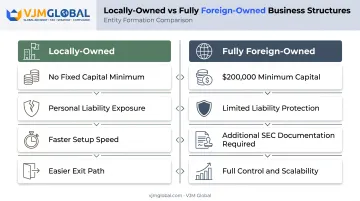
Foreign-Owned vs Locally-Owned Start-Up: The Cost Difference
Ownership structure drives your minimum capital outlay and how much control you keep.
Capital Requirements
- Locally-owned: No fixed minimum for sole proprietorships
- Fully foreign-owned (US investor): $200,000 minimum unless structured as an export enterprise
Liability Exposure
- Sole proprietorship/partnership: Personal liability for business debts
- Corporation/OPC: Liability limited to your investment
Speed and Complexity
Local structures move faster with fewer documentation layers. Foreign-owned structures require additional SEC documentation and inward remittance certificates.
Published agency targets after complete documents are acknowledged:
- SEC eSPARC regular review: 7 working days
- BIR manual processing: 3 working days
The commonly cited 2–3 month total is a realistic planning estimate once you factor in bank setup, lease negotiations, and sector licensing—not an official government service-level guarantee.
Long-Term Flexibility
- Local or joint-venture: Easier exit path, but shared control
- Fully foreign-owned corporation: Full control and a stronger position for scaling or repatriating profits
How US Entrepreneurs Can Plan and Manage Cross-Border Start-Up Costs
Registration is the easy part. The harder work is planning for currency conversion, cross-border tax exposure, and multi-jurisdiction compliance from day one.
Things worth confirming before you file anything:
- Whether your business qualifies as an export enterprise, avoiding the $200,000 domestic-market threshold entirely
- How the US-Philippines tax treaty (in effect since 1982) caps dividend, interest, and royalty withholding—generally at 25%, 15%, and 15%, with lower rates for qualifying ownership
- Whether Philippine activity creates permanent establishment exposure under the treaty, especially if you provide services for more than 183 days
- How to track PHP expenses against USD budgets without losing money to conversion timing
- Whether ongoing compliance (payroll, tax filings, and audits) should be budgeted as recurring costs, not folded into one-time setup
This is exactly where a lot of US founders get burned. They budget for registration and forget that annual permit renewals, mandatory employee contributions, and recurring tax filings don't stop after year one.

Firms with cross-border compliance experience, like VJM Global, can help structure entry decisions from the start. The firm supports entity formation and multi-jurisdiction tax advisory for clients moving between the US and other markets.
If you're entering the Philippines specifically, confirm any advisor's direct experience with SEC, BIR, and PEZA procedures before you engage them. Not every cross-border firm has hands-on Philippine registration experience.
What US Entrepreneurs Often Miss
Four assumptions show up again and again in Philippines start-up budgets. Fix them before you commit capital.
- The $200,000 capital rule is not universal. Export enterprises and certain advanced-technology or startup-enabler businesses can use a $100,000 floor or skip the requirement entirely.
- Local fee schedules vary by city. Metro Manila, Cebu, and Davao each assess Mayor's Permits differently based on your activity and premises.
- Recurring costs stack quickly. Annual permit renewals plus mandatory SSS, PhilHealth, and Pag-IBIG contributions add up once you hire staff.
- Skipping professional guidance rarely saves money. DIY filings that stall registration almost always cost more than the advisory fee would have.
Conclusion
Philippine start-up costs shift dramatically depending on your ownership structure, industry, and capital position. A sole proprietorship might cost you PHP 20,000. A fully foreign-owned corporation could require over $200,000 sitting in a Philippine bank account before you open your doors.
Understanding the Foreign Investment Negative List and capital rules before you file anything prevents budget surprises that stall a launch for months. Weigh ownership control against compliance cost and long-term scalability before you file. VJM Global helps US entrepreneurs plan entity structure, capital requirements, and ongoing compliance when expanding into new markets—so you set the budget once, correctly.
Frequently Asked Questions
How much money do I need to start a business in the Philippines?
It ranges from under PHP 100,000 for small local ventures to $200,000 in paid-up capital for foreign-owned domestic market enterprises. Export enterprises are typically exempt from that higher threshold.
Can an American start a business in the Philippines?
Yes, either through a local partner in restricted sectors or with full ownership in permitted industries. It depends entirely on where your business activity falls on the Foreign Investment Negative List.
What business can I start with 200k in the Philippines?
PHP 200,000 comfortably supports most local sole proprietorships or small domestic corporations. USD 200,000 is a different figure entirely; it's the foreign paid-up capital threshold for domestic market enterprises.
What industries are fully open to 100% foreign ownership in the Philippines?
Export enterprises, BPO/IT services meeting export revenue thresholds, and most sectors outside the Negative List allow full foreign ownership. Land ownership and select service categories remain restricted.
How long does it take to register a foreign-owned business in the Philippines?
Individual steps move fast: SEC review targets 7 working days and BIR processing targets 3 working days. Realistically, budget 2-3 months once you include banking, permits, and sector licensing.
Do I need a local partner to start a business in the Philippines as a US citizen?
It depends on your sector and capitalization. Full ownership is possible if you meet the $200,000 threshold or qualify as an export enterprise; otherwise, a local partner may be required.