But "easy to register" and "easy to run" are two different things. The actual process — choosing the right structure, meeting ACRA's legal requirements, and staying compliant after incorporation — involves more moving parts than most first-time founders expect.
This guide covers everything you need to know about starting a business in Singapore in 2025–26: from choosing the right entity type, to walking through each registration step, to understanding what compliance obligations kick in the moment your company is incorporated.
Key Takeaways
- Singapore-registered companies pay a flat 17% corporate tax rate with no capital gains tax
- The Private Limited Company (Pte Ltd) is the recommended structure for most founders, including foreign investors
- Government registration fees total SGD 315 (SGD 15 name reservation + SGD 300 incorporation)
- Foreign founders must appoint at least one Singapore-resident director before submitting on BizFile+
- Post-incorporation compliance obligations — including a company secretary, annual filings, GST, and CPF — begin immediately after registration
Why Start a Business in Singapore?
Singapore's appeal as a business base isn't just about rankings. The fundamentals are concrete and verifiable.
The tax environment is unusually clean:
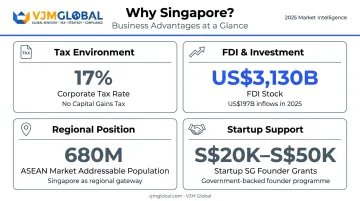
- Flat 17% corporate income tax rate on chargeable income, applicable to both local and foreign companies (IRAS)
- No capital gains tax — gains from the sale of fixed assets, shares, or foreign exchange on capital transactions are not taxable
- Qualifying new startups can access IRAS's startup tax exemption for the first three years of assessment
The investment environment is deep. Singapore's corporate-sector FDI stock reached US$3,130 billion at end-2024, up 9.5% year on year. FDI flows hit US$197 billion in 2025. Global companies including Amazon, Dyson, and Unilever have established regional headquarters here — drawn by predictable regulation, deep talent pools, and infrastructure that few cities in Asia match.
The regional position matters. Singapore sits at the center of Southeast Asia's 680 million-person market. For businesses targeting ASEAN expansion, it offers a platform anchored in legal certainty, treaty-backed trade access, and the region's deepest capital markets — advantages that compound the further into ASEAN you operate.
Startup SG Founder covers grants and mentorship. The Startup SG Founder programme, administered through Enterprise Singapore, provides grants of S$20,000 to S$50,000 (effective from 1 April 2024) alongside mentorship support for first-time entrepreneurs with innovative business concepts.
What to Know Before You Start
Registration can be completed in days. Getting operationally stable takes much longer, and many foreign founders conflate the two — often to their financial detriment.
Legal Requirements That Apply From Day One
Three requirements that catch foreign founders off-guard:
- Local resident director: Every Singapore company must have at least one director who is ordinarily resident in Singapore — meaning a Singapore citizen, Permanent Resident, or valid Employment Pass or EntrePass holder. If you're a foreign founder without Singapore residency, you'll need to appoint a nominee director before you can register.
- Company secretary: Must be appointed within 6 months of incorporation. The secretary must be a natural person ordinarily resident in Singapore and cannot be the sole director.
- Registered office address: A physical Singapore address (not a P.O. box) is required from the moment of incorporation. Virtual office services satisfy this requirement.
The Time-to-Revenue Reality
ACRA can approve a straightforward Pte Ltd application almost immediately after payment. Complex applications may take up to 15 working days. What takes far longer is everything that follows:
- Building a local customer base and establishing market presence
- Obtaining industry-specific licences where required
- Achieving the operational stability that makes scaling sensible
Factor this timeline into your financial runway. Running out of cash six months into what turns out to be a 12-month market entry is a preventable problem.
Choosing the Right Business Structure
Your structure choice affects liability exposure, tax treatment, the ability to raise capital, and how credible you look to customers and banks. Changing structures later is possible, but it's disruptive and costly — so get this right from the start.
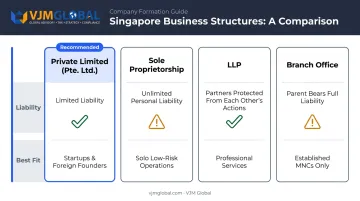
| Structure | Liability | Best For |
|---|---|---|
| Private Limited (Pte Ltd) | Limited to paid-up capital | Startups, foreign founders, growth businesses |
| Sole Proprietorship | Unlimited personal liability | Low-risk solo operations only |
| LLP | Partners protected from each other's actions | Professional services firms |
| Branch Office | Parent company bears full liability | Established MNCs, not early-stage founders |
Private Limited Company (Pte Ltd)
The default choice for most founders. A Pte Ltd is a separate legal entity — shareholders are only liable up to the amount of their unpaid shares. It can have up to 50 shareholders, is eligible for IRAS's startup tax exemptions, and carries the credibility that banks, investors, and enterprise clients expect.
Sole Proprietorship
Minimal setup cost, maximum personal risk. The owner and the business are legally the same entity, meaning personal assets are exposed to business liabilities. Not recommended for foreign founders or anyone with growth ambitions.
Limited Liability Partnership (LLP)
A separate legal entity requiring at least two partners, with no upper limit. It suits consulting firms, agencies, and professional services businesses where partners want protection from each other's individual liabilities — but not from shared business debts.
Branch Office
An extension of a foreign parent company, not a separate legal entity. The parent bears full liability for the branch's obligations. This works for established multinationals that need a local presence, but it brings no liability separation and limited operational flexibility for new entrants.
For most entrepreneurs — particularly foreign founders — a Pte Ltd is the right call. It combines liability protection, tax incentive eligibility, and the investor-readiness that growth businesses need. If you're also managing home-country compliance alongside your Singapore setup (for example, an India-based founder channelling investment through Singapore), your structure choice needs to align with those obligations from day one.
How to Start a Business in Singapore – Step by Step
Step 1 – Validate Your Idea and Define Your Business Model
Before touching BizFile+, confirm that your business is commercially viable specifically in the Singapore or ASEAN market context.
- Define the problem you're solving and who your paying customers are
- Sanity-check pricing against local costs, competition, and the real operating expenses of a Singapore entity (director fees, secretarial costs, registered address, accounting)
- Confirm that demand exists here — an existing customer base in another country does not transfer automatically
Founders who skip this step and move straight to registration often find themselves compliant but unprofitable.
Step 2 – Prepare Your Pre-Registration Requirements
Have these ready before logging into BizFile+:
- Approved company name (check availability on BizFile+ first)
- SSIC business activity code — selecting the wrong code is a common cause of delays
- Registered office address (physical or virtual)
- Local resident director details — nominee director if you don't have Singapore residency
- Shareholder information including identity documents
- Paid-up capital (minimum SGD 1 for a Pte Ltd)
- Company constitution (ACRA's model constitution is acceptable)
Foreign founders without a Singpass must engage a registered Corporate Service Provider to submit on BizFile+. This isn't optional — ACRA requires it. Many incorporation packages include nominee director services alongside registered address and secretarial support.
Step 3 – Reserve Your Business Name and Register via ACRA BizFile+
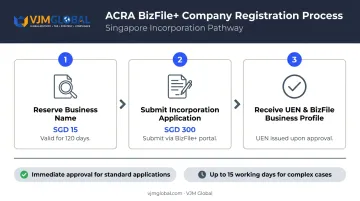
- Reserve your business name on BizFile+ — SGD 15 fee, holds the name for 120 days
- Submit the incorporation application — SGD 300 for a Pte Ltd
- What the form requires: Company type, SSIC code, director and shareholder details, registered address, share capital structure, and constitution
ACRA approves most straightforward applications immediately after payment. Complex applications — those involving restricted business activities or name review triggers — can take up to 15 working days.
On approval, your company receives a Unique Entity Number (UEN) and a BizFile Business Profile. Both are required for opening a corporate bank account and applying for licences.
Step 4 – Set Up Legal, Financial, and Operational Basics
Corporate bank account: DBS, OCBC, and UOB are the main Singapore banking options. You'll need your business profile, constitution, a board resolution authorizing account opening, and director/shareholder ID documents. Digital alternatives like Wise or Payoneer are viable for e-commerce and remote-first founders.
Company secretary: Appoint within 6 months of incorporation. The secretary manages statutory filings, maintains statutory registers, and tracks compliance deadlines — this isn't an administrative role you want to underestimate.
Industry licences: Check the GoBusiness OBLS portal for any licences or permits your business activity requires. Food, education, financial services, and retail businesses typically need approvals before trading can begin.
Cross-border operations (India-Singapore structures): If you're running a Singapore entity alongside Indian operations, the two regulatory environments need to align before transactions flow between them. Key obligations to address from day one include:
- FEMA compliance for cross-border remittances and investments
- India-Singapore DTAA structuring to avoid double taxation
- Transfer pricing documentation for intercompany transactions
VJM Global works with India-based founders and foreign investors managing exactly this kind of dual-entity structure, covering FEMA advisory, DTAA-based tax planning, and transfer pricing compliance.
Step 5 – Go to Market and Build Credibility
In Singapore's B2B market, a professional website, a local business address, and a clean online presence are baseline expectations before prospects take you seriously.
- Choose 1-2 acquisition channels (SEO, paid digital, referrals, trade directories) and set up tracking from the start
- Set conversion tracking before spending on any channel — you need data early, not later
- Assume your existing customer base from another market won't transfer without active effort
Step 6 – Monitor Compliance and Stabilise Before Scaling
Track financial health and statutory obligations in parallel:
- Annual returns must be filed with ACRA
- AGMs for non-listed companies must be held within 6 months after the financial year end
- Corporate income tax returns (Form C, Form C-S, or Form C-S Lite) are due to IRAS by 30 November each year
Stabilise your business model, pricing, and compliance foundations before scaling headcount or entering additional markets — founders who skip this step regularly face cash flow problems or regulatory penalties.
Post-Registration Essentials You Cannot Skip
GST
GST key facts for Singapore businesses:
- Current rate is 9%, effective 1 January 2024
- Mandatory registration threshold: SGD 1 million in annual taxable turnover
- B2B businesses can register voluntarily before hitting the threshold to claim input GST credits
- Voluntary registration commits you to a minimum 2-year registration period
Ongoing Statutory Compliance
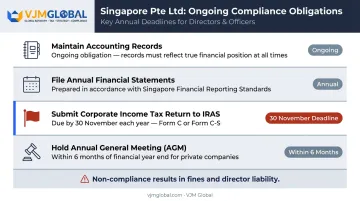
Singapore companies must:
- Maintain proper accounting records
- File annual financial statements
- Submit corporate income tax returns to IRAS by 30 November
- Hold AGMs within 6 months of financial year end (non-listed companies)
Failure to comply results in fines and potential director liability. For most founders, engaging a corporate secretary and external accounting support is the most practical way to stay compliant without diverting focus from the business.
CPF (Central Provident Fund)
Hiring employees in Singapore triggers mandatory CPF contributions. The table below shows 2025 rates (effective 1 January 2025) for Singapore citizens and PRs from their third year onward, on monthly wages above SGD 750:
| Employee Age | Employer | Employee | Total |
|---|---|---|---|
| 55 and below | 17% | 20% | 37% |
| Above 55 to 60 | 15.5% | 17% | 32.5% |
| Above 60 to 65 | 12% | 11.5% | 23.5% |
| Above 65 to 70 | 9% | 7.5% | 16.5% |
| Above 70 | 7.5% | 5% | 12.5% |
Source: CPF Board, January 2025
Conclusion
Starting a business in Singapore is one of the more accessible processes globally. The government infrastructure is clear, the fees are reasonable, and the timeline from application to incorporation can be very short.
What determines whether you succeed isn't how fast you register — it's whether you've chosen the right structure, met your legal requirements from day one, and built a compliance foundation that can support growth rather than constrain it.
For founders running entities in both Singapore and India, the stakes of getting the structure right are higher. Several cross-border obligations need to be addressed before transactions start flowing:
- FEMA compliance for inbound and outbound capital flows
- India-Singapore DTAA planning to avoid double taxation on cross-border income
- Transfer pricing documentation between related entities in each jurisdiction
Working with an advisory partner who understands both regulatory environments, rather than managing each jurisdiction separately, saves time and reduces cost.
Frequently Asked Questions
Can foreigners set up a business in Singapore?
Yes. Foreign nationals can fully own a Singapore-registered company, including a subsidiary of an overseas parent entity. At least one director ordinarily resident in Singapore must be appointed, and nominee director services are readily available through corporate service providers.
How long does it take to register a company in Singapore?
ACRA approves most straightforward Pte Ltd applications immediately after payment is processed. Applications involving restricted business activities, name review triggers, or additional regulatory scrutiny may take up to 15 working days.
How much does it cost to register a business in Singapore?
Government fees total SGD 315 — SGD 15 for name reservation and SGD 300 for Pte Ltd incorporation. Additional costs include nominee director services, registered address fees, and corporate secretarial packages, which vary by provider.
What is the minimum paid-up capital required?
The minimum paid-up capital for a Singapore Pte Ltd is SGD 1. Most startups begin at this level and increase capital as the business grows or when external funding is received.
What are the ongoing compliance requirements after incorporation?
Core post-incorporation obligations include:
- Appoint a company secretary within 6 months of incorporation
- Hold AGMs within 6 months of the financial year end
- File annual returns with ACRA and maintain accounting records
- Submit corporate income tax returns to IRAS by 30 November each year
What is the most recommended business structure for foreign founders?
The Private Limited Company (Pte Ltd) is the structure of choice for most foreign entrepreneurs. It provides limited liability protection, a separate legal identity, and eligibility for startup tax exemptions. This structure also carries the credibility needed to open corporate bank accounts, attract investors, and enter enterprise contracts.