The problem? Most US founders don't know where to start. Juggling MISA licensing, Saudi entity law, and US tax reporting from thousands of miles away feels like solving three puzzles at once.
This guide breaks down what's actually possible remotely, how to pick the right entity, what registration involves step by step, and which sectors give American founders the best shot at success — plus the tax obligations on both sides of the ocean you can't afford to ignore.
Key Takeaways
- MISA's e-service portal lets US founders start licensing online; banking and signer setup still need local execution
- Most sectors now permit 100% foreign ownership, eliminating the old Saudi-partner requirement
- An LLC is the preferred structure for American SMEs testing the Saudi market
- No comprehensive US-Saudi tax treaty exists, making Form 5471, FBAR, and GILTI planning essential
- Technology, e-commerce, healthcare, and franchising are the strongest entry points
Why Saudi Arabia Is Attracting US Entrepreneurs Right Now
The numbers tell the story. Saudi Arabia's non-oil economy grew 4.9% in 2025, part of an overall 4.5% real GDP expansion, according to GASTAT's 2026 economic release. This growth reflects a deliberate, multi-year shift away from oil dependence under Vision 2030.
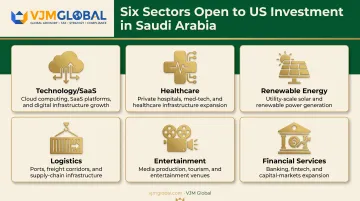
Several sectors are open to US innovation and capital right now:
- Technology and SaaS — driven by digital transformation mandates across government and private industry
- Healthcare — expanding private-sector participation in hospitals, clinics, and specialty care
- Renewable energy — massive solar and green hydrogen investment tied to national climate targets
- Logistics — Saudi Arabia's push to become a global trade and shipping hub
- Entertainment — a sector that barely existed publicly a decade ago
- Financial services — fintech licensing has opened dramatically under the Saudi Central Bank
The biggest structural change for American founders, though, is ownership. Most sectors now permit 100% foreign ownership. Previously, US SMEs had to bring on a Saudi partner just to get a foothold. That requirement deterred many smaller businesses from trying. That barrier is largely gone.
Can Americans Start a Business in Saudi Arabia From the USA?
Yes, mostly. You don't need to relocate to file your initial paperwork, but you also shouldn't expect a fully hands-off process from your kitchen table in Austin or Chicago.
The MISA Digital Portal Handles the First Steps
MISA — the Ministry of Investment of Saudi Arabia — acts as the single-window regulator for foreign investors. Its e-service portal allows applicants to create an account, upload a passport copy, complete the Investment Registration form, and submit everything electronically. MISA commits to reviewing applications within 10 working days.
Once approved, that certificate feeds into the Saudi Business Center's online incorporation service, which handles company formation without requiring an in-person visit for this stage.
What Still Needs Boots on the Ground
A few steps typically require local action or a representative physically present in the Kingdom:
- Notarizing and executing Articles of Association
- Opening a corporate bank account, since Saudi banking rules require named signers authorized within Saudi Arabia
- Biometric enrollment or Iqama processing for any staff who plan to relocate
Power of Attorney: Your Remote-First Workaround
A properly drafted Power of Attorney (PoA) authorizes a local representative or service partner to sign documents, file with ministries, and coordinate with Saudi authorities on your behalf. It's the mechanism that makes a genuinely remote-first setup possible.
The US-Saudi Business Council also connects American companies with guidance and advocacy as they enter the market, though it's not the licensing authority itself.
VJM Global bridges these steps for US clients. Teams that work with both US corporate documentation and Saudi MISA and ZATCA requirements can move formation forward so you don't spend weeks on the ground.
Choosing the Right Business Structure & Ownership Rules
Saudi Arabia offers four main entity types for foreign investors, and picking the right one depends heavily on your scale and intent.
| Entity Type | Best For | Key Trait |
|---|---|---|
| LLC | US SMEs testing the market | Liability protection, familiar structure |
| Branch Office | Companies extending US operations | No separate Saudi legal entity |
| Joint Stock Company | Larger enterprises, potential public listing | Heavier compliance burden |
| Technical/Scientific Office | Support functions only | Cannot conduct commercial sales |
Why the LLC Wins for Most American Founders
The LLC is the most common choice for US SMEs. It offers liability protection and a structure familiar to owners who already run domestic LLCs, so you keep the same basic model for shielding personal assets.
A Branch Office makes sense when a US company wants to operate as an extension of the American parent instead of forming a separate Saudi legal entity. That setup fits service delivery or project work tied directly to the US business.
Joint stock companies suit larger enterprises that may want a public listing later. Technical or scientific offices support the parent only and cannot make commercial sales.
Foreign Ownership Rules
Most sectors open to foreign investment allow 100% US ownership under a MISA license. You generally do not need a Saudi partner in those activities. Ownership limits still apply where the negative list or sector rules say so—confirm your activity code before you lock the cap table.
The Negative List: What's Off-Limits
Not every sector welcomes foreign capital. Saudi Arabia maintains an excluded activities list that currently includes:
- Oil exploration, drilling, and production (with some mining-services exceptions)
- Military-related catering and security/detective services
- Real estate investment in Makkah and Medina, unless through an approved managed fund
- Hajj-related tourist orientation and guidance services
- Recruitment agencies and certain commission-agent activities
Check your specific activity against MISA's current list before you get attached to a business plan.
Capital Requirements Aren't One-Size-Fits-All
Minimum capital isn't a flat number you can look up once and apply everywhere. It varies by entity type, sector, and the specific activity MISA assigns to your registration. Rather than budgeting off a generic figure, get written confirmation from MISA or the Saudi Business Center on your exact capital obligation before finalizing your business plan.
Step-by-Step Process to Register Your Business
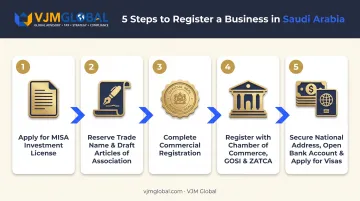
Follow this sequence from first application through to an operational entity:
- Apply for the MISA investment license. Submit notarized and apostilled US parent documents: Certificate of Incorporation, bylaws (or operating agreement), and a board resolution authorizing the Saudi venture.
- Reserve a trade name and draft Articles of Association. These go to the Ministry of Commerce for approval once your MISA certificate is in hand.
- Complete Commercial Registration (CR). This formally establishes your legal entity. MISA benchmarks its own review at about 10 working days; CR timing for foreign investors still varies with document readiness and activity type.
- Register with the Chamber of Commerce, GOSI, and ZATCA. Each of these unlocks a different operational function: trade membership, social insurance, and tax compliance respectively.
- Secure a national address, open a corporate bank account, and apply for visas or Iqamas if you are relocating staff. Banking KYC is often the longest leg, so start it as soon as the CR is issued.
Total setup usually takes several weeks to a few months. Speed hinges on document legalization, bank KYC, and how straightforward your activity is to approve.
Do not lock a launch date until the corporate bank account is actually open.
Taxes & Compliance: What US Business Owners Must Know
This is the section that trips up even experienced founders, because you're managing two completely separate tax systems that don't talk to each other.
Saudi-Side Obligations
- Corporate income tax: The non-Saudi share of profits in a resident company is generally taxed at 20%
- Zakat: Applies at 2.5% to the Saudi/GCC ownership share, calculated on a Hijri fiscal year
- VAT: Standard rate is 15%; register once revenue exceeds SAR 375,000 (voluntary from SAR 187,500)
Saudi Arabia levies no personal income tax, a real perk if you relocate. That still doesn't get US citizens off the hook.
US-Side Reporting Requirements
Americans remain subject to worldwide taxation on foreign business income no matter where they earn it. Owning a Saudi entity triggers several US filing obligations:
- FBAR (FinCEN Form 114): Required once aggregate foreign account balances exceed $10,000 at any point in the year
- IRS Form 5471: Applies to certain US shareholders, officers, or directors of foreign corporations (category thresholds decide who must file)
- GILTI: US shareholders of controlled foreign corporations may owe tax on Global Intangible Low-Taxed Income (Form 8992)
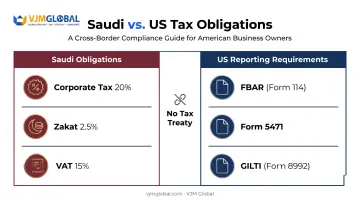
Here's the complication most founders don't see coming: there's currently no comprehensive US-Saudi income tax treaty. Without treaty protections that many other countries offer, double taxation risk is real, and professional cross-border guidance stops being optional.
That dual burden is why coordinated support matters. VJM Global pairs US-trained CPAs on Form 5471, FBAR, and GILTI with Chartered Accountants on ZATCA filings, so both sides stay aligned under one team instead of two advisors who never compare notes.
Best Business Opportunities in Saudi Arabia for Americans
Vision 2030 is channeling investment into a few sectors that fit American entrepreneurs especially well:
- Technology and SaaS — cloud infrastructure demand is climbing fast, backed by government digitization mandates
- E-commerce — a young, mobile-first population with rising disposable income
- Healthcare services — private-sector expansion creating room for specialty clinics and health-tech
- Education and training — corporate upskilling and private education both growing
- Renewable energy consulting — advisory work tied to solar and green hydrogen megaprojects
- Franchising — proven US brand recognition without building demand from scratch
American brands have already proven the market works. McDonald's has operated in the Kingdom for decades, Amazon.sa runs substantial e-commerce and logistics operations out of Riyadh, and Google Cloud launched a dedicated Saudi cloud region in 2023 to serve public and private sector clients.

Franchising is often the lowest-barrier entry point. You adopt an existing brand and playbook, validate local demand, then decide whether full independent incorporation is worth the next step.
Frequently Asked Questions
Can an American start a business in Saudi Arabia from the USA?
Yes. MISA licensing and initial registration can begin online, but banking setup and final signing usually require a local representative or a short visit.
What are the best businesses to start in Saudi Arabia for Americans?
Technology, e-commerce, healthcare, education, and franchising fit Vision 2030 priority sectors and current foreign investment openings.
What American businesses operate in Saudi Arabia?
Well-known US brands across fast food, retail, and cloud technology already operate in the Kingdom, including McDonald's, Amazon.sa, and Google Cloud.
Do I need a Saudi partner to own my business?
No, in most sectors. Reforms now allow 100% foreign ownership, though a shortlist of restricted activities — like oil exploration and certain Hajj-related services — still requires local participation.
How long does it take to register a company in Saudi Arabia?
MISA's own review benchmark is 10 working days for the investment license. Full setup through Commercial Registration and banking typically runs several weeks to a few months.
Is there a tax treaty between the US and Saudi Arabia?
No comprehensive bilateral income tax treaty currently exists between the two countries. That makes coordinated US-Saudi tax planning essential to avoid double taxation.