Interest is coming from multiple directions. Domestic entrepreneurs, foreign investors, NRIs exploring North American expansion, and multinationals sizing up a Canadian footprint are all asking the same core question: what does starting a business in Canada actually involve?
The answer has layers. Registration is accessible, costs are reasonable, and the regulatory environment is navigable — but structure selection, tax setup, licensing, and ongoing compliance each carry consequences that catch underprepared founders off guard.
This guide breaks it down step by step: from choosing the right structure to getting registered, handling taxes, and getting to market.
Key Takeaways
- Canada's 9th-ranked GDP, low corporate rates for eligible businesses, and 15 free trade agreements make it a credible destination for international founders
- Foreigners can incorporate in Ontario and British Columbia without needing a Canadian-resident director, making both provinces the most accessible entry points
- Structure choice (sole proprietorship, partnership, or corporation) affects tax, liability, and fundraising ability from day one
- GST/HST registration is mandatory once revenue crosses CAD $30,000 — late registration triggers penalties and interest
- Budget for ongoing compliance costs — accounting, tax filings, and licences are recurring obligations, not one-time setup expenses
Why Start a Business in Canada?
Canada offers concrete structural advantages for foreign founders and growing businesses — not just a high quality of life.
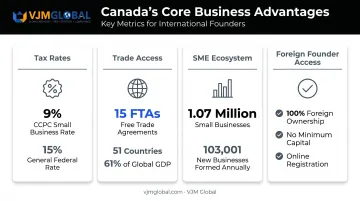
- Competitive corporate tax rates. The federal rate starts at 38%, but drops to 9% for Canadian-Controlled Private Corporations (CCPCs) eligible for the small business deduction. Larger corporations pay 15% after the federal abatement and general tax reduction.
- Unrivaled trade access. Canada is the only G7 nation with free trade agreements covering all other G7 members. According to Canada's Trade Commissioner Service, this spans 15 FTAs, 51 countries, 1.5 billion consumers, and 61% of global GDP — including CUSMA, CETA, and CPTPP.
- A mature SME ecosystem. ISED reports over 1.07 million small employer businesses in Canada in 2024, with roughly 103,001 new small businesses formed annually between 2017 and 2021 — an established base of suppliers, customers, and talent.
- Low barriers for foreign founders. Provinces like Ontario and British Columbia allow 100% foreign ownership with no Canadian-resident director requirement, no minimum capital, and online registration available from day one.
What to Know Before You Start
Most early-stage problems don't come from lack of effort. They come from starting without a clear picture of the requirements.
Immigration Status Determines What You Can Do
Your ability to legally operate a business in Canada depends on your immigration status:
- Permanent residents can operate a business without restriction
- Work permit holders face limitations depending on permit type and conditions
- Foreign nationals operating remotely can incorporate provincially — particularly in Ontario and British Columbia — without needing a Canadian-resident director, and manage the business from abroad
Federal vs. Provincial Incorporation — Choose Carefully
The structure you choose affects name protection, director requirements, and where you can operate:
- Federal incorporation (under the Canada Business Corporations Act) protects your business name nationally and suits multi-province operations. Online filing costs CAD $200 (plus CAD $100 for express processing)
- Provincial incorporation is appropriate for locally focused businesses — but contrary to common assumption, it isn't necessarily cheaper. An Ontario corporation costs CAD $300; a B.C. company costs approximately CAD $380 including name approval
- Federal corporations still need to register in each province where they conduct business
The CBCA also requires that at least 25% of directors be Canadian residents (with at least one resident Canadian director if there are fewer than four directors). Ontario and B.C. have no such requirement — an important distinction for foreign founders.
Plan for the Gap Between Registration and Revenue
Once your legal structure is sorted, the financial reality sets in. Registration wraps up in days; building reliable revenue typically takes six to twelve months. Budget for accounting fees, business licences, and tax filing costs from day one — these aren't optional extras, they're recurring operating costs that catch many first-time founders off guard.
Choosing the Right Business Structure in Canada
Structure determines how you're taxed, your personal liability, your ability to raise capital, and how your business is governed. Get this right before anything else.
Sole Proprietorship
The simplest option — you and the business are the same legal entity. Income flows to your personal tax return, and setup requires little more than a business name registration (CAD $60 in Ontario; CAD $40–$70 in B.C.).
Best for: freelancers, consultants, and early-stage solo ventures. Watch out for: unlimited personal liability — business debts are your debts.
Partnership
Two or more people sharing profits, losses, and liability. A written partnership agreement is essential — it defines roles, revenue splits, and decision-making before disagreements arise.
- General partnerships carry joint and several liability for all partners
- Limited partnerships allow passive investors to cap their exposure to the amount contributed
Corporation
A separate legal entity that limits shareholder liability and pays corporate income tax independently. CCPCs may access the 9% small business deduction rate on eligible active business income, up to the CAD $500,000 business limit — a tax advantage that can translate to tens of thousands of dollars saved annually.
Beyond tax efficiency, corporations offer structural benefits that other structures can't match:
- Investor-ready: easier to bring in shareholders or issue equity to employees
- Continuity: the business survives ownership changes, unlike a sole proprietorship
- Credibility: a numbered or named corporation often signals stability to clients and lenders
Incorporation can be done federally under the CBCA or provincially — Ontario's OBCA and B.C.'s Business Corporations Act are common routes, depending on where you plan to operate.
How to Start a Business in Canada — Step by Step
Each step below builds on the previous one. Rushing registration before validation, or skipping tax setup after registration, is where most early problems begin.
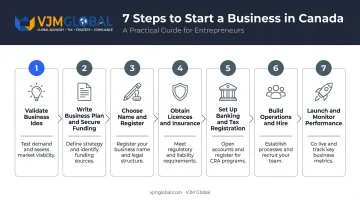
Step 1 – Validate Your Business Idea
Define the problem your business solves and confirm there's a paying customer base in Canada. Competitor analysis, pricing benchmarks, and an understanding of local buyer behaviour all matter here.
Statistics Canada's Small Business Hub uses census data to help founders understand target markets — a practical starting point. ISED's 2024 data shows 5-year survival rates of 69.2% for goods-producing businesses and 66.9% for services businesses. Validation isn't a formality — it's risk control.
Test willingness to pay, not just interest. And check whether your pricing model is sustainable given Canadian cost structures. Rent, wages, and regulatory fees vary significantly by province.
Step 2 – Write a Business Plan and Identify Funding
A Canadian-style business plan should cover:
- Market research and competitive positioning
- Company profile and management structure
- Sales and marketing strategy
- Operations and staffing plan
- Two-year financial projections grounded in realistic local benchmarks
This document is also required for most financing applications, so cutting corners here has compounding consequences.
Main funding pathways:
- Personal savings (the primary source for 76% of SMEs at startup, per ISED research)
- Bank loans and lines of credit
- Government grants and subsidies via Canada's Business Benefits Finder
- Angel investors and venture capital
The most common miss: building a plan on best-case revenue assumptions without accounting for cash flow gaps, licence costs, or the time it takes to close first customers.
Step 3 – Choose a Business Name and Register
Before committing to a name, search for conflicts. Federal incorporations typically require a NUANS (Newly Upgraded Automated Name Search) check — though Corporations Canada's online incorporation process integrates the name search directly for word-name filings.
Names must be distinctive, descriptive of the business type, and free from trademark conflicts.
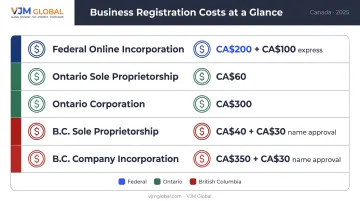
Registration costs at a glance:
| Filing Type | Cost (CAD) |
|---|---|
| Federal online incorporation | $200 (+$100 express) |
| Ontario sole proprietorship | $60 |
| Ontario corporation | $300 |
| B.C. sole proprietorship | $40 + $30 name approval |
| B.C. company incorporation | $350 + $30 name approval |
After registration, obtain a Business Number (BN) from the Canada Revenue Agency and open a corporate tax account if incorporated.
Step 4 – Obtain Licences, Permits, and Insurance
Licensing requirements are not uniform — they depend on industry, province, and municipality. Use the BizPaL permit and licence finder to identify what applies to your business before you launch.
Some sectors carry multiple layers of approval:
- Food businesses: premises regulations, municipal licensing, zoning
- Regulated professions: registration with provincial bodies, certifications
- Childcare and real estate: sector-specific inspections and approvals
Business insurance (general liability, professional indemnity, property) isn't always legally required — but launching without it is one of the most common and costly early mistakes.
Step 5 – Set Up Banking, Accounting, and Tax Registration
Open a dedicated business bank account. Mixing personal and business finances creates audit risk, complicates bookkeeping, and makes it nearly impossible to track actual profitability. You'll need registration documents, your CRA business number, two forms of ID, and proof of business address.
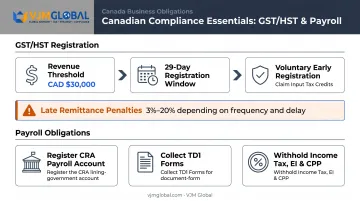
GST/HST registration is mandatory once your gross revenue reaches — or is expected to reach — CAD $30,000 in any four consecutive calendar quarters. Register within 29 days of exceeding the threshold — or voluntarily beforehand to claim input tax credits on business expenses. Missing the deadline triggers CRA penalties: 1% of the amount owing plus compounding monthly charges, with potential interest or prosecution for sustained non-compliance.
Payroll obligations apply the moment you hire. Register a payroll account with CRA before your first remittance due date, collect TD1 forms from all employees, and withhold income tax, Employment Insurance (EI), and Canada Pension Plan (CPP) contributions. Late payroll remittance penalties range from 3% to 20%, escalating for repeat or negligent failures.
For founders managing Canadian obligations alongside cross-border requirements — particularly those with Indian regulatory exposure — advisors experienced in both jurisdictions, such as VJM Global, help prevent the compounding penalties that result from gaps between two compliance regimes.
Step 6 – Build Operations and Plan for Hiring
Define exactly what your product or service includes — and what it doesn't. Ambiguous scope leads to rework, customer dissatisfaction, and margin erosion. Build simple, repeatable delivery processes before trying to scale.
Once your operations are documented, hiring introduces a separate layer of compliance. Canadian employment law requirements include:
- Payroll deductions and CRA remittances
- TD1 forms for each employee
- Compliance with provincial Employment Standards (minimum wage, overtime, statutory holidays, termination notice)
- Ontario's general minimum wage: CAD $17.60 (rising to $17.95 on October 1, 2026)
- B.C.'s minimum wage: CAD $18.25 per hour (as of June 1, 2026)
Federal labour standards apply only to federally regulated industries — for most businesses, provincial standards govern employment relationships.
Step 7 – Launch, Market, and Monitor Performance
Build a go-to-market plan before launch. Focus on:
- Credibility signals: reviews, certifications, clear pricing
- At least one or two active acquisition channels
- A simple method for tracking revenue, expenses, and invoicing delays
Your first tax return arrives faster than most new founders expect. Sole proprietors file a T1 (personal income tax return); corporations file a T2 within six months of their tax year end. Get familiar with CRA filing deadlines early — not after missing one.

Fix gaps before scaling. Inconsistent delivery, cash flow instability, and pricing that doesn't hold in the market are all signs that the business isn't ready to grow. Stabilize first.
Conclusion
Starting a business in Canada is achievable. The market is stable, the regulatory framework is navigable, and international founders have real pathways to ownership — particularly in Ontario and British Columbia.
What separates businesses that succeed from those that don't is execution on the basics: structure selection, registration, tax setup, and financial tracking done correctly from the start. Speed to launch matters far less than getting these foundations right.
For NRIs, Indian diaspora entrepreneurs, and multinationals with cross-border interests between Canada and India, the compliance picture gets more complex. Tax treaty implications, transfer pricing, FEMA obligations on the Indian side, and dual tax residency all add layers that require structured advisory support.
VJM Global works with clients navigating exactly this intersection — Canadian business operations with Indian regulatory obligations. If your setup spans both jurisdictions, getting the right advisory in place early is worth considerably more than correcting it later.
Frequently Asked Questions
How much does it cost to start a business in Canada?
Costs depend on your structure. A sole proprietorship costs CAD $60 in Ontario or about CAD $70 in B.C. Federal corporation incorporation runs CAD $200 online (plus CAD $100 for express service), while Ontario and B.C. provincial corporations cost CAD $300 and approximately CAD $380 respectively. First-year totals — covering accounting, licences, and tax filings — vary widely by industry and province.
Can a foreigner start a business in Canada?
Yes, but eligibility depends on immigration status. Permanent residents operate without restriction. Foreign nationals can incorporate in Ontario or British Columbia without a Canadian-resident director, making these the most accessible provinces for remote international founders. Federal incorporation under the CBCA requires at least 25% Canadian-resident directors in most cases.
What is the 90% rule in Canada?
The 90% test is a CRA rule used to determine whether a CCPC's income qualifies as active business income for the small business deduction. It applies in specific contexts involving specified corporate income and service-related restrictions. Confirm your eligibility with a qualified tax professional before relying on the small business deduction rate.
Do I need a Canadian resident director to incorporate in Canada?
Federal incorporation under the CBCA requires at least 25% resident Canadian directors (or one, if the board has fewer than four). Ontario and British Columbia are exceptions — both permit 100% foreign ownership with no Canadian-resident director required.
What is the difference between federal and provincial incorporation in Canada?
Federal incorporation protects your business name across Canada and suits businesses operating in multiple provinces. Provincial incorporation is jurisdiction-specific , and name protection applies only within that province. Note that federally incorporated companies still need to register in each province where they actively do business.
What taxes does a Canadian business need to pay?
Canadian businesses pay corporate income tax (or personal income tax for sole proprietors), GST/HST once revenue exceeds CAD $30,000, and payroll deductions (income tax, EI, CPP) for any employees. Eligible CCPCs pay 9% on qualifying active business income; the general federal rate is 15%, with provincial tax added on top.