Interest is coming from UK e-commerce sellers, SaaS founders, consultants, and exporters already shipping into the US market. This guide walks through the process step by step, flagging exactly where things get harder for someone applying from London rather than Salt Lake City: banking, EIN delays, and dual-country tax compliance.
Key Takeaways
- Non-US residents can own 100% of a Utah LLC or corporation with no visa or US visit required
- State filing costs just $59 as of July 2025, but agent fees and EIN delays add time and cost
- An LLC suits most UK solo founders; a C-Corp only makes sense if you're raising US venture capital
- The US-UK tax treaty prevents double taxation, but you still need professional structuring advice
- Budget 3-6 weeks from filing to being fully operational with an EIN and bank account
What Is Involved in Starting a Business in Utah as a Non-Resident?
Starting a Utah business as a non-resident means forming a legally recognised US entity (an LLC or corporation) in the state, while you remain in the UK and run operations remotely.
Non-residents can own the entire company without a US visa, green card, or physical presence in the state. You never need to set foot in Utah to form or operate the entity.
Two common paths exist:
- Form a standalone US entity from the outset if you're already committed to the US market
- Test the market first through exports or distributors, then incorporate once demand is proven
What UK Entrepreneurs Should Know Before Starting
Most UK founders underestimate how much friction remote setup adds. Time zones, IRS processes, and banking rules all move slower than they would domestically.
Here's what catches people out:
- Time zone gaps slow down communication with US agencies, banks, and registered agents
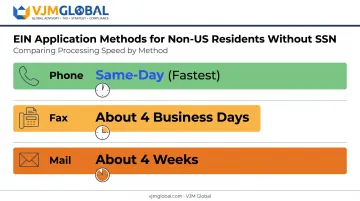
- EIN applications without an SSN must go by phone, fax, or mail rather than the instant online tool US residents use
- Bank account opening often needs extra documents; traditional banks may still want an in-person visit
- A Utah entity doesn't grant work authorisation. Operating hands-on inside the US still requires a visa
- E-commerce or remote service businesses face far fewer hurdles than businesses needing physical US premises
Remote Service vs Physical Presence
If you're selling digital products, SaaS, or consulting remotely, a Utah LLC handles this cleanly. If your model needs US-based staff, warehousing, or a storefront, you face a different compliance layer. Visas and local licensing sit outside entity formation altogether.
Why Utah Specifically?
Any US state can host an LLC, so why does Utah keep coming up for UK founders?
- Fastest-growing state economy: Utah led the US with 4.5% GDP growth in 2024, nearly double the national rate (BEA, 2025)
- Flat 4.50% tax rate: Applies to individuals and corporations in 2025, well below California's 8.84% corporate rate or New York's 6.50–7.25%
- Silicon Slopes ecosystem: A real tech and startup community UK SaaS and fintech founders can join for events, talent, and peer networks
- Straightforward filing: Online formation through the Utah Division of Corporations' UtahID portal
- No statewide general business licence: City or county licences may still apply depending on your activity
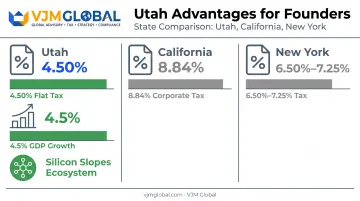
Tax rates above are for 2025. Utah legislation can change year to year, so confirm current rates before filing.
How to Start a Business in Utah from the UK – Step by Step
These steps follow the standard Utah formation process, with notes in each step on where the process differs for a UK-based, non-resident applicant.
Step 1 – Choose Your Business Structure
An LLC suits most UK solo founders and small teams. It offers pass-through taxation and minimal ongoing formality.
A C-Corp makes sense only if you're planning to raise US venture capital or issue stock to investors. The common mistake: choosing a C-Corp for a small, UK-run business without realising it creates double taxation exposure : profits taxed at the corporate level, then again when distributed to you personally.
Step 2 – Appoint a Utah Registered Agent
Every Utah entity needs a registered agent with a physical Utah address to receive legal notices. Since you have no local address, this is mandatory, not optional.
Most UK founders use a commercial registered agent service rather than trying to arrange a personal contact in Utah.
Step 3 – Reserve and Register Your Business Name
Search the Utah Division of Corporations database before filing to confirm your name is available. Utah requires specific suffixes (LLC, Inc.) and restricts certain words, such as "bank" or "insurance," without additional approval.
Name reservation costs $22 and is optional but worth doing if you're not filing immediately.
Step 4 – File Formation Documents
File your Certificate of Organization (LLC) or Articles of Incorporation (Corporation) with the Utah Division of Corporations.
| Filing | Fee |
|---|---|
| LLC Certificate of Organization | $59 |
| Corporation Articles of Incorporation | $59 |
| Expedited processing add-on | $75 |
The Division's current pages don't publish a guaranteed standard turnaround time, so treat any "5-day" promise you see elsewhere with caution.
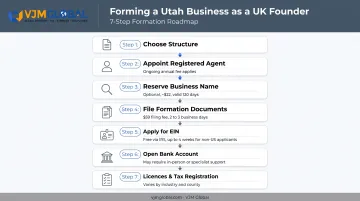
Step 5 – Apply for a Federal EIN as a Non-Resident
This is where UK founders lose the most time. Without an SSN or ITIN, you can't use the IRS's instant online EIN tool.
Your options:
- International phone line: call the IRS directly; an EIN can be issued on the same call
- Fax: roughly 4 business days if you include a return fax number
- Mail: around 4 weeks, and the IRS recommends applying 4–5 weeks ahead of when you need it
On the SS-4 form, write "foreign" on line 7b if the responsible party has no SSN or ITIN.
Step 6 – Open a US Business Bank Account Remotely
You'll typically need your certificate of formation, EIN, ownership details for anyone holding 25%+ of the business, and proof of address.
- Mercury accepts applications from non-US founders when the entity is US-formed with genuine US operations
- Wise Business supports non-US beneficial owners, but needs foreign photo ID and will not treat a registered agent address as your trading address
Neither guarantees zero in-person verification. Approval still depends on your specific business profile.
Step 7 – Licences, Permits, and Tax Registration
Utah has no statewide general business licence, but check your city or county . Many, like South Jordan, run their own licensing procedures.
If you're selling taxable goods or services, you'll need to register for Utah sales tax. Separately, the US-UK tax treaty generally protects business profits from double taxation if you do not create a "permanent establishment" in the US under Article 5 of the treaty.
Cross-Border Considerations: Banking, Taxes, and Compliance
Running a Utah entity from the UK means sorting banking access and obligations to two tax authorities. Costly mistakes often happen here.
Banking is usually the first operational hurdle. Most US banks want an EIN on file, and many still prefer a US person or in-person visit. UK founders often use remote-friendly business banks or fintechs that onboard non-resident owners once the entity and EIN exist.
On the UK side, HMRC will want visibility into US business income you own or control, alongside your normal Self Assessment or corporate filings if applicable.
On the US side, ongoing obligations include:
- Annual report renewal — $18 for LLCs and corporations, with a $10 late fee
- Registered agent renewal (a separate private cost, not a state fee)
- Sales or franchise tax filings if you have nexus in Utah or other states
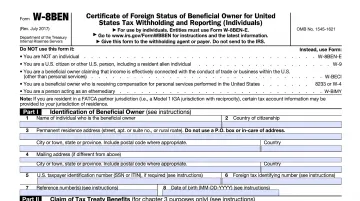
The W-8BEN form certifies your foreign status to US payers so you can claim treaty withholding benefits. You give it to the payer, not the IRS, and it usually stays valid through the third calendar year after signing.
Given how many moving parts sit across both jurisdictions, most UK founders find it worthwhile to bring in cross-border specialists rather than piecing this together alone. VJM Global works with entrepreneurs across 16+ markets, including the UK and US, supporting entity formation, EIN applications, and multi-jurisdiction tax filings without requiring travel or direct navigation of IRS processes.
Conclusion
Starting a Utah business from the UK is entirely achievable without relocating. Thousands of non-residents do it every year. Formation itself is rarely the hard part. EIN timelines, banking documentation, and layered US–UK compliance obligations are where most founders stall.
Getting your structure, registered agent, and tax position right from day one avoids expensive corrections later. Before you file anything, get cross-border guidance so your US and UK obligations line up from the start. VJM Global supports UK founders with Utah entity formation, tax positioning, and ongoing compliance so those pieces are set correctly the first time.
Frequently Asked Questions
How much does it cost to start a business in Utah?
As of July 2025, the state filing fee is $59 for both LLCs and corporations. Add registered agent fees (typically $100-$300 annually) and the $18 annual report fee for ongoing costs.
Does it cost money to start an LLC in Utah?
Yes. The Certificate of Organization costs $59 to file. You'll also pay an $18 annual report fee each year to keep the LLC in good standing.
How much does a business license cost in Utah?
There's no statewide general business licence fee. Costs vary by city or county, so check your specific local government's requirements before assuming a flat cost.
How do I register a foreign business in Utah?
If your entity already exists outside Utah and you're expanding into the state, file a Foreign Registration Statement through the UtahID portal for $59, whether it's an LLC or corporation.
What is required to start a business in Utah?
You'll need to choose a structure, appoint a Utah registered agent, file formation documents, obtain an EIN, and register for any applicable city or county licences and sales tax.
What is the most profitable business in Utah?
Tech (Silicon Slopes), outdoor recreation, and professional services are among Utah's strongest sectors, supported in part by the state's high GDP growth rate.