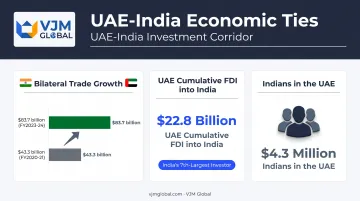
With over 4.3 million Indians living in the UAE and a trade relationship strengthened by CEPA, UAE-based promoters have both the capital and the on-ground familiarity to enter India's infrastructure boom. But moving from "I want to invest" to "I have a compliant, operating company" involves entity selection, RBI reporting, state-level licensing and cross-border tax planning.
This guide walks through each stage of that journey, from choosing between a private limited company, an LLP or a project office, to the FEMA and DTAA mechanics that determine how your profits eventually make it back to Dubai or Abu Dhabi.
Key Takeaways
- Enter via Private Limited, LLP, or Project/Branch Office — FDI and liability differ for each
- Construction-development activity permits 100% FDI under the automatic route, subject to sector conditions
- Registration runs through SPICe+, followed by GST, contractor licensing, and RERA where applicable
- The India-UAE DTAA caps dividend withholding tax at 10%, but requires a Tax Residency Certificate
- Budget incorporation, licensing, working capital, and compliance separately; they're rarely quoted together
Why UAE-Based Investors Are Choosing India's Construction Sector
This isn't a guaranteed win for every promoter. But under the right conditions, the numbers make a strong case.
India's urban push is real and well-funded. PM Gati Shakti alone represents a proposed ₹100 lakh crore national infrastructure plan, while PMAY-U 2.0 targets support for 10 million eligible urban families, backed by an estimated ₹2.30 lakh crore in government assistance.
Add the Smart Cities Mission's 100-city footprint, and you get sustained demand across housing, roads and urban infrastructure.
The UAE-India corridor makes accessing this demand easier than it looks:
- Bilateral merchandise trade under CEPA rose from $43.3 billion in FY2020-21 to $83.7 billion in FY2023-24, per government trade data
- UAE FDI into India totals $22.8 billion cumulatively through March 2025, making the UAE India's seventh-largest investor
- Diaspora familiarity helps UAE-based promoters read Indian regulations, use local contacts, and clear state-level bureaucracy faster than first-time foreign investors
Then there's the FDI policy itself. Construction-development activities (townships, housing, commercial premises, roads, bridges) qualify for 100% FDI under the automatic route, with no minimum land area or capitalisation threshold since 2015. That's a meaningfully open door compared to many other sectors.
The upside isn't limited to one-off contract income either. A construction entity with an active project pipeline builds recurring revenue and equity value in Indian real assets, not just service fees.
Choosing the Right Business Entry Route From the UAE
Most early friction in these deals comes from picking the wrong entity for a cross-border promoter's specific goals.
Private Limited Company (Wholly Owned Subsidiary)
This is the default choice for promoters who want full ownership, limited liability, and eligibility to bid on larger private or government contracts. You'll need:
- An Indian registered office
- At least one director who is resident in India for 182 days in the financial year
- Compliance with Companies Act, FEMA and standard FDI reporting
It's the heaviest compliance load of the three routes, but also the most credible structure when tendering for sizable projects.
Limited Liability Partnership (LLP)
An LLP suits smaller UAE-India ventures wanting lighter compliance than a private limited company. It needs at least two partners, one of whom must be India-resident, with partner rights flexibly defined through the LLP agreement.
Automatic-route FDI into an LLP is only available where the sector permits 100% automatic FDI with no FDI-linked performance conditions. Construction-development carries sector-specific conditions.
Confirm LLP eligibility for foreign investment with an AD bank or FEMA advisor before you commit capital. Don't assume automatic-route access just because the sector cap is 100%.
Project Office
If your UAE parent has landed a single, defined Indian construction contract and does not want a new Indian company, a Project Office is the more direct route (a Branch Office is a separate option for ongoing presence, not a one-off project). It requires:
- RBI approval (though general permission applies if the project is funded by inward remittance, a multilateral/bilateral agency, or a term loan from an Indian bank/public financial institution)
- Registration with the Registrar of Companies
- A defined project timeframe — this isn't a permanent presence
| Factor | Pvt Ltd | LLP | Project Office |
|---|---|---|---|
| Ownership | Up to 100% | Up to 100%, conditions apply | N/A — extension of parent |
| Liability | Limited to shareholding | Limited to contribution | Parent bears liability |
| Compliance load | Highest | Moderate | Lower, project-bound |
| Best for | Large/government contracts | Smaller ventures | Single defined contract |
Eligibility still hinges on whether your specific activity qualifies for automatic-route FDI. Firms such as VJM Global usually settle that question first, then recommend a structure—rather than defaulting to a subsidiary because it looks like the obvious choice.
Step-by-Step Process to Register Your Construction Company in India
Once you've settled on a structure, the incorporation journey follows a fairly fixed sequence. UAE-based promoters hit two friction points more often than resident founders: FEMA/RBI reporting deadlines, and underestimating how long UAE document authentication takes.
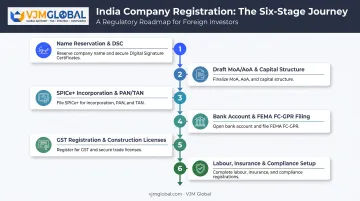
Reserve your name and obtain Digital Signature Certificates. Name reservation runs through the MCA21/SPICe+ portal. UAE-based directors need notarised or consular-attested documents from the UAE. The UAE is not a signatory to the Apostille Convention, so apostille alone won't work—use UAE Ministry of Foreign Affairs attestation or the relevant Indian mission instead.
Draft the MoA/AoA and finalise your capital structure. Define the specific construction activities, share capital, and how FDI will flow in. Align this with the FC-GPR filing you'll make once funds arrive.
Incorporate via SPICe+ and obtain PAN/TAN. This single web-based filing secures your Certificate of Incorporation, DIN, PAN and TAN together. MCA figures put average business-start time at around 4 days once documentation is in order, though resubmission queries can extend real-world timelines.
Open an Indian bank account and complete FEMA reporting. Once inward remittance from the UAE lands, report the equity issuance on Form FC-GPR within 30 days of the share allotment date. Missing this window is a common, avoidable compliance slip.
Register for GST and apply for construction-specific licenses. Typical requirements include:
- GST registration
- Relevant state contractor license
- RERA registration for real estate or housing development
- Environmental clearance for larger projects
Set up labour, insurance and ongoing compliance systems. Register with EPFO/ESIC if hiring locally (EPF generally kicks in at 20 employees; ESI thresholds vary by establishment type). Arrange liability and workers' compensation cover, and build a compliance calendar for RoC filings, GST returns and license renewals.
Licenses, Permits & Sector-Specific Compliance
Incorporation is only step one. Construction is one of the more license-heavy sectors in India, and requirements shift by state and project type.
Beyond RoC registration, expect to deal with:
- Contractor licenses — not standardised nationally; states set their own classes (e.g. Assam PWD Class I(A), II and III). Confirm the target state's scheme before bidding
- Municipal building permits — local approvals required for any physical construction
- RERA registration — mandatory before advertising, marketing or booking any unit (exemption: land under 500 sq m or projects of 8 apartments or fewer)
- Environmental clearance — larger builds (about 20,000–150,000 sq m built-up) generally need EIA Notification 2006 review
Skipping environmental clearance where it applies is one of the costliest timeline risks in this sector. Projects have been halted mid-construction over exactly this oversight. Verify local bylaws and clearance thresholds with your state authority before committing to a bid, not after.
Taxation, FEMA & Repatriation Considerations for UAE Investors
Setting up the company is one challenge. Getting profits back to the UAE compliantly is another, and it involves both India's domestic tax regime and outbound FEMA rules simultaneously.
On the tax side:
- Domestic companies pay corporate tax at 25% or 30% by turnover, or 25.168% under Section 115BAA (22% base plus surcharge and cess)
- GST on construction services is generally 18% (9% CGST + 9% SGST) for residual works contracts; affordable housing and some categories differ
- These rates apply regardless of the promoter's country of origin; UAE residence does not change the domestic tax math
On the treaty side, the India-UAE DTAA caps withholding tax on dividends at 10% of the gross amount for a UAE beneficial owner. Interest is capped at 5% or 12.5%, depending on the lender type.
To claim treaty rates, you need a Tax Residency Certificate issued in the UAE, plus Form 10F where the TRC does not cover all prescribed details.
On repatriation, dividends can generally move out through an authorised dealer bank once tax is deducted and documentation is in place. Capital transactions (exiting an investment or transferring shares) must fit FEMA's general permission framework, or they need specific RBI approval.
This is two-sided compliance work: Indian entity-level filings on one end, UAE-side TRC and structuring decisions on the other. VJM Global runs advisory teams on both sides of the corridor as one workflow—from FC-GPR at entry to DTAA-optimised dividend structuring at exit—rather than treating India compliance and UAE tax planning as separate projects.

Frequently Asked Questions
How do I start my own construction company in India?
Choose your entity type (Pvt Ltd, LLP, or Project Office) and incorporate through the RoC via SPICe+. Obtain PAN, TAN and GST registration, then secure construction-specific licences such as your contractor licence and RERA registration before bidding on projects.
How much money is needed to start a construction company in India?
Capital needs vary widely based on project scale and entity type, covering incorporation costs, state licensing fees, and working capital for materials and labour. Get a professional cost estimate specific to your project type rather than relying on generic figures.
Can UAE promoters also hold a UAE entity while setting up in India?
Yes. Many UAE-based promoters keep or form a mainland LLC or free-zone entity (for example DMCC, JAFZA or DIFC) as a holding or contracting vehicle, then invest into the Indian company under the applicable FDI route.
Does India allow 100% FDI in the construction sector?
Construction-development activities like townships, housing and commercial premises are generally permitted 100% FDI under the automatic route, subject to sector conditions on phased development and local approvals. Always verify current thresholds before finalising your capital structure.
Is there a tax treaty between India and UAE that benefits investors?
Yes, the India-UAE DTAA caps withholding tax on dividends at 10% and interest at 5-12.5% for eligible UAE residents. You'll need a Tax Residency Certificate from UAE authorities to claim these reduced rates.
How long does it take to register a construction company in India from the UAE?
Private limited company incorporation typically takes around 13 days once documents are ready. UAE-based promoters should budget extra time for notarisation and consular attestation, since the UAE is not part of the Apostille Convention.