
Setting up a legally compliant business in India from the UAE is entirely achievable without relocating. The process is governed by India's FDI policy, FEMA, and the Companies Act 2013 — and for most sectors, UAE investors can own 100% of an Indian company without any prior government approval.
This guide is written for NRIs, Overseas Citizens of India (OCIs), UAE-registered companies, and Indian-origin founders based in the UAE. It covers structure selection, step-by-step registration, FEMA compliance, tax treaty benefits, and the mistakes that cost investors time and money.
Key Takeaways
- UAE investors can own 100% of an Indian company in most sectors under the automatic FDI route
- A Private Limited Company (wholly owned subsidiary) is the right structure for most UAE investors
- FC-GPR filing with the RBI is mandatory within 30 days of share allotment; missing the deadline triggers a costly compounding application
- UAE documents require legalisation/attestation before submission to Indian authorities
- The India-UAE DTAA (in force since 1993) caps dividend withholding at 10%, though a valid TRC and Form 10F are required each year to claim the benefit
Why UAE-Based Investors Are Choosing India for Business Setup
The India-UAE corridor has become one of the most active bilateral trade relationships globally. According to the Indian Embassy in the UAE, bilateral trade reached US$101.25 billion in FY2025-26, and cumulative UAE FDI into India has hit US$25.59 billion from April 2000 through March 2026 — making the UAE India's seventh-largest overseas investor.
A key driver of this growth is the India-UAE Comprehensive Economic Partnership Agreement (CEPA), signed in February 2022 and in force from May 2022. PIB data shows merchandise trade nearly doubled — from US$43.3 billion in FY2020-21 to US$83.7 billion in FY2023-24 — in the years immediately following CEPA implementation.
Three Reasons India Appeals to UAE Investors
- Market scale: 1.4 billion consumers across a rapidly growing middle class
- Talent depth: Engineering, tech, and professional services talent at significantly lower cost than most Western markets — increasingly used by UAE companies as an offshore delivery hub
- CEPA-linked advantages: Tariff reductions on qualifying goods make India attractive as a manufacturing or services hub for companies serving regional and global markets

The NRI/OCI Factor
A significant share of UAE businesses are owned or co-founded by Indian-origin individuals. For these founders, setting up in India combines market access with personal ties. From an FDI policy standpoint, NRI-owned foreign entities receive the same treatment as any other foreign investor — they follow the same automatic approval route and are subject to the same sectoral ownership limits.
Business Structures Available to UAE Investors in India
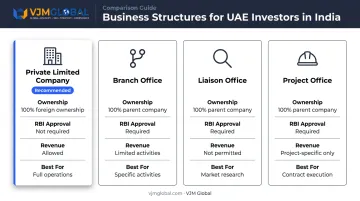
Choosing the wrong structure has real consequences : it affects tax exposure, compliance burden, and how freely you can repatriate profits. Four main options exist, and the right one depends on your intended activity and profit repatriation goals.
Private Limited Company (Wholly Owned Subsidiary)
This is the right choice for most UAE investors. A Private Limited Company is a separate legal entity that can hire staff, hold assets, sign contracts, and pay dividends to the UAE parent under RBI guidelines. It allows 100% foreign ownership in most sectors under the automatic FDI route and carries the lowest ongoing compliance burden relative to its operational flexibility.
If you plan to run operations, employ staff, or generate revenue in India, this structure fits.
Branch Office
A Branch Office is an extension of the foreign parent, not a separate legal entity. It requires prior RBI approval and is restricted in what it can do : manufacturing and retail are both prohibited. Compliance requirements are heavier than a subsidiary, and for most UAE businesses, a Branch Office adds regulatory complexity without meaningful operational benefit. It's rarely the right choice.
Liaison Office and Project Office
These are niche structures for specific situations:
- Liaison Office: For market research and representation only. Cannot earn revenue in India. Suitable for companies testing the market before committing to a full setup
- Project Office: For UAE companies executing a specific Indian contract — common in construction and EPC sectors. Must be wound up once the project ends
Both require RBI approval and are unsuitable as long-term business structures.
Here's a quick comparison across all four structures:
| Structure | Foreign Ownership | RBI Approval | Revenue Allowed | Best For |
|---|---|---|---|---|
| Private Limited Company | Up to 100% (auto route) | Not required (most sectors) | Yes | Ongoing commercial operations |
| Branch Office | 100% (parent entity) | Required | Limited (no manufacturing/retail) | Established foreign companies with specific activities |
| Liaison Office | 100% (parent entity) | Required | No | Market research, pre-entry exploration |
| Project Office | 100% (parent entity) | Required | Project-specific only | Single-contract execution (construction, EPC) |
Choosing the wrong structure at the outset has downstream tax and compliance consequences that are expensive to correct. VJM Global's business setup team (with 30+ years of experience supporting foreign and NRI-based investors entering India) advises UAE investors on structure selection before a single form is filed. Correcting a wrong structure after incorporation typically means dissolving the entity, refiling, and managing any tax exposure created in the interim.
Step-by-Step: How to Register Your Business in India from the UAE
The full process from structure decision to first hire typically takes 8–14 weeks. MCA incorporation itself can move faster — PIB confirms SPICe+ reduced company starting time to 4 days from 18 days for straightforward applications — but banking, GST, and RBI filings add time.
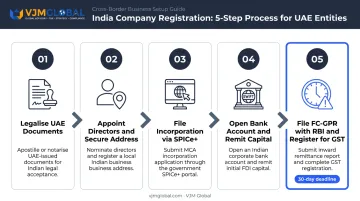
Here's the end-to-end sequence:
Step 1: Prepare and Legalise UAE Documents
The UAE parent entity must provide the following documents for submission to Indian authorities:
- Certificate of Incorporation
- Memorandum and Articles of Association
- Board Resolution authorising the Indian subsidiary setup
- Proof of registered address
These documents require attestation through UAE Ministry of Foreign Affairs, followed by the Indian Embassy or Consulate where required. Errors at this stage can invalidate downstream filings, so verify current authentication requirements with an advisor before submitting.
Step 2: Appoint Directors and Secure a Registered Office Address
A Private Limited Company needs at least two directors. Under Section 149(3) of the Companies Act 2013, at least one must have stayed in India for 182 days during the financial year.
Each director needs:
- A Digital Signature Certificate (DSC) (required for all MCA e-filings)
- A Director Identification Number (DIN) (a unique lifetime identifier from MCA)
For the registered address: a virtual office works for incorporation, but GST registration generally requires a physical address.
Step 3: File Incorporation via SPICe+ on the MCA Portal
Incorporation is filed through the MCA portal using the SPICe+ form, which bundles 10 integrated services into a single application: company incorporation, DIN allotment, PAN, TAN, EPFO, ESIC, and others. Have DSCs for all directors ready before starting — the portal requires them to authenticate the filing.
Step 4: Open a Bank Account and Remit Capital from UAE
After receiving the Certificate of Incorporation, open an Indian corporate bank account. The bank will typically require:
- Trade licence or incorporation certificate
- MOA/AOA
- Passport copies of directors and shareholders
- A business plan
Once the account is open, transfer share capital from the UAE parent via SWIFT.
Step 5: File FC-GPR with RBI and Register for GST
This is where many UAE investors run into trouble.
FC-GPR filing: Within 30 days of the Indian company allotting shares to the UAE entity, an FC-GPR (Foreign Currency Gross Provisional Return) must be filed with the RBI through the FIRMS portal. Missing this deadline triggers a compounding application to the RBI, which is both costly and slow.
GST registration: Mandatory once annual turnover exceeds INR 20 lakh. Indian subsidiaries invoicing the UAE parent for services qualify as zero-rated exports under Section 16 of the IGST Act (not standard-rated supplies). Getting this classification right from day one affects both cash flow and compliance exposure.
FEMA, FDI Rules, and the India-UAE DTAA: What UAE Investors Must Know
FDI Policy Essentials
Most sectors allow 100% FDI under the automatic route — no prior government approval needed. Sectors requiring government approval include multi-brand retail, brownfield pharma above the automatic cap, print/news media, and public sector banking.
One important point for UAE investors: the Press Note 3 land-border restriction (which requires government-route approval) applies to countries sharing a land border with India — Bangladesh, Pakistan, China, Nepal, Myanmar, Bhutan, and Afghanistan. The UAE is not on this list. UAE-origin investment is not subject to Press Note 3 simply because it originates from the UAE. However, if the beneficial owner of the UAE entity is from a land-border country, that restriction still applies.
Share Valuation Requirement
When the UAE parent subscribes to shares in the Indian subsidiary, the issue price must meet or exceed fair market value determined by a SEBI-registered merchant banker or Chartered Accountant using an RBI-recognised methodology. This rule exists to prevent capital from leaving India at below-market prices.
Annual FLA Return
Every Indian company with outstanding foreign investment must file a Foreign Liabilities and Assets (FLA) Return with the RBI by 15 July each year. Key points to keep in mind:
- Deadline: 15 July each year, without exception
- Consequence: Missing the deadline attracts RBI penalties
India-UAE DTAA Benefits
The India-UAE DTAA, in force since September 1993, reduces withholding tax rates on payments from the Indian subsidiary to the UAE parent:
| Payment Type | Treaty Rate |
|---|---|
| Dividends | 10% of gross amount |
| Interest (bank/financial institution) | 5% of gross amount |
| Interest (other cases) | 12.5% of gross amount |
| Royalties | 10% of gross amount |
To claim these reduced rates, the UAE parent must furnish a valid Tax Residency Certificate (TRC) and Form 10F to the Indian subsidiary each year treaty relief is claimed. Without these documents, the Indian company must deduct withholding tax at the higher domestic rate.
The India-UAE DTAA contains no separate article on Fees for Technical Services. In practice, this means such payments typically fall under the Business Income article and are taxable in India only if the UAE entity has a Permanent Establishment here — a structuring consideration worth addressing early.
Permanent Establishment Risk
If UAE parent employees habitually operate in India or conclude contracts on the UAE entity's behalf, this creates a Permanent Establishment (PE) in India, exposing UAE-entity profits to Indian corporate tax. DTAA Article 5 defines PE broadly, including a dependent-agent PE where someone habitually exercises authority to conclude contracts for the foreign enterprise.
Managing this risk requires deliberate structuring:
- Draft clear service agreements between parent and subsidiary
- Define and document each party's scope of authority
- Maintain consistent records showing where key decisions are made

Common Mistakes UAE-Based Entrepreneurs Make When Setting Up in India
Getting the setup right matters. These are the most frequent and costly errors:
Document legalisation confusion: Using the wrong attestation process for UAE corporate documents delays incorporation and can require starting the authentication process again. Work with advisors who know the current UAE-to-India document requirements.
Missing the FC-GPR deadline: The 30-day window from share allotment is absolute. This is the single most commonly missed compliance milestone in UAE-to-India setups. Missing it requires a compounding application to the RBI — a process that adds cost, delays operations, and draws regulatory attention.
GST classification errors: Indian subsidiaries providing services to their UAE parent frequently charge 18% GST when the supply qualifies as a zero-rated export under IGST. Under Section 2(6) of the IGST Act, three conditions must all be met:
- Payment must be received in convertible foreign exchange
- The place of supply must be outside India
- The supplier and recipient must not be establishments of a distinct person
Getting this wrong from the start creates cash flow problems and a costly remediation process.
Ignoring transfer pricing from day one: Any inter-company transactions between the UAE parent and the Indian subsidiary are subject to Indian transfer pricing rules. Once aggregate transactions exceed INR 1 crore, full Rule 10D documentation must be maintained. Even below that threshold, the pricing must be defensible at arm's length.
All four mistakes are avoidable with the right advisory support from the outset. VJM Global works with foreign companies, NRIs, and OCI investors on UAE-to-India entry — covering FEMA compliance, FDI filings, GST structuring, and transfer pricing documentation. The team of 100+ professionals brings 30+ years of cross-border experience to each engagement.
Frequently Asked Questions
Can a NRI start a business in India?
Yes. NRIs can establish a business in India either by meeting the 182-day residency threshold or as a foreign investor through the FDI route. India treats NRI-owned foreign entities the same as other foreign investors under FDI rules, with 100% ownership permitted in most sectors under the automatic route.
How do you start a business with a small budget in India?
There is no minimum capital requirement for a Private Limited Company, but any FDI from the UAE must be remitted through proper banking channels at fair market value. For very small local ventures, a sole proprietorship carries far less regulatory overhead and is the lightest-cost starting point.
What is the best business structure for a UAE company entering India?
For most UAE companies, a Private Limited Company (wholly owned subsidiary) is the right choice — it offers full operational flexibility, 100% foreign ownership in most sectors, and allows profit repatriation to the UAE parent. Branch Offices and Liaison Offices are appropriate only for narrow, specific use cases.
Do I need to travel to India to register a company from the UAE?
Most of the process — MCA filings, SPICe+ submission — can be handled remotely, but at least one director must satisfy India's 182-day residency requirement. Opening a bank account may still require an in-person visit depending on the bank's KYC policy.
What is the India-UAE DTAA and how does it benefit UAE investors?
The India-UAE Double Tax Avoidance Agreement (active since 1993) caps withholding tax on dividends at 10% and on interest at 5% for bank loans or 12.5% for other cases. To claim these rates, the UAE entity must submit a valid Tax Residency Certificate and Form 10F to the Indian company annually.
What ongoing compliance applies after registering from the UAE?
Core annual obligations include GST filings (monthly or quarterly), TDS returns, ROC annual filings, statutory audit, corporate income tax return, and the FLA Return with the RBI by 15 July. Transfer pricing documentation under Rule 10D applies when inter-company transactions exceed INR 1 crore; the Section 92E report is required for all international transactions regardless of value.