A PLC comes with stricter statutory requirements than a Private Limited Company: more shareholders, more directors, and public accountability obligations. For UAE-based applicants, success depends heavily on how well-prepared your documents are, how they're authenticated, and which FDI route applies to your sector.
This guide walks through eligibility, the exact registration steps, UAE-specific FEMA and FDI compliance, the documents you'll need, and the mistakes UAE entrepreneurs most often make along the way.
Key Takeaways
- A PLC needs 7 shareholders and 3 directors minimum, with one director meeting India's 182-day residency rule
- UAE promoters can hold up to 100% equity in most sectors under the FDI Automatic Route
- Register remotely via MCA's SPICe+ form; UAE documents need notarisation and Indian consular attestation, not apostille
- File Form FC-GPR within 30 days of allotment and the Annual FLA Return by 15 July once UAE shareholding exists
- Most operational entrants are better served by a Private Limited subsidiary than a PLC
How to Register a Public Limited Company in India from the UAE
Step 1: Confirm Eligibility and Choose the Right Structure
Before filing anything, check whether a PLC actually fits your plans. You'll need:
- 7 or more shareholders (versus 2 for a Private Limited Company)
- 3 or more directors (versus 2 for a Private Limited Company)
- Paid-up capital "as may be prescribed": no fixed statutory floor, though most PLCs capitalise at levels banks and regulators expect
Next, confirm your sector sits under the FDI Automatic Route. According to DPIIT's Consolidated FDI Policy, most sectors allow up to 100% foreign ownership without prior government approval. A handful of sectors (private banking, certain financial services, and a few regulated categories) require government-route approval instead.
One point that works in your favour: the UAE doesn't share a land border with India. That means Press Note 3 (2020) restrictions, which force a government-approval route for investors from bordering countries like China or Pakistan, don't apply to you by default. Just be sure no beneficial owner in your ownership chain sits in a bordering country.
Step 2: Obtain Digital Signature Certificates (DSC) and Director Identification Numbers (DIN)
Every proposed director — including those based in the UAE — needs a DSC and a DIN before SPICe+ can be filed.
- DSC applications require a photograph, address proof, and PAN (or passport, for foreign nationals)
- DIN is allotted directly through SPICe+ Part B for first-time directors
- At least one director must satisfy the 182-day India residency test under Section 149(3) — this is a stay requirement, not a citizenship requirement
Here's where UAE applicants often trip up: passport copies and address proof issued in the UAE cannot simply be apostilled. The UAE hasn't acceded to the Hague Apostille Convention, so these documents need notarisation followed by authentication from the Indian Embassy or Consulate in the UAE.
Firms like VJM Global typically coordinate this attestation sequence alongside the DSC application so directors aren't stuck waiting on paperwork.
Step 3: Reserve the Company Name and Draft the MOA and AOA
Name reservation happens through SPICe+ Part A. The name must comply with MCA naming guidelines and carry the "Limited" suffix required for a public company.
Once reserved, you'll draft two founding documents:
- Memorandum of Association (MOA): defines the company's objects and scope of business
- Articles of Association (AOA): sets out PLC-specific governance rules, including director rotation and rules on share transferability
These aren't boilerplate. A PLC's AOA needs provisions a Private Limited Company's articles simply don't require, particularly around public shareholding and director rotation at annual general meetings.
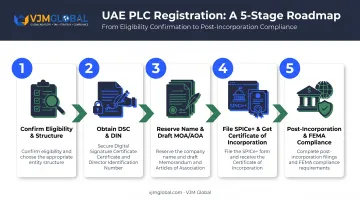
Step 4: File SPICe+ with the MCA and Obtain the Certificate of Incorporation
SPICe+ Part B is filed together with linked forms — e-MOA, e-AOA, and AGILE-PRO-S — covering incorporation, PAN, TAN, and (optionally) GST registration in one submission.
For UAE shareholders, you'll also submit:
- Certificate of Incorporation of the UAE entity (where a corporate shareholder is subscribing)
- Board Resolution authorising the India investment
- Constitutional documents of the UAE company
All of these need the notarisation-plus-consular-attestation treatment described above, not an apostille stamp.
On timelines: there's no official MCA-published average for Certificate of Incorporation issuance. Based on VJM Global's own client experience, though, once documentation is complete and correctly filed, the typical sequence runs roughly:
| Stage | Typical duration |
|---|---|
| DSC issuance | ~2 days |
| DIN allotment | ~1–2 days |
| Name approval | ~5 days |
| ROC review and Certificate of Incorporation | ~5 days |
For UAE clients, the real variable sits upstream: notarisation and consular attestation can add days or weeks depending on embassy appointment availability.
Step 5: Complete Post-Incorporation and FEMA Compliance
Incorporation isn't the finish line. Once the Certificate of Incorporation and CIN are issued:
- Open an Indian corporate bank account and remit share capital via SWIFT from the UAE
- Allot shares formally to the UAE shareholder(s) and record it in the statutory registers
- File Form FC-GPR with the RBI within 30 days of allotment through the FIRMS portal
- Apply for the Certificate of Commencement of Business, where applicable to your sector
- Register for GST, Professional Tax, and PF/ESI before your first employee joins
Miss the FC-GPR deadline and you're no longer filing a routine form — you're applying for a late-submission fee waiver or, worse, a compounding application. More on that below.
Eligibility Criteria and Documents You Need Before Registering
Document readiness is the single biggest variable affecting the timeline for UAE-based applicants, more so than for promoters already operating in India.
Minimum requirements snapshot:
- 7 or more shareholders
- 3 or more directors (one meeting the 182-day India residency test)
- No fixed statutory minimum paid-up capital (the old ₹5 lakh requirement was removed by the 2015 Companies Act amendment)
- A registered office address in India — a virtual or commercial address is acceptable at incorporation stage
Identity and address proof for UAE-resident directors and shareholders:
- Valid passport — the only accepted ID proof for foreign nationals
- UAE address proof not older than one year
- Both documents notarised and authenticated by the Indian Embassy/Consulate in the UAE (not apostilled)
If the UAE shareholder is a corporate entity, you'll additionally need:
- Certificate of Incorporation of the UAE company
- MOA/AOA of the UAE entity
- Board Resolution authorising the India investment
- A separately obtained PAN for the foreign entity in India
Registered office proof (address evidence must be no more than two months old):
- NOC from the property owner
- Utility bill or similar address evidence
- Property tax receipts can support ownership but are not held to the two-month rule
Whether your UAE shareholder is a mainland DED-licensed entity, a free zone company (DMCC, JAFZA, or DIFC), or an offshore structure, the corporate documents you need will differ. VJM Global can map the right checklist to your specific UAE structure before you collect paperwork.
Key Compliance Considerations for UAE-Based Promoters and Directors
Compliance for a UAE-invested PLC doesn't stop at incorporation. It continues under FEMA and the India-UAE DTAA for as long as the shareholding exists.
FDI Automatic Route and Sectoral Caps
Confirm whether your investment needs prior RBI or government approval before shares can be issued. Misclassifying your sector, even by a narrow NIC code reading, can delay share allotment or push the investment into the Approval Route and add months to your timeline.
FC-GPR Filing and Annual FLA Return
These mandatory RBI filings report UAE-origin investment into your Indian PLC.
Miss the 30-day FC-GPR deadline and you face a late-submission fee. RBI's 2022 circular sets this at:
- ₹7,500 base fee
- Plus 0.025% of the investment amount per year of delay
- Available for up to three years
Beyond that window, the default becomes a formal compounding application. FEMA Section 13 penalties can run up to three times the quantifiable amount (or ₹2 lakh where it isn't quantifiable), plus ₹5,000 for each day the default continues.
The Annual FLA Return is due by 15 July. There is no monetary threshold: if you have any outstanding foreign liability at year-end, you file. A flat ₹7,500 late fee applies if you miss the date.
India-UAE DTAA Benefits
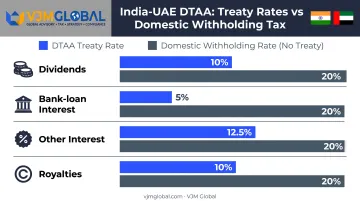
The treaty caps withholding tax on dividends, interest, and royalties repatriated to UAE shareholders well below India's domestic rate.
Treaty rates versus the 20% domestic baseline under Section 115A:
- Dividends: 10%
- Bank-loan interest: 5%
- Other interest: 12.5%
- Royalties: 10%
You only get these rates with a valid UAE Tax Residency Certificate and Form 10F, both renewed annually. VJM Global's international tax team helps individual NRI clients and UAE corporate entities secure these documents each year.
Transfer Pricing on Related-Party Transactions
Transactions between your Indian PLC and its UAE parent or shareholders must be priced at arm's length under Section 92 of the Income Tax Act.
Form 3CEB is mandatory for every international related-party transaction, regardless of size. There is no exemption threshold. The commonly cited ₹1 crore figure only relates to lighter documentation under Rule 10D, not an exemption from filing 3CEB itself.
Public Limited Company vs Private Limited Company: Which Should You Choose From the UAE?
A PLC isn't the safer or default choice. Most UAE companies entering India purely for operations do better with a Private Limited subsidiary.
| Factor | Public Limited Company | Private Limited Company |
|---|---|---|
| Minimum shareholders | 7 | 2 |
| Minimum directors | 3 | 2 |
| Can raise capital from the public | Yes, via prospectus | No — articles prohibit public subscription |
| Director rotation | Required | Not required |
| Ongoing compliance load | Higher | Lower |
A PLC makes sense when:
- You're planning a future IPO
- You need to raise capital from the Indian investing public
- You're entering a regulated, large-scale sector that requires public shareholding
A Private Limited Company fits better when:
- Your UAE parent wants a wholly-owned operating subsidiary
- You want faster setup with fewer members and directors
- You have no interest in public subscriptions or director rotation
Common Mistakes UAE Entrepreneurs Make When Registering a PLC in India
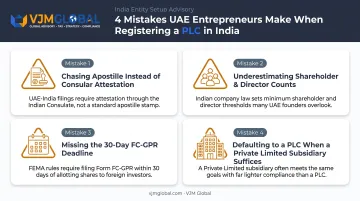
Four missteps delay UAE founders more than any other part of the India PLC process. Avoid them early and you protect both timeline and cost.
- Chasing apostille instead of consular attestation. The UAE is not party to the Hague Apostille Convention, so UAE documents need notarisation plus Indian Embassy or Consulate authentication, not an apostille. Wrong stamping can cost weeks on rejected filings.
- Underestimating shareholder and director counts. A qualifying India-resident director (182-day test under Section 149(3)) is a frequent late-stage bottleneck. Nominee director arrangements through firms such as VJM Global close this gap before incorporation stalls.
- Missing the 30-day FC-GPR deadline. After the window closes, the filing is no longer routine: you face late fees or, in worse cases, an RBI compounding application.
- Defaulting to a PLC when a Private Limited subsidiary would suffice. Many UAE promoters pick a PLC by assumption, then carry heavier compliance for years without needing public shareholding. Flag the entity choice before incorporation, not after.
Frequently Asked Questions
Can a UAE company or individual own 100% of a Public Limited Company in India?
Yes, most sectors permit 100% foreign ownership under the FDI Automatic Route, with no requirement for an Indian co-owner. You'll still need at least one India-resident director on the board.
What is the minimum share capital required to register a Public Limited Company in India?
There's no fixed statutory minimum anymore. The earlier ₹5 lakh requirement was removed in 2015; capital is now "as may be prescribed," though PLCs typically capitalise higher given their scale.
Do all directors and shareholders need to be Indian residents?
No. Only one director must meet the 182-day India residency test under Section 149(3). All other directors and every shareholder can be based in the UAE.
How long does it take to register a Public Limited Company in India from the UAE?
DSC and DIN typically take a few days each, name approval around 5 days, and ROC review another 5 days once documentation is complete. The real variable is notarisation and consular attestation of UAE documents, which can add extra weeks.
What is the difference between registering a Private Limited Company and a Public Limited Company from the UAE?
A PLC needs 7 shareholders and 3 directors and can raise capital from the public; a Private Limited Company needs only 2 of each and cannot invite public subscription. Private Limited setup is faster and carries lower ongoing compliance costs.
Do UAE documents need to be apostilled for Indian company registration?
No. The UAE hasn't joined the Hague Apostille Convention. UAE-issued documents need notarisation followed by authentication from the Indian Embassy or Consulate in the UAE before they're used for DSC, DIN, or SPICe+ filings.