Introduction
The pound has had a strong run against the dollar lately, and UK wedding and editorial clients are increasingly open to hiring photographers from outside Britain. For American photographers with an established US portfolio, that combination makes the UK a genuinely viable second market.
Photographers exploring this path usually fall into one of three groups:
- Hobbyists ready to go pro
- US studio owners expanding internationally
- Digital nomads who want a UK-registered company while living elsewhere
The hard part is not demand. It is UK company formation, visas, tax residency, and banking rules that do not map to a typical US "start a photography business" guide. This article covers exactly what a US citizen needs to know before launching in the UK.
Key Takeaways
- Owning a UK company and physically working in the UK are two separate legal questions
- Most non-resident founders register a UK Limited Company, not a sole trader setup
- US owners face dual compliance: UK filings plus US worldwide income reporting under FBAR/FATCA
- Full setup (incorporation, banking, first bookings) takes longer than a UK-only launch
- Pricing and positioning must reflect UK market rates, not converted US figures
Can You Legally Start a Photography Business in the UK as a US Citizen? (Visa & Legal Status)
Here's the misconception that trips up almost every American exploring this: forming a UK Limited Company does not grant you the right to live or work in the UK. These are two completely separate legal processes, and they need separate plans from day one.
Running the Business Remotely vs. Shooting on UK Soil
Incorporating as a foreign director is straightforward. You don't need a visa to own a UK company if you're not physically operating there. Editing, invoicing, and marketing your business from a laptop in New York or Austin is fine.
The moment you fly to the UK to shoot a wedding or a commercial job, that's paid work activity, and it changes everything. A Standard Visitor visa does not permit paid or unpaid work for a UK business, self-employed or otherwise.
There's one narrow exception worth knowing: a permitted paid engagement, which explicitly covers professional artists including photographers. It requires a written UK invitation and proof of relevant expertise, and the paid work must fall within the first month of a visit (visits can last up to six months).
Visa Routes Worth Researching
For photographers planning regular, ongoing UK shoots rather than a one-off engagement, a few routes are worth researching:
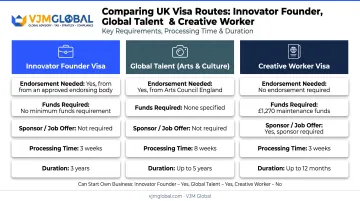
- Innovator Founder visa - for innovative, scalable businesses; needs an endorsement plus at least £1,270 held for 28 days. Lasts three years; decisions take three weeks outside the UK or eight weeks inside
- Global Talent (arts and culture) - for leaders in visual arts; usually needs an endorsement unless you hold a qualifying prize
- Creative Worker visa - needs a licensed sponsor and job offer; does not allow you to start your own business
None of these are quick weekend applications. Budget weeks, not days, and treat the visa question as a distinct project from your company registration.
How to Register and Structure Your UK Photography Business
Most non-resident founders skip sole trader status entirely and register a Private Limited Company (Ltd). There's a practical reason: sole trader status ties your personal and business finances together, and doing that across two tax jurisdictions creates a mess nobody wants to untangle later. A Ltd company also carries more weight with UK banks and clients who are wary of unregistered foreign freelancers.
Registered Office, ID Verification, and Name Checks
A few requirements catch American founders off guard:
- UK registered office address - Companies House will not accept a US address; arrange a physical UK address through a formation agent or virtual office
- Identity verification - as of November 2025, every director and Person with Significant Control must verify identity via GOV.UK One Login or an Authorised Corporate Service Provider before the company can file its confirmation statement
- Name and trademark checks - run the name through Companies House and the Intellectual Property Office before you commit to branding, print, or a domain
UK Business Bank Account
Opening a UK business bank account as a non-resident is where most people get stuck. It is consistently the slowest, most document-heavy step in the process.
Working with a firm that handles entity formation and registered agent support for foreign founders, such as VJM Global, can shorten that timeline. Full incorporation plus an active bank account typically takes several weeks for a US-based founder, not days, because of the extra verification layers.
Tax, Banking & Compliance for US Owners of UK Photography Businesses
This is where generic business guides fall apart, because a UK Ltd owned by a US person answers to two tax authorities at once.
UK Corporation Tax and Companies House Filings
Your UK company owes Corporation Tax and annual Companies House filings regardless of where you personally live. Corporation Tax sits at 19% on profits up to £50,000 and rises to 25% above £250,000, with marginal relief in between. Annual accounts are due nine months after your year-end; Corporation Tax is due nine months and one day after that.
FBAR, FATCA, and the US-UK Tax Treaty
As a US citizen, you're still taxed on worldwide income. The US-UK tax treaty exists specifically to prevent double taxation, generally through foreign tax credits claimed on Form 1116. But that credit isn't automatic or simple:
- FBAR applies if your UK business account (combined with any others) exceeds $10,000 at any point in the year
- FATCA Form 8938 has its own separate thresholds and reporting requirements
- Penalties for missing either can run into tens of thousands of dollars
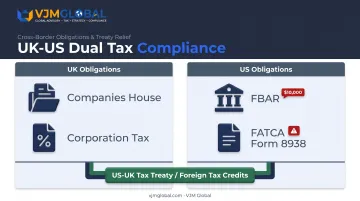
Treat FBAR and FATCA as two coordinated filings, not two independent ones.
Those US reports also sit on top of a different entity model. A common and costly mistake is assuming US LLC tax logic—pass-through treatment, informal recordkeeping—carries over to a UK Ltd. It doesn't. A UK Ltd has its own registration rules, its own CT600, and its own compliance calendar, entirely separate from anything familiar from a US LLC.
UK Business Banking
Opening a UK business account as a non-resident director is often the hardest operational step. Many high-street banks want a UK address and in-person ID checks. Digital banks and fintechs are usually more workable from the US, provided you have Companies House documents and proof of identity ready.
VAT and Hiring UK Staff
Mandatory VAT registration kicks in once your UK taxable turnover crosses £90,000 over a rolling 12 months, or when you expect to cross that threshold in the next 30 days. A business based outside the UK may still need to register regardless of turnover if it supplies certain services to UK clients.
If you hire a second shooter or editor based in the UK, you'll need to register as an employer, run PAYE, and handle National Insurance contributions.
Dual UK-US filings leave little room for guesswork. A cross-border specialist—such as VJM Global for entity formation plus multi-jurisdiction tax compliance—can align Companies House, CT600, VAT/PAYE, and FBAR/FATCA from day one instead of unwinding mistakes later.
Building Your Photography Business: Equipment, Portfolio, Niche & Pricing
Once the legal groundwork is sorted, the photography itself follows familiar principles, with a few UK-specific adjustments.
Equipment: Most photographers start with gear they already own from their US business. Budget for:
- A UK power adapter (and dual-voltage chargers if needed)
- A local backup body or lens rental relationship
- Insurance that specifically covers UK shoots
Niche & portfolio: Wedding photography is the largest revenue slice of the UK industry, so a strong bridal portfolio carries real weight if that is your focus. Build UK-relevant work through test shoots, collaborations with UK stylists and venues, or styled shoots at British locations. Match the niche to local demand rather than importing a US specialism with thin demand overseas.
Pricing: Price in GBP from UK benchmarks, not a converted USD number. A 2025 survey of UK wedding photographers found average full-day packages (roughly 10 hours, 600-1,000 edited images) landing around £2,100, with most falling between £1,600 and £2,500.
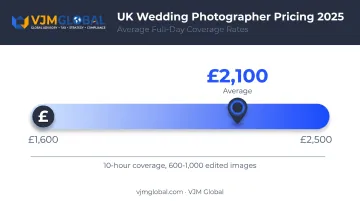
If your US day rate converts well above or below that range, adjust your positioning, not just the currency symbol.
Marketing Your Photography Business to UK Clients
A foreign-owned business has to work harder to earn local trust, and that starts online.
- Get a .co.uk domain and build UK-specific SEO and business listings—a country-code domain signals local intent even if it is not a direct ranking factor
- Partner with UK venues for styled shoots and referrals; venue relationships carry more weight with British couples than a polished Instagram grid
- Join a British photography association such as BIPP, SWPP, or the AOP for credibility and directory listings
- Collect UK reviews early, even from discounted or trade shoots—British client testimonials do more than anything else to ease "foreign photographer" hesitation
Lean into what makes you different rather than competing head-on with fully local studios. Destination weddings, expat family portraits, and shoots for American couples marrying in Britain all play to a US-founded, UK-operating business's natural strengths.
Frequently Asked Questions
Do I need a UK registered office if I live in the US?
Yes. Every UK limited company must have a registered office address in the United Kingdom. Non-resident founders typically use a formation agent or accountant’s address for Companies House mail and statutory records.
Do I need a UK visa to start a photography business in the UK from the US?
No, not to register and own the company remotely. You do need appropriate visa or work authorisation if you plan to physically travel to the UK to shoot for clients.
Can I register a UK limited company from the US without living there?
Yes. You'll need a UK registered office address and to complete identity verification, though expect a longer setup timeline than a UK resident would face.
Do I have to pay tax in both the UK and the US on my photography income?
UK-sourced income is subject to UK Corporation Tax, and as a US citizen you separately report worldwide income to the IRS. The US-UK tax treaty prevents true double taxation through foreign tax credits.
Can a US citizen open a UK business bank account remotely?
Yes, but it's usually the slowest step in the whole process. Documentation and identity verification requirements can take several weeks without local support.
How long does it take to set up a photography business in the UK from the US?
Incorporation itself can happen quickly. Full operational readiness, including a working bank account, insurance, and compliance registrations, typically takes several weeks for a non-resident founder.