Introduction
American entrepreneurs are increasingly registering companies in the UK without ever boarding a flight. The appeal is straightforward: a stable legal system, an English-language market, and a company formation process that runs entirely online.
Interest goes well beyond tech founders. US expats weighing a move, freelancers scaling their client base internationally, and small businesses eyeing a UK subsidiary hit the same frictions: non-resident banking, UK tax filings, and whether the setup can run from a home office. The question is simple—can you run this from home?
You can. Running it from home does not mean skipping the paperwork. This guide walks US-based founders through UK company formation, banking, and tax obligations, in the order you'll need them before your first sale to a UK customer.
Key Takeaways
- No UK residency required — only a genuine UK registered office address
- UK Limited Company is the best-fit structure for most non-resident founders
- IRS + HMRC both apply — report UK ownership via FBAR/FATCA and file in the UK
- Banking and tax take longer than incorporation — plan for weeks, not days
- Structure → register → bank → tax → launch is the order that avoids rework
What Does Starting a UK Online Business From the USA Actually Involve?
It means registering and running a business under UK law while you remain physically based in the USA. In most cases, that means incorporating a UK Private Limited Company, not simply shipping products to UK customers from your existing US company.
That distinction matters. Selling to UK buyers from a US LLC is common and requires no UK entity at all. Operating as a UK business is different: the company itself is UK-registered, pays UK Corporation Tax, and files with Companies House and HMRC.
Two setups dominate this path:
- A UK Ltd company run remotely by a non-resident director. The founder stays in the USA, owns and directs the company, and never needs to visit the UK—the usual route for solo online entrepreneurs.
- A US company with a UK branch or subsidiary. Typically used by established US SMEs entering the UK market, since it involves more setup and reporting overhead than a single-founder needs.
For most readers here—freelancers, ecommerce sellers, and digital service providers—the first option applies.
What to Know Before You Start
Most US founders don't underestimate the online business itself. They underestimate the admin that comes with running it across two countries.
Residency isn't required, but a UK address is. A director doesn't have to live in the UK, and there's no residency requirement for shareholders either. What you cannot skip is a registered office: a genuine, physical UK address where official mail can be delivered.
Two countries mean two sets of filings. Expect UK company formation, ongoing Companies House and HMRC filings, and separately, US tax reporting on your foreign entity ownership. These aren't optional extras. They're baseline compliance for a US person who owns a foreign company.
The realistic timeline runs longer than incorporation day:
- Company registration: often same-day
- Corporation Tax activation with HMRC: 10 days, or up to 21 days if you're abroad
- Business banking: a few days with fintech providers, up to 4-8 weeks with traditional banks
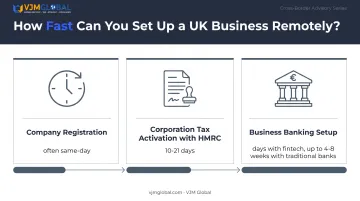
Budget several weeks, not several hours, before you're fully operational and compliant on both sides.
This is a paperwork game more than a skills game. Your ability to build a good product matters less here than your ability to stay organised across two regulators. Missing a Companies House deadline is far more likely to cause problems than any gap in technical skill.
One early distinction matters: "selling online to UK customers" and "operating as a UK business" aren't the same thing. A US LLC can sell to UK shoppers all day without any UK registration. The full compliance picture only kicks in once you incorporate a UK entity, usually to build local credibility or access UK payment rails.
Why Start a UK Online Business From the USA? (When It Makes Sense)
This route isn't the right call for every US founder. It makes sense under specific conditions.
When it's worth doing:
- You're targeting UK or EU customers as a primary market, not an occasional one
- You want local credibility, since a Companies House number and UK address carry weight with UK buyers and marketplaces
- You're comfortable managing two sets of compliance in exchange for that market access
- You expect to earn meaningfully in GBP and want a structure built to receive and hold it
The market opportunity is real. Companies House recorded 801,871 new company incorporations in 2024-25 alone, a sign of how active UK company formation remains even for founders who've never set foot in the country.
Other advantages worth weighing:
- Earning in GBP while costs sit in USD (or the reverse) can work in your favor—though exchange rates cut both ways
- UK incorporation is fast and inexpensive: online registration typically costs £100 and completes within 24 hours, with no UK visit required
None of this replaces genuine demand. If your product doesn't resonate with UK buyers, a Ltd number won't fix that. When the demand is there, formation itself isn't the bottleneck.
Early Decisions That Matter When Starting a UK Online Business From the USA
Most cross-border founders don't get tripped up by lack of effort. They get tripped up by underestimating how two legal systems interact.
Entity choice, made carelessly. Deciding between a UK Ltd company and continuing to sell into the UK from your existing US entity isn't a minor detail. Get it wrong, and you can create tax exposure or compliance obligations you never intended to take on.
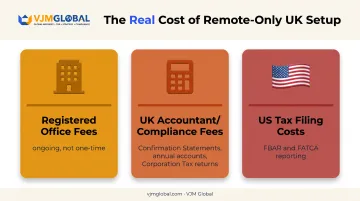
The real cost of "remote-only." Founders often budget for registration and stop there. What actually adds up:
- Registered office fees, which are ongoing, not one-time
- UK accountant or compliance fees for Confirmation Statements, annual accounts, and Corporation Tax returns
- US tax filing costs tied to foreign company ownership, including FBAR and FATCA reporting
US banking assumptions that don't hold up. A US business bank account or PayPal balance often isn't enough. UK customers, marketplaces, and payment processors frequently expect UK banking details, meaning a sort code and account number, not a US routing number.
Threshold blind spots. UK Corporation Tax, the VAT registration threshold, and US reporting deadlines all interact. Founders who have an unexpectedly strong first year can trip several of these at once without realising it.
No local presence means no local safety net. Nobody is physically in the UK to open mail or catch a Companies House reminder. Missed filings and unread notices pile up fast when you are thousands of miles away.
That gap is where cross-border support matters. VJM Global has supported more than 250 UK businesses with entity formation and compliance. The firm also helps American clients manage FBAR and FATCA reporting on foreign holdings, the kind of detail a solo founder working from a kitchen table in Ohio is likely to miss.
How to Start a UK Online Business From the USA – Step by Step
Remote UK setup breaks into five practical stages, from validating demand to staying compliant after launch. The mistakes that hurt most aren't dramatic: registering the wrong entity type, delaying tax registration, or assuming a US bank account will work for UK operations.
Step 1 – Validate Your Online Business Idea for the UK Market
US demand doesn't automatically transfer. UK consumer behavior, pricing expectations, and preferred platforms differ enough that skipping this step is a common, and costly, mistake.
Before registering anything:
- Research UK-specific competitors, not just US ones
- Check UK marketplaces directly, such as Etsy UK and Amazon UK, for demand signals
- Confirm UK buyers will actually pay in GBP at your target price point
- Look at UK search and social data separately from US data
Where founders go wrong: validating only in the US market and assuming it carries over. UK buyers often have different price sensitivity and trust signals than US ones.
Step 2 – Choose the Right UK Business Structure as a Non-Resident
Three options exist: a UK Limited Company, UK sole trader status, or continuing to operate as a US entity selling into the UK.
For most non-resident founders, a Ltd company is the workable choice. It separates personal and business liability, doesn't require UK residency for directors or shareholders, and gives you a Companies House number that UK customers recognize.
Sole trader status is trickier than it looks. It's often assumed to require UK tax residency, but non-UK residents can still be required to file Self Assessment on UK income. The bigger issue is that sole trader status offers no liability protection, which matters more once you're operating across borders.
Watch-out: defaulting to sole trader because it sounds simpler, without checking whether it fits a non-resident setup.
Step 3 – Register Your UK Company From the USA
Companies House registration happens entirely online. You'll need:
- A company name that isn't already registered and usually ends in "Limited" or "Ltd"
- A genuine UK registered office address
- Director and shareholder details, including identity verification
- A SIC code describing your business activity
- Basic governing documents: memorandum, articles, and a statement of capital
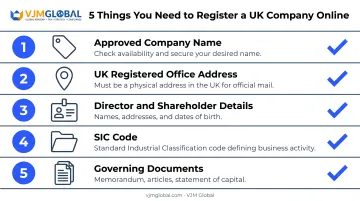
Online registration costs £100 and is usually completed within 24 hours, with no UK visit required at any point.
The address is where founders slip up. Using a friend's or relative's UK address informally, without a formal registered-office arrangement, causes real problems later: missed mail, lapsed compliance notices, even risk to the company's good standing.
Step 4 – Set Up UK Banking, Payments, and Tax Registration
Traditional UK banks often expect in-person verification, which doesn't work from Ohio or Texas. Most non-resident founders instead use UK-focused fintech or e-money providers, which verify digitally and can approve accounts in days rather than weeks.
On the tax side:
- Register for Corporation Tax with HMRC, usually triggered automatically when you incorporate online, unless the company is dormant
- Monitor the VAT threshold. Registration becomes mandatory once taxable turnover crosses £90,000 in a 12-month period, or is expected to within the next 30 days
Then there's the US side, easy to forget in the excitement of launching. FinCEN requires an FBAR filing when the combined value of foreign financial accounts exceeds $10,000 at any point in the year, and FATCA disclosure through Form 8938 can apply at similar thresholds.
Dual US–UK filing is easy to miss when you're focused on launch. Bring in a cross-border tax specialist from day one so FBAR, FATCA, Corporation Tax, and VAT stay aligned. VJM Global supports American founders on both sides of that reporting, which prevents a scramble later.
Step 5 – Build Your Offering, Launch, and Stay Compliant
With structure and registration sorted, build your storefront or service delivery around UK expectations: GBP pricing, realistic fulfilment timelines, and payment methods UK customers actually use.
Once live:
- Set up basic analytics to see which UK traffic is converting
- Mark your Confirmation Statement date, due annually and filed within 14 days of your review period ending
- Note your first accounts deadline, 21 months after registration, then 9 months after each financial year-end going forward
After launch: plenty of founders generate real revenue, then miss the first UK filing deadline simply because nobody local is there to catch the reminder.
Conclusion
Starting a UK online business from the USA is entirely achievable without relocating. Thousands of founders are already doing it. Success hinges on getting entity choice, registration, and dual-country tax obligations right from day one—not on how fast you launch.
A UK Ltd company gives most non-resident founders the cleanest path: no residency requirement, straightforward formation, and a structure UK customers recognize. That simplicity on the UK side doesn't remove your US reporting obligations, though. FBAR, FATCA, and ongoing Corporation Tax and VAT compliance all need attention as the business grows.
Review both sides of the Atlantic regularly, not just at launch. Working with a firm experienced in both UK and US compliance, such as VJM Global, tends to save founders from the errors that surface only after year one.
Frequently Asked Questions
Which online business is most profitable in the UK?
Retail and ecommerce, along with service-based niches like consulting and digital products, currently show strong margins. Profitability depends more on niche demand and pricing than on the business type itself.
Can a US citizen own a UK limited company?
Yes. UK company law doesn't restrict non-resident ownership or directorship, though you'll still need a genuine UK registered office address and standard compliance filings.
Do I need to live in the UK to register a company there?
No. UK residency isn't required to incorporate, but you must have a genuine UK registered office address where official correspondence can be delivered.
How do I open a UK business bank account from the USA?
Traditional UK banks often require in-person verification, which is impractical from the USA. Most non-resident founders use UK-focused fintech or e-money accounts instead.
Will I be taxed in both the UK and the US?
UK company profits are generally taxed in the UK first. US persons must also report foreign company ownership to the IRS, though the UK-US tax treaty helps reduce double taxation.
Do I need a UK visa to run an online business from the USA?
No. Owning and directing a UK company remotely from the USA doesn't require a visa, since you're not physically working in the UK.