Here's the short answer: yes, you can form a UK company as a US citizen with zero residency or visa requirements. The real complexity isn't incorporation. It's what happens after, specifically cross-border tax coordination and banking.
This guide walks through the structure decision, the registration steps, US-UK tax treaty obligations, and the visa routes that matter only if you eventually want to relocate.
Key Takeaways
- US citizens can register a UK private limited company remotely through Companies House, with no UK residency required
- Incorporation often completes within 24 hours, but banking and tax registration can take several weeks
- The US-UK Double Taxation Treaty governs how dividends and director income are taxed across both countries
- A UK visa is required only to live and work in the UK, not to incorporate or manage remotely
Why the UK Is an Attractive Market for US Entrepreneurs
The US-UK trade relationship is substantial. In 2025, the United States was the UK's largest trading partner, with bilateral trade reaching GBP 331.7 billion, or 17.5% of total UK trade. That scale reflects decades of integrated commercial activity between the two economies.
US-owned businesses already have a meaningful footprint in the UK. According to a UK Department for Business and Trade study, US-owned local business units made up just 1% of all UK business units but generated 11.4% of UK business turnover and supported 1.48 million jobs.
What makes the UK appealing beyond the numbers:
- Transparent, predictable legal system with strong contract enforcement
- English-language business environment (no translation or interpretation overhead)
- Established gateway to European and global markets through UK trade agreements
Where the friction actually shows up:
- Opening a UK business bank account as a non-resident director
- Managing dual tax filing obligations with both HMRC and the IRS
- FATCA and FBAR reporting requirements unique to US citizens owning foreign entities
None of these are dealbreakers. They just require planning most founders skip until it's too late.
Business Structures in the UK: Which One Fits a US Founder
Your structure choice affects three things:
- Personal liability
- How profits get taxed in both countries
- How easily you can scale or raise capital later
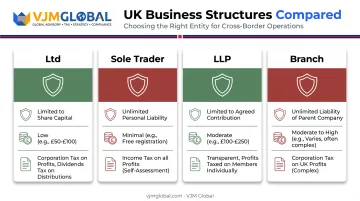
Private Limited Company (Ltd)
This is the default choice for most US founders entering the UK. An Ltd is a separate legal entity, meaning your personal assets stay protected from business liabilities.
UK Corporation Tax rates:
- 19% small-profits rate on profits up to £50,000
- 25% main rate on profits above £250,000
- Marginal relief applies between £50,000 and £250,000, according to HMRC's Corporation Tax rates guidance
Sole Trader
A sole trader setup suits freelancers or consultants testing the UK market before committing to a full entity. You file a simple HMRC Self Assessment return, but liability is unlimited: your personal assets are exposed if something goes wrong.
LLP
Common for professional services partnerships such as consulting, legal, and accounting firms. Profits pass through to partners for tax purposes.
LLPs still file annual accounts and a confirmation statement with Companies House, the same as an Ltd.
Branch / UK Establishment
If you already run a US company and just want a UK presence, registering a branch (Form OS IN01) may make more sense than forming a new entity. The catch: your US parent company carries the liability. There's no separate equity cushion protecting it.
| Structure | Setup Cost | Liability | Tax Treatment |
|---|---|---|---|
| Ltd | Low | Limited to shareholding | UK Corporation Tax (separate entity) |
| Sole Trader | Minimal | Unlimited | Self Assessment |
| LLP | Moderate | Limited to contribution | Pass-through |
| Branch | Low (£124 fee) | Parent liable | Taxed as UK establishment |
How to Start a UK Business from the USA: Step-by-Step
None of the steps below require a visa. You can complete every one of them remotely from your kitchen table in Ohio.
Step 1 – Choose a Company Name and Registered UK Office Address
Your company name must be unique and follow Companies House naming rules (no offensive terms, no implying government affiliation without approval).
You also need a physical UK registered office address — not a US address and not a PO Box. Most US founders use a virtual or registered office provider based in the UK.
Step 2 – Appoint a Director and File for Incorporation
Directors don't need to be UK residents. You'll need:
- Company name and registered office
- At least one director and details of shareholders/persons with significant control
- Memorandum and Articles of Association
- A SIC code describing your business activity
Standard online registration is usually completed within 24 hours, according to Companies House registration guidance. Fees range from £100 for standard online filing to £156 for same-day software registration.
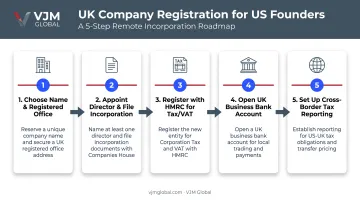
Step 3 – Register with HMRC for Corporation Tax and VAT
HMRC issues your Unique Taxpayer Reference (UTR) after incorporation. You must notify HMRC within 3 months of your Corporation Tax accounting period starting.
VAT is where non-UK-established businesses get caught off guard. UK-established businesses only register once turnover crosses £90,000. Non-UK-established taxable persons don't get that threshold. Registration is generally required from the first taxable UK supply, with limited exceptions for zero-rated goods or services.
Step 4 – Open a UK Business Bank Account
This is often the slowest part of the process. Traditional UK banks can be reluctant to open accounts for non-resident directors without an in-person visit.
Digital alternatives like Wise Business and Revolut Business have become the practical workaround, though they still require:
- Certificate of incorporation and registration number
- Evidence of business activity and online presence
- Identity verification for anyone owning 25% or more of the company
Step 5 – Set Up Cross-Border Tax Reporting from the US Side
This is where most founders under-prepare. Owning a foreign corporation as a US person triggers IRS reporting obligations independent of anything HMRC requires, including:
- Form 5471: information return for US shareholders of foreign corporations
- FBAR (FinCEN Form 114): required when foreign account value exceeds $10,000 at any point in the year
VJM Global works with US entrepreneurs on both sides of this equation. The team coordinates UK company setup with the matching US compliance obligations so nothing falls through the cracks between HMRC and the IRS.
US-UK Tax Treaty and Ongoing Compliance
The US-UK Double Taxation Treaty exists specifically to prevent you from paying tax twice on the same income.
On dividends (Article 10): source-state tax is capped at 5% of gross dividends where the beneficial owner is a company holding at least 10% of voting power, and 15% otherwise, under the US-UK Double Taxation Convention.
On director's fees (Article 15): fees paid to a resident of one country for board service to a company resident in the other country may be taxed in that other country.
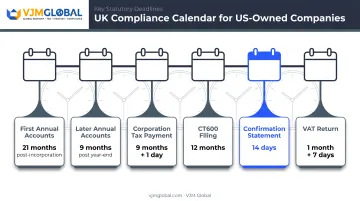
Your UK compliance calendar looks like this:
| Requirement | Deadline |
|---|---|
| First annual accounts | 21 months after incorporation |
| Later annual accounts | 9 months after financial year end |
| Corporation Tax payment | 9 months + 1 day after accounting period ends |
| CT600 filing | 12 months after accounting period ends |
| Confirmation statement | Within 14 days of review period ending |
| VAT return | 1 month + 7 days after VAT period ends |
UK deadlines are only half the picture. Owning a UK company from the US triggers a separate reporting stack:
- Form 5471 for US persons with an interest in a foreign corporation
- FBAR (FinCEN Form 114) for foreign financial accounts
- Form 8938 for FATCA asset reporting when thresholds apply
Miss either side’s deadlines and penalties follow. Run the UK and US calendars as one coordinated schedule, not two disconnected to-do lists.
Visa Routes for US Founders Planning to Relocate to the UK
Here's the distinction that trips people up: incorporating and managing a UK company from the US requires no visa. A visa only becomes necessary if you want to physically live and work in the UK.
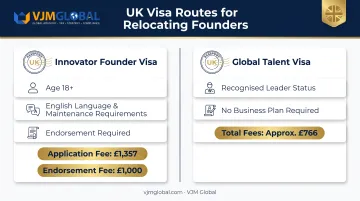
If relocation is the goal, the Innovator Founder Visa is the primary route:
- Applicants must be at least 18 and meet English language and maintenance requirements
- Requires endorsement from an approved body assessing your business as innovative, viable, and scalable
- Application fee from outside the UK: £1,357
- Endorsement fee: £1,000
- Additional £500 per mandatory endorsing-body meeting, plus the immigration health surcharge
Fee details are set out in GOV.UK's Innovator Founder Visa guidance.
The Global Talent Visa is an alternative for recognised leaders in academia, arts and culture, or digital technology, without needing a specific business plan. Total fees run around £766, split between endorsement and visa application costs.
Frequently Asked Questions
Can a non-resident start a business in the UK?
Yes. Non-residents, including US citizens, can register a UK private limited company without any residency requirement. You'll need a UK registered office address, but you don't need to live there.
Can a foreigner buy a business in the UK?
Yes, foreigners can acquire existing UK businesses. This involves standard due diligence, Companies House filings to reflect ownership changes, and sector-specific approvals for regulated industries.
What is the easiest business to start in the UK?
Service-based or online businesses, like consulting or e-commerce, are typically easiest since they need minimal physical presence and can run entirely remotely from the US.
Do I need to be physically present in the UK to register and run a company?
No. Registration and day-to-day remote management are fully possible without setting foot in the UK. Physical operations involving staff or premises, however, require a visa.
How much does it cost to start a business in the UK from the USA?
Companies House charges £100 for standard online incorporation. Registered office services, banking setup, and tax advisory support usually push total costs well above that statutory fee.
What taxes does a US entrepreneur pay on a UK business?
You'll pay UK Corporation Tax at 19–25% based on profit level, plus VAT if your turnover and establishment status require it. The US-UK tax treaty helps prevent double taxation on the same income.