
Part of the appeal is cost. Setup and running costs in Oman tend to undercut the UAE for comparable activities, English is widely used in commercial dealings, and the tax position (0% personal income tax, currently) is attractive for founders used to UK rates. Trade ties between the UK and the GCC continue to strengthen, even as headline bilateral figures fluctuate year to year.
This interest isn't limited to large corporates. UK SMEs, freelance consultants, trading businesses, and companies looking to diversify beyond Europe are all exploring Oman. This guide walks through what starting a small business in Oman actually involves when you're doing it from a UK base, not relocating first and figuring it out later.
TL;DR
- Royal Decree 50/2019 allows 100% foreign ownership in most sectors, so UK nationals generally don't need a local Omani partner
- Registration runs through MOCIIP's Oman Business Platform (formerly Invest Easy) and can largely be started remotely from the UK
- The Commercial Registration certificate issues immediately on a complete application; preparation, attestation, and banking take far longer
- Costs vary by activity, structure, and office lease—budget to your activity code, not a generic first-year average
- Structure choice (LLC, SPC, branch, free zone) and UK–Oman tax coordination cause the most delay when you get them wrong
What Does Starting a Small Business in Oman from the UK Involve?
In practical terms, this means a UK resident or UK-registered company legally establishing and owning a commercial entity in Oman — either managed remotely with a single visit for banking, or after relocating outright.
This is distinct from applying for Omani citizenship or a standard employment visa. It covers company registration, licensing, and ongoing compliance, not immigration status.
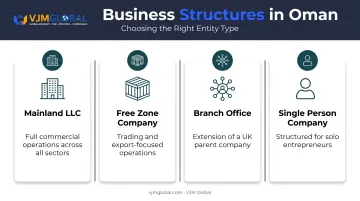
Most UK founders end up choosing between four formats:
- Mainland LLC — the most common route for UK SMEs wanting full commercial operations
- Free zone company — suited to trading, logistics, and export-focused businesses
- Branch office — for existing UK companies extending operations without forming a new entity
- Single Person Company (SPC) — designed for solo entrepreneurs and consultants operating alone
What UK Entrepreneurs Should Know Before Starting a Business in Oman
Many UK founders underestimate the logistics of setting up in a market they've never lived in. Registration and residency are two different processes, and confusing them causes most of the early delays.
Remote Coordination Has Limits
Most registration steps can be initiated online through the Oman Business Platform. A trip to Oman is usually still required for corporate bank account opening and biometric or visa-related steps, which can't be finished entirely from London or Manchester.
You may not need to travel for every step. Oman allows an appointed local Authorised Signatory to handle day-to-day registration matters, so a UK director need not be present throughout. Banking is the common exception.
UK Tax Obligations Don't Disappear
Setting up an Omani entity doesn't automatically remove your UK tax exposure. Two things matter here:
- Individual residence: UK residents normally pay UK tax on worldwide income. HMRC's Statutory Residence Test (including the 183-day automatic UK test) determines your status, not your nationality alone
- Corporate residence: A non-UK-incorporated Omani company can still be treated as UK tax resident if central management and control actually happens in the UK, according to HMRC's own guidance
The UK-Oman Double Taxation Agreement (in force since 1998) helps coordinate taxing rights, but it doesn't remove the need to check your specific filing position before assuming you're clear of UK obligations.
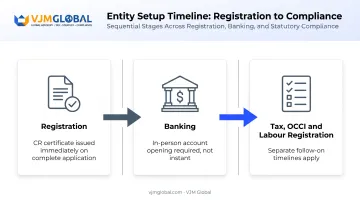
The Timeline Has Three Distinct Stages
Don't treat "registered" and "operational" as the same thing:
- Registration — the CR certificate is issued immediately once a complete application is filed on the Oman Business Platform
- Banking — opening a corporate account typically requires an in-person visit and isn't instant
- Tax, OCCI, and labour registration — these follow registration and each carry their own separate timelines
If you're not ready to commit fully, a representative office lets you test the market without the full commercial licence burden of an LLC. Full commercial operations, including invoicing and trading, need the proper LLC or SPC structure.
Why UK Founders Are Choosing Oman (When It Makes Sense)
Oman isn't a guaranteed win for every UK business. It makes sense under specific conditions.
Tax position:
- 0% personal income tax now; 5% above OMR 42,000 from 2028 under Royal Decree 56/2025
- Corporate tax sits at 15%, with a reduced 3% rate for qualifying small enterprises
Trade and market access:
- UK-Oman bilateral trade reached £1.6 billion in the 12 months to Q1 2025, though this was down 4.6% year on year
- A single Omani base gives commercial access into the wider GCC, East Africa, and South Asia
Cost and residency:
- Setup and operating costs generally undercut the UAE for comparable activities; figures vary by sector and structure
- Investor visa: OMR 250 for five years, or OMR 500 for ten years
- Golden Residency (launched September 2025): renewable 10-year visa from OMR 200,000 investment
None of this suits every founder. If your business model depends on rapid scaling or heavy digital infrastructure, the UAE's more developed ecosystem might still win out. Oman tends to suit founders prioritising lower overheads and a longer-term Gulf foothold over speed.
Early Decisions UK Founders Often Get Wrong When Setting Up in Oman
Most early-stage problems come from applying a UK company-formation mindset to a different regulatory system. Companies House habits don't transfer cleanly.
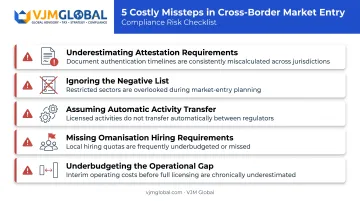
Common missteps:
- Underestimating attestation requirements: UK passports and company records need apostille or attestation before MOCIIP will accept them—this step is often rushed
- Ignoring the Negative List: activity codes must be checked against MOCIIP's prohibited list or the filing is rejected. Ministerial Decision 435/2024 added 28 further prohibited activities in personal services, transport, and agriculture
- Assuming automatic activity transfer: a UK limited company's registered activities do not carry over to an Omani branch; each must match Omani classifications
- Missing Omanisation requirements: after a year of operation, a foreign-investment establishment must hire at least one Omani within three months of Ministry notice, which shapes UK staffing plans
- Underbudgeting the operational gap: commercial registration is not full operation—banking, tax registration, and municipal licensing still sit ahead
How to Start a Small Business in Oman from the UK – Step by Step
These steps are for founders starting from the UK, not for someone already based in Oman. The two most common mistakes: registering before verifying the activity code, and travelling to Oman before documents are properly attested.
Step 1 – Choose Your Business Activity and Structure
Confirm your intended activity isn't on Oman's Negative List using MOCIIP's published activity list before doing anything else.
For most UK SMEs, an LLC or SPC via the Oman Business Platform is the practical route. Branch offices suit existing UK companies extending operations rather than starting fresh.
Common miss: Selecting a broad activity code that seems flexible but later restricts the specific services you actually deliver.
Step 2 – Prepare and Attest UK Documents Remotely
Gather passport copies, UK company incorporation documents (where applicable), and board resolutions.
Get these apostilled through the FCDO before submission to MOCIIP. UK legalisation costs and turnaround vary by service level:
| Service | Cost | Turnaround |
|---|---|---|
| Standard paper apostille | £45 | Up to 25 working days |
| e-Apostille | £35 | Up to 2 working days |
| Next-day paper (registered business) | £40 | 1 working day |
| Same-day urgent (pre-approved) | £100 | Same day |
Common miss: Underestimating how long attestation takes. Founders who assume a few days often end up delaying the entire submission by weeks.
Step 3 – Register Online via the Oman Business Platform
Reserve a trade name and set up digital identity verification. Non-residents use MOCIIP's KYC service, involving biometrics and facial recognition rather than the resident PKI card route.
Submit the Memorandum of Association along with shareholder and manager documents. Once a complete application is filed, the CR certificate is issued immediately.
Common miss: Assuming a local Omani director is mandatory. In most cases, only an appointed Authorised Signatory based in Oman is required: not a co-owner.
Step 4 – Handle Capital, Banking, and Office Requirements
Oman's 2019 Commercial Companies Law sets no fixed numeric minimum capital for an LLC. The declared capital figure should reflect your activity and what a bank will consider credible, not an arbitrary round number.
Plan a trip to Oman specifically for opening the corporate bank account. This generally can't be completed remotely. While you're there, secure a registered office address or flexi-desk appropriate to your licensed activity.
Step 5 – Complete Tax, OCCI, and Labour Registration
Register for a Tax Registration Number within 60 days from the start of activity or the beginning of the enterprise, whichever comes first, not necessarily 60 days after your CR is issued.
Join the Oman Chamber of Commerce and Industry (OCCI), which is mandatory for every commercial entity and currently costs OMR 33 for the membership certificate.
If you plan to hire, register with the Ministry of Labour. Be aware of Omanisation quotas: businesses that have operated for a year face a requirement to plan at least one Omani hire within three months of notification, which affects how fast you can bring on expatriate staff.
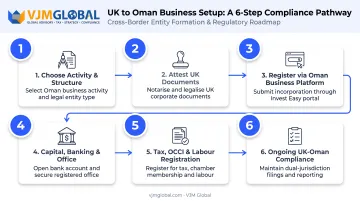
Step 6 – Manage Ongoing UK-Oman Compliance
Once operational, you're running two compliance calendars simultaneously, not one.
On the UK side, that typically includes Companies House filings, Corporation Tax registration and returns (CT600), and Confirmation Statement deadlines. On the Oman side, it means OCCI renewals, tax filings, and labour reporting.
Coordinating both calendars is where many founders lose track. One filing deadline gets missed because attention sits entirely on the other jurisdiction.
VJM Global helps UK businesses build cross-border compliance roadmaps that keep Companies House and HMRC obligations aligned with a foreign entity's requirements. If Oman is new for your business, set up one coordinated calendar from day one rather than two separate projects.
Common miss: Treating Oman compliance as a standalone task disconnected from what's still owed to HMRC and Companies House back home.
Conclusion
Starting a small business in Oman from the UK is achievable. Foreign ownership rules under Royal Decree 50/2019 remove the need for a local partner in most sectors, and much of the registration process can be initiated from your desk in the UK.
Success mostly comes down to two things:
- Getting the activity classification right before you submit anything
- Getting UK documents attested early rather than at the last minute
Founders who plan for the banking trip and tax coordination from the outset avoid the delays that catch out most first-timers.
Longer term, treat your Omani entity as part of one coordinated UK-Oman compliance structure, not a side project running on its own clock.
Frequently Asked Questions
How much does it cost to start a business in Oman?
Costs depend on your activity, structure, and office lease, so there's no single reliable average. Budget for MOCIIP registration fees, OCCI membership (OMR 33), attestation costs, and ongoing licensing specific to your sector.
What businesses are in demand in Oman?
Tourism, logistics, professional and consulting services, e-commerce, and light manufacturing are all priority sectors under Vision 2040, making them relatively easier to license and grow.
Can a British citizen live in Oman?
Yes. British citizens can live in Oman through an investor visa tied to their company (five or ten-year options), or through the Golden Residency for larger investments of at least OMR 200,000.
Do I need a local Omani partner to start a business in Oman as a UK national?
No, in most cases. Royal Decree 50/2019 allows 100% foreign ownership across most sectors, except for activities listed on Oman's Negative List.
How long does it take to register a company in Oman from the UK?
The Commercial Registration certificate is issued immediately once a complete application is submitted. The real timeline depends on document preparation, attestation, and how quickly banking and tax registration follow.
Can I register my Oman company without travelling from the UK?
Registration itself can be completed remotely through the Oman Business Platform. A visit is generally still required for opening the corporate bank account and completing biometric or visa-related steps.