Introduction
A growing number of US-based Indians and American entrepreneurs are eyeing India's solar sector right now. Aggressive renewable energy targets, relaxed foreign investment rules, and a market adding capacity faster than almost anywhere else in the world are driving the interest.
Timing matters too. US-India clean energy cooperation has deepened over the past few years. Foreign investors can now own 100% of a renewable energy company through India's automatic FDI route. Many diaspora professionals also want a long-term asset back home they can manage remotely.
This isn't only an NRI path. American investors and clean-energy founders with no Indian roots are entering too. The hard part is doing it from the USA: choosing the right entity, moving capital under FEMA, securing registrations, and running operations without a full-time presence on the ground.
This guide covers the legal structure, FDI and funding steps, compliance, and day-to-day operating realities of building a solar business in India while you remain based in the USA.
Key Takeaways
- Starting a solar business in India from the USA means pairing remote entity setup with strong on-ground execution
- India permits 100% FDI in renewable energy generation under the automatic route — no prior government approval needed
- Core steps: pick a business model, register remotely, complete FDI/RBI formalities, secure licenses, build a local team
- Expect 4 to 6 months from planning to operational launch, factoring incorporation, banking, and licensing timelines
- Profitability depends far more on compliance discipline and local execution than on the size of your initial investment
Why India's Solar Market Is a Compelling Opportunity for US-Based Entrepreneurs
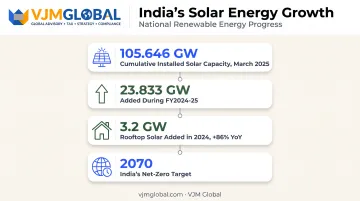
India's solar capacity has grown at a pace few markets can match. Cumulative installed solar capacity reached 105.646 GW as of March 2025, with FY 2024-25 alone adding 23.833 GW, according to MNRE's year-wise achievement data.
Rooftop solar is accelerating just as fast: India added 3.2 GW of rooftop capacity in 2024, an 86% jump over the previous year.
The country's net-zero target for 2070 points to decades more of policy support for renewables.
The FDI Advantage
For a US-based founder, the regulatory door is wide open. Under the Consolidated FDI Policy, power generation, transmission, distribution, and trading (except atomic energy) sits under the 100% automatic route. That means:
- No prior RBI or government approval required before investing
- Full ownership of your Indian solar entity from day one
- Standard post-investment reporting only, not pre-approval hurdles
Why NRIs and US Entrepreneurs Are Well-Positioned
Beyond policy, structural advantages favor diaspora and American founders:
- Existing family or professional networks in India that ease vendor and customer trust-building
- Familiarity with regional markets, languages, and business culture (for NRIs specifically)
- A rupee-cost advantage: capital earned in dollars stretches further against India's lower labor and installation costs
Demand itself is broad-based. Residential rooftop, commercial and industrial rooftop, and corporate open-access solar are expanding at once, driven by rising electricity tariffs and subsidy programs such as PM Surya Ghar. Policy support plus real demand growth is why the compliance work is worth doing for US founders entering this market.
Legal Structures & Entry Routes: Setting Up a Solar Business in India from the USA
US founders typically choose among four entry routes: a Wholly Owned Subsidiary (Private Limited Company), a Joint Venture with an Indian partner, an LLP with FDI-linked conditions, or a Branch/Liaison Office.
| Entry route | Best when | Key constraint |
|---|---|---|
| Wholly Owned Subsidiary (Pvt Ltd) | You want full control and tender access | India-resident director required |
| Joint Venture | You need local market access or licenses | Shared equity and control |
| LLP | Lighter compliance for certain activities | FDI conditions; weaker tender access |
| Branch / Liaison Office | Exploratory presence or limited project work | Liaison cannot earn India revenue |
For most solar founders, the Wholly Owned Subsidiary route wins out. Here's why:
- Full ownership with no need to share equity or control with a local partner
- Limited liability protection, separating personal and business risk
- Eligibility for government tenders and subsidy programs, including PM Surya Ghar, which typically require an Indian corporate entity
The Resident Director Requirement
Indian company law requires at least one director who is resident in India for 182 days or more in the financial year. A wholly owned subsidiary needs at least two directors (one India-resident) and two shareholders, who can both be foreign nationals.
US-based promoters can obtain Digital Signature Certificates (DSC) and Director Identification Numbers (DIN) without traveling to India. Both are processed online through the Ministry of Corporate Affairs portal using notarized identity and address documents.
FEMA and RBI Reporting
Once shares are allotted to the foreign shareholder, the company must file Form FC-GPR with the RBI within 30 days of allotment. Miss that window and you face late-filing fees, plus complications in later fundraising or subsidy applications.
VJM Global handles this end-to-end for foreign promoters: incorporation, resident director coordination, DSC/DIN processing, and the regulatory filings that follow. A US-based founder does not need to be physically present in India to get the entity live.
Common miss: Choosing the wrong entity structure (for example, a liaison office when you need revenue-generating capability) or missing FDI reporting deadlines. Both create headaches that surface later, often during a tender application or funding round.
How to Start a Solar Energy Business in India from the USA – Step by Step
This process splits cleanly into two categories: what you can do remotely from the USA, and what genuinely requires boots on the ground in India. Understanding that split early saves months of frustration.
The single biggest mistake founders make: assuming the entire business can be run online. Incorporation, banking, and licensing can happen remotely. Installation, client visits, and quality control cannot.
Step 1 – Choose Your Solar Business Model and Niche
Five broad models exist:
| Model | Capital Need | Remote Manageability |
|---|---|---|
| EPC/Installation | Moderate | Good, with a local lead |
| Distribution/Dealership | Low-Moderate | Good |
| Manufacturing | Very High | Poor without a strong partner |
| O&M (Operations & Maintenance) | Low-Moderate | Moderate |
| Consultancy | Low | Excellent |
Match your model to both your available capital and your local support network. A founder with no on-ground contacts should lean toward distribution or consultancy first, then expand into EPC once trust and cash flow are established.
Common miss: Jumping straight into manufacturing because the margins look attractive on paper, without first securing a strong local operating partner. Manufacturing demands constant on-site oversight that no remote founder can substitute for.
Step 2 – Register Your Entity in India Remotely
You'll need notarized and apostilled copies of your passport, US address proof, and a Power of Attorney authorizing your resident director or authorized representative to act on your behalf during incorporation.
The typical sequence looks like this:
- DSC issuance — roughly 2 working days
- DIN allotment — roughly 1 working day
- Company name approval — around 5 days
- Incorporation filing and Certificate of Incorporation — around 5 days
That's a documented 13-day core registration timeline, though real-world cases stretch longer once document collection is factored in.
Firms that handle India entry work—such as VJM Global—routinely coordinate the apostille chain, resident-director paperwork, and MCA filings so US founders are not stuck managing Indian portals across time zones.
Common miss: Underestimating how long US apostille and notarization actually take. Some US states process apostilles in days; others take weeks. Start this paperwork before you think you need to.
Step 3 – Complete FDI, RBI, and Banking Formalities
Your investment must move through proper banking channels, not informally. After the Indian entity issues shares to you, it must:
- Open a corporate bank account and fund the subscription amount within 180 days of incorporation
- File Form FC-GPR with the RBI within 30 days of share allotment
- Complete KYC formalities, including board resolutions and parent-company registration proof, since banks scrutinize foreign-linked accounts closely
Common miss: Routing money informally — through personal accounts or family transfers — instead of documented FDI channels. It feels faster in the moment but creates compliance gaps that surface during audits, subsidy applications, or future fundraising.
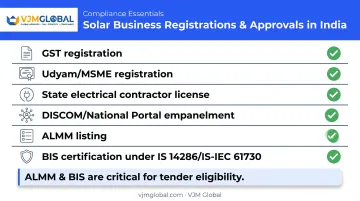
Step 4 – Obtain Licenses, GST, and Sector-Specific Approvals
Depending on your business model, expect to register for:
- GST, with thresholds and mixed-supply rules varying by activity type
- Udyam/MSME registration, useful for certain government scheme eligibility
- State-specific electrical contractor licenses, required for many installation tenders
- DISCOM/National Portal empanelment for subsidized rooftop projects under PM Surya Ghar
Two approvals deserve special attention: ALMM listing (Approved List of Models and Manufacturers) and BIS certification for solar panels under IS 14286 and IS/IEC 61730 standards. Both are gatekeepers for government and net-metering projects.
Common miss: Skipping ALMM/BIS compliance because it seems like a manufacturer's problem, not an installer's. It isn't — non-compliant panels can disqualify your entire tender bid, even if everything else is in order.
Step 5 – Build Your Local Team and Launch Operations
Once the entity, capital, and licenses are in place, execution shifts from paperwork to people. This is where remote founders either succeed or stumble. Installation crews, client site visits, and daily quality checks simply cannot happen from a laptop in the USA.
Two practical paths exist:
- Direct hiring — build your own installation and sales team, giving you full control but requiring more management time
- Partnering with an existing EPC/installer network — faster to launch, though margins get shared
Either way, your resident director becomes your compliance anchor — the person accountable for statutory filings and day-to-day regulatory adherence while you focus on strategy from the USA.
Common miss: Trying to run daily operations entirely remotely without a trusted local lead. Time zones alone make same-day decision-making nearly impossible, and that delay compounds into missed deadlines and frustrated customers.
Compliance, Taxation, Repatriation & Common Challenges for US-Based Owners
Getting the entity registered is step one. Staying compliant year after year is where most remote founders lose momentum.
Ongoing Compliance Obligations
Every foreign-invested Indian entity must handle:
- Annual ROC filings — annual returns, director disclosures, and statutory register updates
- GST returns — monthly or quarterly, depending on turnover
- Income tax filings — annual corporate tax returns and statutory audits
- RBI's Annual FLA return — Foreign Liabilities and Assets reporting for any entity with foreign investment on its books
Taxation and Repatriation
Indian domestic companies elect one of two main corporate tax regimes, plus applicable surcharge and a 4% health and education cess:
- 22% under Section 115BAA
- 25% under Section 115BA
For dividends flowing back to the USA, the India-US tax treaty caps withholding at 15% of gross dividends when the US shareholder owns at least 10% of voting stock, and 25% in other cases. That relief depends on filing the right treaty documents, including a Tax Residency Certificate and Form 10F.
Repatriation itself moves through Authorized Dealer banks after tax payment and RBI-linked compliance checks are complete.
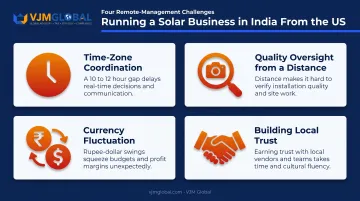
Real Challenges Remote Owners Face
- Time-zone coordination — a 10–12 hour gap between the US and India leaves only a narrow daily overlap
- Quality oversight from a distance — installation defects are hard to catch over a video call
- Currency fluctuation — rupee-dollar swings affect margins on any capital repatriated or reinvested
- Building local trust — customers and DISCOMs sometimes hesitate with overseas-owned brands until a track record is established
Those remote-operating pressures make deadline-driven compliance easy to miss. VJM Global's accounting and compliance teams handle ongoing ROC, GST, and FEMA-linked filings for foreign-invested entities so founders are not tracking every statutory due date themselves.
Conclusion
Success in India's solar sector as a US-based founder comes down to sequencing: get the legal structure and compliance foundation solid first, then scale operations. Skip that order, and even a well-funded venture can stall on a missed filing or a disqualified tender bid.
Partnering with local experts for entity setup and ongoing compliance closes the distance gap without requiring you to relocate. VJM Global supports US founders with India entity formation, FEMA/FDI advisory, GST, and ROC compliance so you can focus on the solar business itself.
India's solar market is still growing quickly. Founders who lock in structure and compliance first are better placed to use policy support and rising demand from day one.
Frequently Asked Questions
How to start a solar business in India?
Choose a business model, register your entity (typically a wholly owned subsidiary), complete FDI/RBI formalities, secure licenses like GST and ALMM/BIS, then build a local team. For a US-based promoter, incorporation and banking can happen remotely, but operations need someone on the ground.
How much does it cost to start a solar business in India?
Small EPC or distribution setups can start with working capital in the range of a few lakh rupees for licensing, initial inventory, and staffing. Manufacturing sits in a different league entirely: CEEW's 2025 analysis puts solar-cell manufacturing capex at roughly $70 million per GW of capacity.
Is a solar business profitable in India?
Generally yes, given strong demand growth and sustained government support. But profitability hinges on getting compliance right, maintaining pricing discipline, and having reliable local execution, not on market tailwinds alone.
What is the 20% rule for solar in India?
It refers to a Delhi Electricity Regulatory Commission provision requiring net-metering capacity at the distribution-transformer level to be at least 20% of that transformer's rated capacity. It's not a universal cap on individual consumer solar systems.
Can a US citizen or NRI own 100% of a solar company in India?
Yes. Renewable energy generation and distribution falls under the 100% FDI automatic route, meaning no prior government approval is needed, just standard post-investment reporting like Form FC-GPR.
Do I need to be physically present in India to register and run a solar business?
No, not for incorporation. A resident director and Power of Attorney handle that remotely. Day-to-day operations, though, need a trusted local team or partner since installation and client work can't be managed from overseas.