That scale is exactly why US entrepreneurs and telecom companies are taking a second look. India permits 100% foreign direct investment in telecom services through the automatic route, meaning no prior government approval is required to get started. Government incentive programs are also lowering the barrier to entry for equipment makers and infrastructure providers.
This isn't just a large-corporation play. ISPs, Virtual Network Operators, infrastructure providers, and US tech companies eyeing global expansion are all part of this wave. What follows is a step-by-step breakdown of what actually goes into starting a telecom business in India from the USA — licensing, compliance, and the operational reality behind the paperwork.
Key Takeaways
- A telecom business in India requires a DoT/TRAI-regulated license, not just company registration
- US founders can hold 100% ownership via the automatic FDI route
- License costs range from ₹50,000 for a regional ISP to ₹3 crore+ for pan-India coverage
- Infrastructure build-out and staffing add months after license approval
- Local execution, not remote management, determines first-year survival
What Is a Telecom Business in India?
A telecom business in India is an entity authorized by the Department of Telecommunications (DoT) to provide regulated communication services under Telecom Regulatory Authority of India (TRAI) oversight: voice, data, internet access, or the network infrastructure that carries them.
The core product is connectivity itself, not general software or IT services. That distinction matters because sector-specific licensing—not standard company registration—is the real gatekeeper.
Common license formats include:
- Unified License – covers voice and data services under one consolidated authorization
- Internet Service authorization – issued at national or circle/metro level, depending on geographic scope
- Infrastructure Provider (IP-I) – registration for passive infrastructure such as towers, ducts, and dark fiber
- Virtual Network Operator (VNO) – reselling services over an existing licensee's network rather than building your own
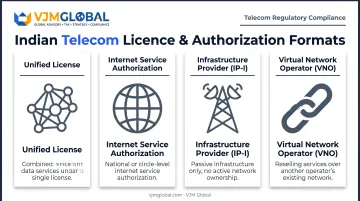
Each format carries a different capital footprint, and that's the piece most US founders underestimate going in.
Why Start a Telecom Business in India from the USA? (When It Makes Sense)
Entering India's telecom market isn't a guaranteed win just because the market is big. It makes sense under specific conditions.
Growing subscriber base: India recorded 1,087.50 million broadband subscribers by June 2026, and internet subscriptions crossed 1,092.79 million by March of the same year, according to TRAI. That's recurring demand at a scale few markets can match.
100% FDI on the automatic route: Under DPIIT Press Note 4, foreign investment in telecom services, including infrastructure providers, is fully permitted without a government screening committee. You still need standard licensing and security clearances, but you avoid a discretionary approval wait.
Programs that lower entry friction:
- BharatNet continues funding rural fiber connectivity, with over 218,000 gram panchayats service-ready as of early 2025
- The Telecom PLI scheme offers incentives of 4–6% on incremental sales for five years to qualifying equipment manufacturers
- The Telecom Technology Development Fund (TTDF), financed from Universal Service Obligation Fund collections, supports indigenous telecom hardware and rural connectivity pilots
Regional entry over national head-to-head: A district-level or regional ISP license, or a VNO arrangement, faces far less competitive density than a pan-India fight with entrenched national carriers. For a first-time US operator, that is often the more realistic starting point.
What to Know Before You Start a Telecom Business in India
Most US founders assume incorporating a company is the hard part. It isn't. The license is. Setting expectations here matters more than anything else in this article.
License Category and Capital Reality
The license category you choose (pan-India Unified License, circle-level Internet Service authorisation, VNO, or Infrastructure Provider (IP-I)) determines both your entry fees and the scale of infrastructure spend that follows. Here's what DoT's current fee schedule shows:
| Authorisation Type | Entry Fee | Bank Guarantee |
|---|---|---|
| Internet Service (NSO), Circle/Metro | ₹50,000 | ₹20,000 |
| Internet Service (NSO), National | ₹10 lakh | ₹4 lakh |
| Internet Service (VNO), National | ₹10 lakh | ₹1 lakh |
| Access Service (VNO) | ₹12.5 lakh | ₹20 lakh |
| Access Service (NSO) | ₹50 lakh | ₹2 crore |
| Unified Service Authorisation (VNO) | ₹3 crore | ₹4.4 crore |
Source: DoT fee schedule, 2026
IP-I registration for passive infrastructure runs a flat, non-refundable ₹5,000, the cheapest entry point on the list, though it only covers infrastructure, not service delivery. Legacy Unified License entry fees can run up to ₹15 crore, with an annual fee of 8% of Adjusted Gross Revenue.
Company registration itself is inexpensive by comparison. It's the license entry fee, the bank guarantee, and the infrastructure build that make this a capital-intensive business.
Compliance and Structural Considerations
A wholly owned Private Limited subsidiary is the standard structure for US-origin capital entering Indian telecom. It supports full FDI, limited liability, and the credibility DoT expects from an applicant.
This is where firms like VJM Global typically get involved: structuring the entity, drafting a telecom-specific object clause into the Memorandum of Association, and preparing shareholding documentation that will later need to hold up during licensing review.
A few structural realities to plan around:
- Foreign capital inflow triggers FEMA reporting to the RBI — separate from, and in addition to, DoT licensing
- The subsidiary needs at least two directors (one India-resident) and two shareholders, who may be foreign nationals
- DoT review of a complete license application is often discussed as taking around 60 days, though this isn't a published guarantee; incomplete FDI or shareholding documentation is the most common cause of delay
- Infrastructure setup and staffing typically extend real launch timelines to several months beyond license approval
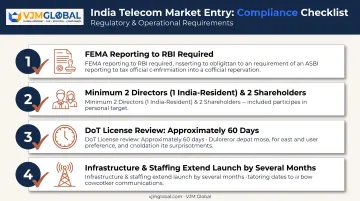
The most common miss? Founders treat Pvt Ltd incorporation as the finish line, then discover they can't legally operate until the sector-specific DoT license is in hand.
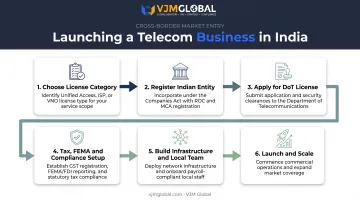
How to Start a Telecom Business in India – Step by Step
The path breaks into practical stages shaped by India's telecom rules. Two mistakes show up repeatedly: choosing a license category that outruns available capital, and trying to run day-to-day operations remotely from the US.
Step 1 – Choose Your Telecom Business Model and License Category
Identify which segment fits your capital and goals:
- Internet Service authorisation (circle/metro or national)
- Unified Service Authorisation for broader access and data services
- Infrastructure Provider (IP-I) for passive infrastructure only
- VNO to resell over an existing operator's network
Match geographic scope to realistic funding. A pan-India license without the bandwidth agreements or infrastructure to support it is a common and expensive mistake.
Step 2 – Structure and Register Your Indian Entity
Incorporate a Private Limited Company through the MCA, complete with Digital Signature Certificates and Director Identification Numbers for all directors. DSCs take about two days, DIN allotment about one day, and full incorporation typically runs another week or so.
Set the object clause in your MOA/AOA to specifically reflect telecom activity. A generic clause can delay or block your DoT license application later. Caught early, that gap is fixable; missed, it gets costly.
Step 3 – Apply for the DoT License and Regulatory Approvals
Submit your application through DoT's Authorisation Portal (the successor to Saral Sanchar) with:
- Certificate of incorporation and Indian-company status
- Board resolution authorising the application
- Shareholding and equity documentation
- Network diagram and business plan
Pay the processing fee, entry fee, and required bank guarantee for your license category. Incomplete FDI or equity paperwork is the single biggest cause of avoidable delay in this stage.
Step 4 – Set Up Tax, FEMA, and Ongoing Compliance
Register for PAN, TAN, and GST before commencing operations. Separately, complete FEMA reporting for the foreign capital that funded your Indian entity. That generally includes Form FC-GPR for the share allotment and the Annual FLA Return to the RBI, filed through the FIRMS portal.
Once operational, ongoing obligations stack up fast:
- Statutory audit under the Companies Act
- Annual ROC/MCA filings and director disclosures
- AGR-based license fee reporting to DoT, at 8% of Adjusted Gross Revenue, paid in quarterly installments
Compliance is ongoing and tied directly to license renewal. Treating it as a checkbox exercise is how licenses get flagged.
Step 5 – Build Infrastructure, Bandwidth, and a Local Team
Set up core network architecture (NOC, routers, servers) and lock in wholesale bandwidth agreements. VNOs specifically need a signed commercial agreement with a parent Network Service Operator before they can deliver anything to a customer.
Hire local technical and compliance staff. Remote US-based management can't cover on-ground network operations or DoT liaison work. VJM Global can run payroll and HR compliance for those local hires once the entity exists.
Step 6 – Launch, Monitor Compliance, and Scale
Launch within your authorised service area and track subscriber growth, churn, and AGR revenue for regulatory reporting. Stabilize operations and compliance in that first area before applying to expand geography or upgrade your license category. Expanding too early, before the first market is cash-flow stable, is the most common way ambitious operators stall out.
Conclusion
Starting a telecom business in India from the USA comes down to matching license category to actual capital and operational capacity. Company registration is the easy part.
FDI access and government incentive programs make the market genuinely attractive. They don't replace disciplined compliance or realistic infrastructure planning.
Stabilize one license area first. Scale geography and service categories only after that first market can sustain itself. For entity formation, FEMA/FDI filings, and ongoing India compliance, a cross-border advisory team can run the statutory work while you focus on licenses and operations.
Frequently Asked Questions
How much money is required to start a telecom company in India?
Entry fees alone range from around ₹50,000 for a circle-level Internet Service authorization to ₹3 crore or more for a pan-India Unified Service Authorization (VNO). Infrastructure build-out and bandwidth contracts typically cost far more than the entry fee itself.
Can a US citizen or US company start a telecom business in India?
Yes. India permits 100% FDI in telecom/ISP services via the automatic route, but you still need to incorporate an Indian entity, secure the relevant DoT license, and meet FEMA/RBI reporting requirements.
Is a telecom business in India profitable?
Profitability depends on license category, capital discipline, and local execution. Underserved regional markets carry less competition, while pan-India operations need serious scale to turn a profit.
Which telecom license is right for a US company entering India?
It depends on target geography and available capital. A VNO or circle-level Internet Service authorization suits regional entry; a Unified License fits pan-India ambitions.
How long does it take to get a telecom license in India?
DoT review is often estimated at around 60 days for a complete application, though this isn't an official published SLA. Infrastructure setup and staffing typically add several more months before launch.
Do I need to live in India to run a telecom business there?
Ownership can be managed from the US, but day-to-day network operations, compliance, and DoT liaison work require a local team or a trusted on-ground partner.