Interest has grown for good reason. The Netherlands offers predictable EU market access, a business-friendly regulatory climate, major logistics infrastructure, and a decades-old tax treaty with Canada. This isn't just a large-corporation story, either — Canadian SMEs, tech founders, exporters, and independent consultants are all exploring Dutch entities.
This guide walks through the practical process: choosing a structure, understanding residency implications, and registering step by step.
TL;DR
- Choose a legal structure, register with the KVK (Chamber of Commerce), secure a business address, and complete tax registration.
- Residency and visa status decide what's realistic: owning a BV remotely differs from relocating to run one.
- The BV (private limited company) is the most common structure for foreign founders.
- CETA gives Canadian businesses a real trade advantage when using the Netherlands as an EU base.
- Registration itself takes 2-4 weeks; add months if immigration is part of the plan.
What Is Involved in Starting a Business in the Netherlands from Canada?
Starting a business in the Netherlands from Canada means registering a legal Dutch entity with the KVK (Dutch Chamber of Commerce), whether you stay based in Canada or relocate.
There are two broad paths:
- Operating remotely — owning a BV or a branch office from Canada without relocating
- Relocating — moving to the Netherlands under a residence permit to run the business in person
Canadians commonly use one of three structures:
- BV (private limited company) — separate legal entity with limited liability
- Branch office — an extension of an existing Canadian company
- Sole proprietorship — only workable if you live in the Netherlands
What to Know Before You Start
Before the paperwork, get clear on residency rules, substance requirements, and the cross-border issues that trip up a lot of otherwise well-prepared founders.
Residency and Presence Requirements
Non-EU founders, Canadians included, generally don't need to relocate to own a BV. KVK's registration process is built for directors living abroad, and documentation can be handled by post when you can't visit an office in person.
Sole proprietorships work differently. They require actual Dutch residency, since KVK ties registration to either a Dutch home address (if you'll be in the country more than four months) or a Dutch visiting address (for shorter stays).
Economic substance is the other trap. A BV managed entirely from Canada, with no real decision-making on Dutch soil, can face scrutiny over where it is actually tax resident. The Dutch tax authority (Belastingdienst) looks at where management and the head office genuinely sit, not just where the paperwork says.
Time and Effort Expectations
Incorporation itself typically takes 2-4 weeks. Building actual operations — a working address, a bank account, staff — takes considerably longer.
There's a meaningful difference between:
- Using the Netherlands purely as a legal EU base (lighter footprint, less local activity)
- Actually operating day to day in the country (deeper commitment, more compliance)
Know which one you're actually building before you commit to a structure.
Why Start a Business in the Netherlands from Canada (When It Makes Sense)
This isn't a guaranteed win for every Canadian business. It makes sense under specific conditions.
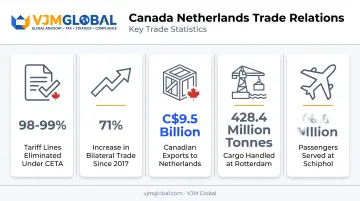
- Trade access: CETA eliminates duties on roughly 98% of tariff lines at entry into force, rising toward 99% overall. A 2025 European Commission evaluation reported a 71% increase in bilateral trade since provisional application began in 2017.
- Export scale: In 2025, the Netherlands was Canada's largest EU export market, with C$9.5 billion in Canadian goods exports.
- Logistics position: Rotterdam is Europe's largest port (428.4 million tonnes of cargo in 2025). Schiphol Airport served 68.8 million passengers and 300 destinations across five continents that year.
- Tax treaty coverage: The Canada–Netherlands income-tax convention (1986; protocols 1993 and 1997) is the framework for double-taxation and dual-residence questions.
- Low capital barrier: A BV requires as little as €0.01 in share capital per KVK guidance, though notary and registration costs still apply.
- Language and culture: High English proficiency across Dutch business, banking, and government shortens the learning curve for Canadian founders.
Early Decisions That Matter
Most problems here come from underestimating cross-border complexity. A few areas are commonly overlooked:
- Structure choice: A BV limits liability to the company. A branch office is a legal extension of the Canadian parent, so the parent carries full liability for Dutch operations.
- Real costs: Registration fees are modest, but notary fees for a BV typically run €500–€1,500. Ongoing compliance from abroad (accounting, filings, translation) adds up over a year.
- Residence permits: You do not need a visa only to own a Dutch company remotely. A permit is required only if you move there to run it in person.
- Banking access: Non-resident founders often get stuck here. Traditional Dutch banks often expect in-person visits or a citizen service number (BSN), which non-resident directors do not have.
How to Start a Business in the Netherlands from Canada – Step by Step
The steps below break the process into practical stages. The most common mistakes are skipping substance planning and assuming remote ownership automatically avoids Dutch tax exposure: it doesn't.
Step 1 – Choose Your Legal Structure
Weigh your options against liability, tax, and control:
| Structure | Liability | Residency needed? |
|---|---|---|
| BV | Limited to the company | No |
| Branch office | Full parent liability | No |
| Sole proprietorship | Personal liability | Yes |
A common miss: picking sole proprietorship without realizing it requires you to actually live in the Netherlands. It's not a paperwork-only option.
Step 2 – Secure a Dutch Business Address and Notary
A BV must be incorporated through a Dutch civil-law notary, who prepares the deed and articles of association, then registers the company and its ultimate beneficial owners (UBOs) with KVK.
Canadians typically authorise a representative through power of attorney to complete this remotely — though execution requirements vary by notary, so confirm the process with yours before assuming it's fully hands-off.
Step 3 – Register with the KVK and Dutch Tax Authorities
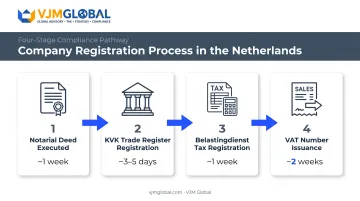
The registration flow runs in sequence:
- Notarial deed executed and filed
- KVK Trade Register registration, producing your KVK number
- Belastingdienst (tax) registration, generating an RSIN
- VAT number (BTW-nummer) issuance, where applicable
The one-time KVK registration fee is €85.15 as of January 2026. After Trade Register registration, expect a Tax Administration notice by post within about two weeks.
Step 4 – Address Residency and Work Permits (If Relocating)
Canada isn't in the EU/EEA, so relocating founders need a residence permit. The self-employment route is points-based, assessed across:
- Personal experience
- Business plan quality
- Added value to the Dutch economy
Applicants need at least 30 points in each area, or 45 points combined across personal experience and business plan. Immigration authorities (IND) publish a 90-day decision period for this route.
Note: VJM Global's services cover entity formation and compliance — not immigration or visa applications. For permit questions, work with a qualified immigration adviser alongside your compliance provider.
Step 5 – Open a Business Bank Account and Set Up Finances
This is often the most frustrating step for non-resident founders. Traditional Dutch banks frequently expect an in-person visit or a BSN, neither of which a Canadian director based abroad automatically has.
Coordinated formation support makes the banking path clearer. VJM Global handles Dutch BV setup end to end: civil-law notary coordination, KVK registration, UBO-register filing, and Belastingdienst registration for the RSIN and VAT number.
On the finance side, the firm supports bookkeeping, bank and ledger reconciliations, and management reporting in Xero, QuickBooks, or NetSuite, so Canadian founders are not chasing every filing manually.

Step 6 – Establish Local Substance and Stay Compliant
Genuine substance means real decision-making happening in the Netherlands, not just a mailing address. Ongoing obligations include:
- Corporate tax filing (vennootschapsbelasting)
- VAT returns at the standard 21% rate
- Annual accounts filed with KVK
For Canadian companies hiring Dutch staff without a full entity, VJM Global's Employer of Record service can act as the local legal employer. That covers Dutch employment contracts, payroll, wage-tax withholding, and the 30% ruling for qualifying expatriate employees.
Multi-jurisdiction compliance support across Dutch and Canadian obligations also reduces the need to build an in-house finance team solely to stay compliant in both countries.
Conclusion
Starting a Dutch business from Canada comes down to matching your legal structure to your residency plans and CETA-driven trade goals:
- A BV works well for most remote founders
- A branch office suits companies extending existing Canadian operations
- A sole proprietorship only makes sense if you're relocating
Get clarity early on substance, tax residency, and banking access — these are where costly missteps happen, not at registration. Long-term success depends on maintaining genuine compliance and real local presence, not just filing paperwork and walking away.
VJM Global supports Canadian founders with Dutch entity formation, tax compliance, and ongoing corporate governance so you stay compliant after day one.
Frequently Asked Questions
What is the 5 year rule in the Netherlands?
It refers to the continuous residency requirement for obtaining Dutch permanent residence: five consecutive years on a valid permit, living mainly in the Netherlands. It's separate from business registration itself.
Can a Canadian own a Dutch BV without living in the Netherlands?
Yes. Dutch law doesn't impose a residency requirement on BV directors or shareholders. That said, tax substance considerations still apply if management decisions happen entirely from Canada.
How long does it take to register a company in the Netherlands from Canada?
Incorporation itself typically takes 2-4 weeks. Add extra time if a residence permit is part of your plan, since immigration decisions can take up to 90 days.
Do Canadians need a visa to start a business in the Netherlands?
No, not to own a BV remotely. A visa or residence permit only becomes necessary if you're relocating to run the business in person.
What is the cheapest way to start a business in the Netherlands?
A BV requires as little as €0.01 in minimum capital. A branch office can also serve as a lower-cost way to test the market before committing to a full subsidiary.
Does Canada have a trade agreement that benefits businesses set up in the Netherlands?
Yes: CETA. It eliminates duties on roughly 98-99% of tariff lines between Canada and the EU, making a Dutch entity a strong base for accessing the broader European market.