Introduction
India and Vietnam have set an ambitious bilateral trade target of $25 billion by 2030, and the corridor is already moving. Two-way trade hit $18.28 billion, up 15.98% year-on-year, according to the Indian Embassy in Hanoi.
Vietnam's rise as a preferred "China+1" hub and ASEAN gateway is no longer boardroom theory. It's happening.
Yet many Indian companies still stumble at the entry stage. They pick the wrong structure, underestimate timelines, or assume Vietnamese business culture works like other ASEAN markets. It doesn't.
This article breaks down the real market opportunity, the entry structures available, the legal and tax framework, the best regions for Indian investment, and the pitfalls that trip up first-time entrants.
Key Takeaways
- Vietnam's 8.0% GDP growth in 2025 and young workforce make it one of Asia's most active investment destinations
- Entry structure should match your objective — testing demand differs entirely from building a manufacturing base
- No blanket foreign ownership restriction applies, but conditional sectors need early screening
- Full setup typically takes 3-6 months, not the few statutory weeks often advertised
- Regional choice (North, Central, South) matters as much as the legal structure itself
Why Vietnam Is a High-Potential Market for Indian Businesses
Vietnam's economy expanded 8.0% in 2025, according to the World Bank, with growth projected at 6.8% for 2026. Population is about 102.3 million, and roughly 68% are of working age: a demographic dividend few Southeast Asian economies can match right now.
Indian investment is already sizeable. The Indian Embassy in Vietnam records 473 valid Indian FDI projects worth over $1.11 billion in registered capital.
It estimates actual Indian-linked investment closer to $2 billion once third-country routing is factored in. Well-known names on the ground include:
- Tata Coffee, running a 5,000 MTPA freeze-dried coffee plant in Binh Duong since 2019
- ONGC Videsh, present since 1988 through Block 06.1
- HCLTech, operating a Vietnam delivery centre since July 2020
- Wipro Consumer Care, manufacturing FMCG products locally
- Adani Group, reportedly exploring up to $3 billion across ports and renewables
Three Opportunity Categories
Indian firms are entering Vietnam through three broad channels:
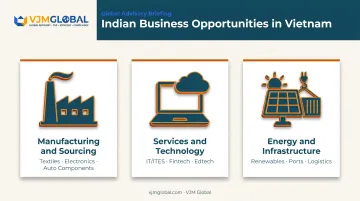
- Manufacturing and sourcing — textiles, electronics, and auto components benefiting from lower labour costs and export infrastructure
- Services and technology — IT/ITES, fintech, and edtech riding Vietnam's digital economy growth
- Energy and infrastructure — renewables, ports, and logistics, an area where Vietnam actively courts foreign capital
The "Vietnam + Global" Advantage
What sets Vietnam apart from a plain low-cost base is its FTA network. It sits inside the ASEAN-India Trade in Goods Agreement, RCEP, the EU-Vietnam FTA, and CPTPP.
India is not a party to RCEP, EVFTA, or CPTPP. Indian companies manufacturing in Vietnam can still reach those preferential markets when output meets local rules-of-origin requirements. That turns Vietnam into a re-export platform, not only a production site.
Key Factors Indian Businesses Must Evaluate Before Entering Vietnam
Vietnam isn't one market. It's three, and treating it as a single homogenous destination is a common early mistake.
- North (Hanoi, Hai Phong, Bac Ninh): Electronics and heavy industry concentration, closer to Chinese supply chains
- Central (Da Nang): Emerging logistics and port infrastructure, lower entry costs
- South (Ho Chi Minh City, Dong Nai): Consumer demand, financial services, and commercial density
Each region has different regulatory presence and industry clusters, so your site-selection process should start with the sector, not the map.
Geography is only the first filter. Relationship-building takes longer here than in most ASEAN markets. Vietnamese business culture runs on trust and consensus rather than speed. A nod or smile in a meeting doesn't equal agreement — it often just means the conversation continues.
Indian firms accustomed to faster deal cycles in Singapore or the UAE need to budget extra time for in-person visits and introductions through trusted intermediaries.
Finally, screen your sector early. Telecom, education, distribution, and logistics remain conditionally restricted, with ownership caps, licensing requirements, or capability tests attached. Skipping this screening before structuring your entity is where many timelines fall apart.
Choosing the Right Market Entry Structure and Process in Vietnam
There's no single "correct" entry vehicle. The right choice depends on how much control you need versus how fast you want to move.
| Structure | Best For | Trade-off |
|---|---|---|
| Local distributor | Testing demand without capital commitment | Limited control over branding and pricing |
| Representative Office | Market research, liaison activity | Cannot generate direct revenue |
| WFOE (Wholly Foreign-Owned Enterprise) | Full operational and equity control | Higher setup cost and compliance burden |
| Joint Venture | Regulated or relationship-dependent sectors | Requires governance clarity upfront |
| M&A/acquisition | Fast market entry with existing infrastructure | Due diligence complexity, integration risk |
The Incorporation Process
Vietnam's newer Law on Investment (143/2025/QH15) has changed sequencing for some investors, allowing an ERC-first route in specified cases. The process runs through:
- Pre-investment screening: confirm sector market-access status and any conditions
- Investment Registration Certificate (IRC) or ERC-first route, depending on eligibility
- Enterprise Registration Certificate (ERC)
- Corporate e-ID registration: mandatory for business use since July 2025
- Post-licensing steps: tax registration, company seal, bank account, and labour registration
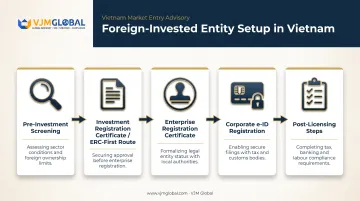
Statutory IRC processing runs around 15 days, with ERC issued in roughly 3 working days for a complete dossier. Those figures cover paperwork only. Between conditional-sector review, document legalisation, banking setup, and site approvals, most Indian investors should plan for 3-6 months end-to-end.
Match structure to objective:
- Testing the market → distributor or Representative Office
- Long-term manufacturing with full control → WFOE
- Regulated sectors or fast local access → Joint Venture
A local partner isn't legally mandatory for most sectors, but a JV can accelerate licensing where regulation is dense.
Legal, Tax, and Compliance Framework Indian Investors Must Navigate
Two statutes anchor Vietnam's corporate framework: the Law on Enterprises (59/2020/QH14, as amended) and the current Law on Investment (143/2025/QH15). Recent amendments specifically affect licensing sequences and conditional-sector treatment, so relying on older guidance can mislead your planning.
Tax Rates to Budget For
- Standard CIT: 20%
- Reduced CIT: 15% (revenue up to VND 3 billion) or 17% (VND 3-50 billion), per PwC's Vietnam tax summary
- VAT: 0% for exports, 5% for essential goods, 10% standard (temporarily 8% through end-2026 on eligible supplies)
- Foreign Contractor Tax: typically 5% VAT plus 5% CIT on cross-border service payments to unlicensed foreign contractors
Mandatory Compliance Obligations
Foreign-invested entities in Vietnam must handle:
- Annual statutory audit by a Ministry of Finance-approved Vietnamese auditor
- Transfer pricing documentation under Decree 132/2020-ND-CP for related-party transactions
- Interest deductibility cap at 30% of EBITDA on related-party net interest
- Social insurance contributions: 17.5% employer / 8% employee for SI, plus 3% / 1.5% for health insurance
Available Incentives
Qualifying projects in high-tech, renewable energy, or education can access CIT holidays (commonly 4 exempt years plus 9 half-rate years), preferential rates as low as 10%, and land rent exemptions tied to location and sector.
Indian FEMA/ODI rules sit alongside Vietnamese entity and tax law, so the real risk is treating them as two separate workstreams. VJM Global supports Indian businesses on that dual layer: Outbound Direct Investment (ODI) compliance under FEMA, multi-jurisdiction transfer pricing documentation, and coordinated planning so both sides of the investment are handled as one process.
Best Regions in Vietnam for Indian Investment
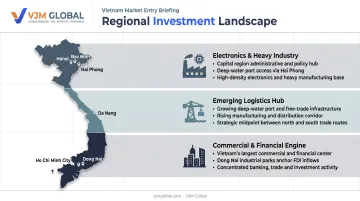
Vietnam’s investment map splits into three belts. Match the region to your sector, cost tolerance, and how fast you need market access.
Northern Vietnam
Hanoi, Hai Phong, and Bac Ninh form an electronics and automotive corridor.
- Bac Ninh hosts a major Samsung complex
- Hai Phong’s Lach Huyen and Dinh Vu ports link to Hanoi on a 105 km expressway
- Proximity to Chinese supply chains suits Indian electronics and component makers
Central Vietnam
Da Nang is building toward a logistics-hub role by 2030, anchored by the Lien Chieu cargo port project and deep-water Tien Sa port.
- Land and labour costs sit below North and South levels
- Strong early-mover window for Indian industrial projects before costs rise
- Better fit when you can trade some ecosystem depth for lower entry cost
Southern Vietnam
Ho Chi Minh City and Dong Nai remain Vietnam’s commercial engine—and the usual default when speed beats pure cost.
- Dong Nai’s government prioritises manufacturing and processing FDI
- HCMC offers the deepest consumer market and financial-services base
- Best path for Indian firms that need talent, buyers, and banking depth quickly
Common Pitfalls and Risk Mitigation for Indian Companies Entering Vietnam
Three mistakes show up repeatedly when Indian companies enter Vietnam:
- Treating Vietnam as a pure cost play. Teams focused only on price and efficiency under-invest in relationship-building, and Vietnamese partners notice. Trust takes visits, introductions, and time — not just a competitive quote.
- Picking a structure before validating demand. Setting up a full wholly foreign-owned enterprise (WFOE) before testing the market wastes capital if assumptions turn out wrong. Entering a joint venture (JV) without clear governance terms upfront creates disputes later, not efficiency.
- Assuming ASEAN uniformity. Vietnam's rules don't mirror Singapore, Thailand, or Indonesia. Conditional sectors, licensing sequences, and recent legal amendments (such as the 2025 Investment Law changes) all need fresh local verification.
The fix across all three: engage local legal, tax, and compliance expertise before finalising structure or location. It costs less than unwinding a bad decision six months in.
Frequently Asked Questions
What are the best market entry strategies for Indian companies entering the Vietnam market?
It depends on your objective and risk appetite. Use distributors for market testing, Representative Offices for research, Wholly Foreign-Owned Enterprises (WFOEs) for full control, and JVs or M&A for regulated sectors or faster scale.
What is the minimum capital requirement for a foreign-owned company in Vietnam?
There's no statutory minimum outside conditional sectors like banking or real estate. Authorities still expect registered capital to realistically match your stated business plan.
How long does it take to set up a business in Vietnam?
Statutory incorporation can take a few weeks, but the full process, including licensing, tax registration, and bank setup, typically runs 3-6 months.
Can Indian firms fully own their companies in Vietnam?
Yes, 100% foreign ownership is allowed in most sectors. Restrictions mainly apply to telecom networks, defence-related activity, and select logistics segments.
What tax incentives are available for Indian investors in Vietnam?
Corporate Income Tax (CIT) holidays, reduced CIT rates (as low as 10%), and land rent exemptions are available for high-tech, renewable energy, and select priority-sector investments.
Do Indian companies need a local partner to enter Vietnam?
No, a local partner isn't required in most sectors. Joint ventures can still help navigate regulated industries or speed up market access where licensing is complex.