Introduction
India-Vietnam bilateral trade hit US$15.76 billion in April 2024–March 2025, up 6.40% year-on-year according to the Indian Embassy Hanoi — and that number is still climbing. For Indian businesses expanding into Southeast Asia, Vietnam has moved from an interesting option to a serious priority.
Market opportunity and market readiness are different things. Many Indian entrepreneurs assume setting up a company in Vietnam works the same as registering a private limited company back home — it doesn't. Pick the wrong structure and you'll face regulatory delays, restricted business activities, or tax problems that a single earlier decision could have prevented.
What follows covers every company structure available to Indian investors in Vietnam — how each works, what it costs you in time and compliance, and which one fits your specific business goals.
Key Takeaways
- Vietnam offers five entry structures for Indian investors: LLC, JSC, Representative Office, Branch Office, and Business Cooperation Contract (BCC)
- The LLC suits most Indian SMEs; the RO is fastest for market testing only
- 100% foreign ownership is permitted in most sectors — but not all
- Indian outward investments must comply with RBI/FEMA regulations, not just Vietnamese law
- Choosing a structure based on speed alone — rather than operational fit — routinely costs Indian founders more to fix later
Why Vietnam Matters for Indian Businesses Right Now
Vietnam's GDP grew 8% in 2025 according to the World Bank, with 6.8% projected for 2026. For Indian businesses, several factors make this a genuinely actionable opportunity — not just a headline statistic.
Vietnam features directly in India's Act East Policy, which Prime Minister Modi formalised at the 2014 East Asia Summit to deepen trade and investment ties with Southeast Asia. More Indian businesses are now acting on that signal — and the on-the-ground numbers back the move.
The structural advantages are worth spelling out:
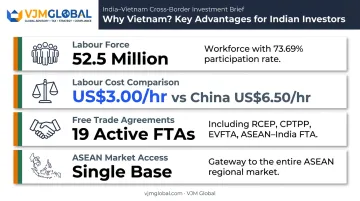
- A labour force of 52.5 million with a 73.69% participation rate (World Bank, 2024)
- Manufacturing labour costs significantly lower than China's (BCG data via Vietnam Briefing cites China at US$6.50/hour vs Vietnam at US$3.00 in 2020)
- 19 active free trade agreements as of October 2024, including RCEP, CPTPP, EVFTA, and the ASEAN-India FTA
- ASEAN market access from a single operational base
Those advantages come with a non-negotiable condition: Vietnam operates under its own Enterprise Law and Investment Law, and Indian investors are classified as foreign investors subject to those rules. Knowing which company structures are available — and which apply to your business — is where any serious entry plan has to start.
Types of Companies Indian Investors Can Set Up in Vietnam
Vietnam's Enterprise Law 2020 (Law No. 59/2020/QH14) and Investment Law 2020 (Law No. 61/2020/QH14) govern what structures foreign investors — including Indians — can use. There is no India-specific carve-out; Indian nationals and entities are subject to the same rules as any other foreign investor.
Limited Liability Company (LLC)
The LLC is the default choice for most Indian SMEs entering Vietnam, and for good reason.
How it works: A single-member LLC is owned by one individual or organisation. A multi-member LLC has between 2 and 50 members. Both can be 100% foreign-owned in most sectors. Members' liability is capped at their capital contribution — similar in concept to an Indian Private Limited Company.
What it's suited for:
- Trading, manufacturing, and service businesses
- Companies wanting full operational control from day one
- Indian founders who don't need a Vietnamese joint-venture partner
- Revenue-generating operations (invoicing, contracting, employing staff)
Key constraints to know:
- All charter capital must be contributed within 90 days of Enterprise Registration Certificate (ERC) issuance — Indian founders need to plan the RBI remittance timeline accordingly
- An LLC cannot issue shares, which limits public fundraising
- Governance requires a Members' Council and General Director — administrative overhead that some founders underestimate
- No statutory minimum capital for most industries, but the Department of Planning and Investment assesses whether the declared amount is adequate for planned operations
Joint Stock Company (JSC)
A JSC is the structure for Indian companies with larger ambitions in Vietnam — fundraising, institutional investors, or an eventual listing on the Ho Chi Minh Stock Exchange (HOSE).
How it works: Minimum three shareholders, no maximum. Capital is divided into transferable shares. If a JSC has more than 11 shareholders, or if any shareholder group holds more than 50% of shares, a Board of Controllers is required under Article 137 of the Enterprise Law.
What it's suited for:
- Indian companies planning to bring in external investors
- Businesses targeting an IPO-track growth path in Vietnam
- Structures where share transferability matters
The trade-offs:
- More complex governance: General Meeting of Shareholders, Board of Directors, General Director, and in many cases a Board of Controllers
- Founding shareholders face a 3-year restriction on share transfers unless shareholders' meetings approve otherwise
- Setup is longer than an LLC — plan for 6–8 weeks vs. 4–6 weeks
- Listing on HOSE requires the entity to be a JSC; an LLC structure cannot list
Representative Office (RO)
An RO is a dependent unit of the Indian parent — not a separate legal entity. Registered under Decree 07/2016/ND-CP, its sole purpose is to represent the parent without generating revenue.
Permitted activities:
- Market research
- Promoting the Indian parent's services
- Liaison with potential local partners
- Preparatory and supporting functions
What it cannot do: Sign commercial contracts in its own name, invoice Vietnamese clients, or generate profit. All operating costs must be funded by the parent company in India.
Where it fits: Indian IT, pharmaceutical, and manufacturing companies that want to evaluate the Vietnamese market before committing capital to a full entity. The RO setup process typically takes 3–4 weeks, requires no charter capital, and carries minimal ongoing tax obligations.
Once your business needs to earn revenue in Vietnam, the RO is the wrong structure. Operating commercially through an RO is prohibited and can trigger penalties and forced re-registration.
Branch Office
A branch can engage in commercial activities and generate revenue — a step up from an RO. Unlike an LLC or JSC, however, it is not a separate legal entity; the Indian parent company bears full legal and financial liability for everything the branch does.
Key facts:
- Governed by Decree 07/2016/ND-CP, with sector-specific oversight from MOIT or relevant ministries
- The Indian parent generally must have been operating for at least 5 years before a branch can be established
- Branch licences are valid for up to 5 years and are renewable
- Not all sectors permit ordinary branch licensing — banking and insurance branches are governed by their own sector-specific regulatory frameworks
For most Indian founders, unlimited parent-company exposure to Vietnamese operations is a significant risk. An LLC provides cleaner liability separation.
Business Cooperation Contract (BCC)
A BCC is a contractual arrangement under Article 27 of Vietnam's Investment Law 2020, not a registered company. Parties cooperate on a defined business activity and share profits or products as specified — without creating a new legal entity.
The Investment Law 2020 allows BCCs between domestic investors, between domestic and foreign investors, or between foreign investors only. A Vietnamese counterparty is not always legally required, though in practice many BCCs do involve a local partner.
Where BCCs are commonly used: Project-based sectors such as infrastructure, telecommunications, oil and gas, and natural resources.
What to watch:
- Because there's no separate registered entity, the contract itself governs the entire relationship
- Due diligence on any Vietnamese partner and careful contract drafting are essential
- BCCs involving foreign investors still require IRC procedures under Investment Law Article 38
How to Choose the Right Structure as an Indian Investor
The structure decision comes down to four questions:
Do you need to generate revenue in Vietnam from day one? If yes, only an LLC, JSC, or Branch Office qualifies. An RO and most BCCs are off the table for revenue-generating operations.
Does your sector restrict foreign ownership? Decree 31/2021/ND-CP identified 25 prohibited and 58 conditional sectors for foreign investors. Retail distribution, certain education services, some healthcare activities, and media/publishing are among the areas with conditions or caps. Sector-specific rules — updated under the 2026 amendments to Vietnam's investment regulations effective March 2026 — must be checked before assuming 100% ownership is available.
Are you planning to raise external capital or list in Vietnam? If the answer is yes at any point in the next five years, start with a JSC. Converting an LLC to a JSC after registration requires a formal amendment process with Vietnamese authorities — it's manageable but adds time and cost when you're trying to move fast.
Have you addressed the Indian side of the equation? This is where many Indian founders get caught out. Outward investments from India are governed by the Foreign Exchange Management (Overseas Investment) Rules and Directions 2022, notified by RBI on 22 August 2022. Three obligations apply before a single rupee moves:
- All remittances must route through an Authorised Dealer Category-I bank — direct transfers to Vietnam are not permitted
- Total financial commitment to foreign entities is capped at 400% of the investor's net worth per the last audited balance sheet
- Annual Performance Reports (APRs) must be filed with the RBI for every overseas entity where ODI exists
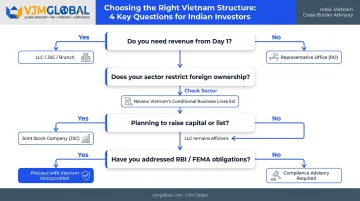
This dual compliance layer — Vietnamese incorporation on one side, RBI/FEMA obligations on the other — is where most Indian investors underestimate the workload. VJM Global's FEMA advisory practice handles outbound investment structuring, RBI approvals, and ongoing statutory compliance, so Indian businesses can focus on the Vietnam side without missing obligations back home.
Compliance Obligations for Indian-Owned Companies in Vietnam
Vietnamese Compliance Requirements
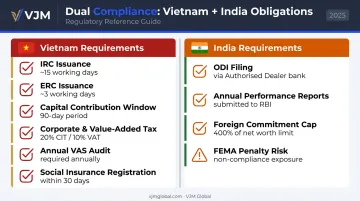
Any revenue-generating entity (LLC, JSC, or Branch) must obtain two certificates before commencing operations:
- Investment Registration Certificate (IRC): Typically issued within approximately 15 working days of application under the Investment Law
- Enterprise Registration Certificate (ERC): Issued within 3 working days of a valid application under the Enterprise Law
Charter capital must be fully contributed within 90 days of ERC issuance.
Ongoing obligations include:
| Obligation | Key Detail |
|---|---|
| Corporate Income Tax (CIT) | Standard rate 20%; preferential rates of 10%, 15%, or 17% for qualifying sectors and locations |
| Value-Added Tax (VAT) | Standard rate 10%; 0% and 5% rates also apply depending on goods/services (Law 48/2024/QH15, effective July 2025) |
| Financial statements | Prepared under Vietnamese Accounting Standards (VAS); annual independent audit required |
| Social insurance | Employer registration required within 30 days of hiring employees |
Indian Compliance Requirements
Vietnamese-side registration is only half the picture. Indian parent entities must simultaneously maintain compliance under FEMA and RBI guidelines. Obligations include:
- File ODI-related documentation through their Authorised Dealer bank
- Submit Annual Performance Reports (APRs) to the RBI for each foreign entity where ODI exists
- Ensure total foreign financial commitments remain within the 400% net worth cap
Non-compliance on the Indian side carries FEMA penalties regardless of Vietnamese-side compliance status. APRs are due annually, and missing filings can trigger compounding charges — so both tracks need active monitoring from day one of the investment.
Common Mistakes Indian Companies Make When Choosing a Structure
Picking the wrong structure is rarely obvious at the start — the consequences show up months later during audits, client invoicing, or fundraising. These are the most common missteps Indian companies make:
- Registering an RO with plans to invoice Vietnamese clients — this is prohibited under Vietnamese law and typically results in forced re-registration plus penalties
- Opting for a JSC when an LLC would work fine — the governance overhead, setup time, and compliance costs are higher without a concrete fundraising or listing plan to justify them
- Overlooking RBI/FEMA outward investment requirements — Vietnamese law alone does not cover your obligations; the gap creates legal exposure back in India
- Replicating a competitor's structure without checking whether their sector restrictions, revenue model, or ownership intent actually match yours
Getting the structure right from the start is far less costly than correcting it after operations are underway.
Frequently Asked Questions
Can Indians start a business in Vietnam?
Yes. Indian nationals and Indian companies can establish businesses in Vietnam and are treated as foreign investors under Vietnamese law. 100% ownership is permitted in most sectors, though some industries require a Vietnamese partner or impose ownership conditions.
Can an Indian company own 100% of a company in Vietnam?
In most sectors, yes. However, certain sectors — including retail distribution, some media activities, and parts of education and healthcare — impose ownership caps or require a Vietnamese joint-venture partner. Always check the applicable sector conditions before selecting your structure.
What is the minimum capital required to register a company in Vietnam?
There is no statutory minimum for most industries, but the Department of Planning and Investment assesses whether declared charter capital is adequate for planned operations. Regulated sectors such as banking, finance, and language training centres have specific minimum capital requirements set by sector law.
How long does it take to register a company in Vietnam from India?
An LLC or JSC typically takes 6–10 weeks in total — the Investment Registration Certificate (IRC) takes approximately 15 working days and the Enterprise Registration Certificate (ERC) takes around 3 working days, plus post-registration steps. A Representative Office can be set up in approximately 3–4 weeks. Timelines vary by sector and document readiness on both sides.
Do Indian companies need a local Vietnamese partner?
Indian companies can establish a fully foreign-owned LLC or JSC without a local partner in most sectors. In conditional or restricted sectors, partial local ownership or a Vietnamese joint-venture partner may be required.
What Indian regulations apply when investing in Vietnam?
Indian companies making outward investments must comply with the Foreign Exchange Management (Overseas Investment) Rules and Directions 2022. This includes filing through an Authorised Dealer bank and submitting Annual Performance Reports to the RBI. Non-compliance carries FEMA penalties regardless of Vietnamese compliance status.