Introduction
Picture this: an entrepreneur in Mumbai spends 20 minutes filling out an online LLC formation form for their new U.S. business. They complete every field, pay the filing fee, and hit submit — never noticing the registered agent field buried midway through the form. They enter their India address. The state rejects the filing.
This happens more often than it should. For non-resident founders, the registered agent requirement is one of the most misunderstood steps in U.S. entity formation — and one of the most consequential to get wrong.
This article covers what a registered agent actually is, why every LLC and corporation must have one, who qualifies, what the role involves, and what happens when the designation lapses.
Key Takeaways:
- Every active U.S. LLC and corporation must designate a registered agent, with no exceptions
- The agent must maintain a physical street address (not a P.O. Box) and be available during business hours
- Non-resident founders cannot serve as their own agent — a commercial service is required
- A lapsed agent can trigger administrative dissolution and exposure to default judgments
- Commercial registered agent services typically cost $99–$200 per year
What Is a Registered Agent?
A registered agent is the person or entity formally designated to receive legal documents, state correspondence, and official notices on behalf of an LLC or corporation. This is a legal requirement under state law — not a formality you can skip or defer.
The Two Core Requirements
Most states require the agent to meet two baseline conditions:
- Physical street address in the state of formation (P.O. Boxes are not accepted)
- Physical availability during normal business hours — Florida statute, for instance, specifies the office must be open at least 10 a.m.–noon and 2–4 p.m. on weekdays
Agent vs. Registered Office
These two terms get confused regularly, but they refer to different things. Delaware law is explicit on this point: the registered agent is the person or entity authorized to receive documents; the registered office is the physical address where delivery occurs. One is the recipient, the other is the location.
State Terminology Varies
The same role goes by different names depending on where you form your entity:
| State | Official Term |
|---|---|
| Arizona, Ohio | Statutory agent |
| Maryland, Michigan | Resident agent |
| Rhode Island (LLCs) | Resident agent |
| California | Agent for service of process |
| New York | Secretary of State (mandatory for LLCs); private agent optional |
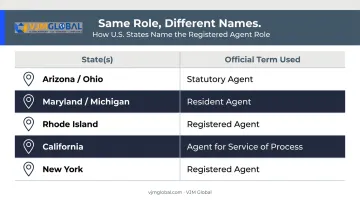
New York's model is the clear exception here. Under LLC Law 301, the Secretary of State serves as the agent for domestic and authorized foreign LLCs by default — making New York the exception to the "private agent with street address" model that most states follow.
The registered agent's name and address become part of the public record maintained by the Secretary of State — searchable by anyone.
Why Every LLC and Corporation Must Have a Registered Agent
Every U.S. state requires active business entities — LLCs, corporations, LPs, and LLPs — to designate and maintain a registered agent. There are no meaningful exceptions for small businesses or sole-member LLCs.
Service of Process
When someone files a lawsuit against your business, they serve the registered agent with the complaint and summons. That delivery counts as official legal notice to the business. Without a valid agent on file, a plaintiff may still be able to proceed — they just serve the Secretary of State instead.
This is where the real exposure lies. In Katy Venture, Ltd. v. Cremona Bistro Corp., businesses that had moved without updating their registered office address received process at the wrong location. The Secretary of State's forwarded notices were returned undelivered. A default judgment exceeding $820,000 followed before the Texas Supreme Court later addressed equitable review. The case illustrates severe exposure, even if not every missed-agent default is irreversible.
State Correspondence
State authorities send critical compliance notices to the registered agent's address. Delaware, for example, sends notifications to all registered agents each December. Failing to receive them can trigger:
- Late fees on annual reports and franchise tax filings
- Administrative dissolution of the entity
- Loss of good standing, which blocks bank accounts, contracts, and foreign qualifications
The Non-Resident Founder Problem
Foreign entrepreneurs and NRIs forming a U.S. LLC face a harder constraint: if you don't live in the state of formation, you cannot serve as your own registered agent. This makes the registered agent decision one of the first practical steps in the formation process, not a checkbox to tick later.
VJM Global works with international founders on U.S. business formation from the start — including selecting a compliant registered agent before the LLC paperwork is filed.
Who Can Serve as a Registered Agent: 4 Options
Option 1 — Yourself (Owner/Founder)
Any individual who is at least 18 years old (required expressly in Wyoming and Maryland; verify your state's rule), resides in the state of formation, and has a physical address there can serve as their own registered agent. Cost: nothing beyond the time commitment.
The trade-offs are significant:
- Your personal name and home address appear in the public record
- You must be at that address during all business hours — no remote days, no travel
- You risk being personally handed legal papers in front of clients or family
Option 2 — An Officer, Member, or Employee
An internal person can fill the role using the same eligibility rules. The risk: when that person leaves the company, the registration must be updated immediately. Miss that update and the business loses its valid agent on file — a compliance gap that can trigger state penalties.
Option 3 — An Attorney or Accountant
A business's attorney or CPA can serve as registered agent, either as part of an ongoing engagement or for a separate fee. This works well for litigation-sensitive businesses but usually costs more than a commercial service — often $200–$500 per year higher.
Option 4 — A Commercial Registered Agent Service
Commercial registered agent companies maintain physical addresses across all 50 states and handle thousands of clients simultaneously. The main advantages:
- Keeps your home address off public filings by substituting theirs
- Removes the requirement to be physically present at an address during business hours
- Sends automated reminders for annual reports and state compliance deadlines
- Scales easily if you expand into additional states
Current pricing from major providers (verified July 2026):
| Provider | Annual Price | Notes |
|---|---|---|
| ZenBusiness | $99 first year / $199 renewal | All 50 states |
| Northwest Registered Agent | $125 | 1–4 states |
| Registered Agents Inc. | $200 | All 50 states + D.C. + Puerto Rico |
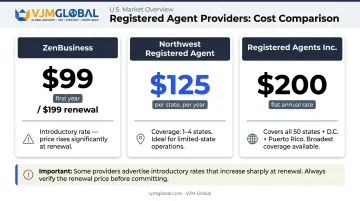
For non-resident founders, a commercial service is usually the only workable option. Compare renewal and per-state pricing carefully before committing, since introductory rates can more than double at renewal.
Key Responsibilities of a Registered Agent
A registered agent handles four main categories of documents:
- Service of process — lawsuits, summonses, subpoenas, and court orders
- State correspondence — annual report reminders, franchise tax notices, dissolution warnings, certificates of good standing
- Tax notices — from state revenue departments; routing varies by state and agency
- Regulatory correspondence — notices from industry-specific agencies
Forwarding and Document Management
Receiving documents is only half the job. A quality agent must forward them to the business promptly — ideally with same-day scanning and email notification — and maintain a digital record of all received correspondence. No statute imposes a universal same-day forwarding standard, so this is something to negotiate contractually. Slow forwarding can cause a business to miss a lawsuit response deadline — a contractual term worth specifying upfront.
Multi-State Operations
These document management responsibilities multiply as a business expands. When a company registers in additional states — a process called foreign qualification — it must maintain a separate registered agent in each state. Florida statute 605.0113, for instance, covers each foreign LLC holding a certificate of authority. This is where commercial services with nationwide physical offices offer the most practical advantage — one vendor relationship covering multiple states.
How to Choose the Right Registered Agent Service
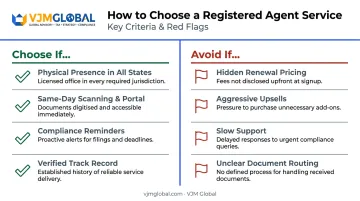
Four Criteria That Matter
Evaluate commercial registered agent services on these factors:
- Physical presence in every state where you are or plan to register (not just a mail-forwarding arrangement)
- Document handling that includes same-day scanning, email notification, and an online portal for accessing received documents
- Compliance reminders with proactive alerts for annual report deadlines and state fee due dates
- Track record of years in operation, verifiable customer reviews, and demonstrated responsiveness
Four Red Flags to Avoid
- Headline pricing that excludes scanning or notifications (read the fine print on renewal rates)
- Aggressive upsells for services unrelated to basic compliance
- Slow customer support — test response times before committing
- Multiple unrelated businesses listed at one address without clear document routing procedures
If a service raises any of these flags after you've already signed on, switching is straightforward in most states.
Changing Your Registered Agent
Most states allow a registered agent change via a Statement of Change filed with the Secretary of State. The change takes effect only once filed and confirmed. Do not stop using your current agent until the new designation is on record with the state.
What Happens If Your LLC Doesn't Have a Registered Agent
Administrative Dissolution
A lapsed or invalid registered agent gives the state grounds to administratively dissolve the LLC or corporation. Dissolution strips the entity of its liability protection and good standing. Getting back in good standing requires reinstatement paperwork and back fees.
In Florida, for example, LLC reinstatement costs $100 plus $138.75 for each missed report year, with card-paid filings typically posting within 2–3 business days. Once effective, reinstatement relates back to the dissolution date, but the process is an avoidable cost that disrupts normal operations in the meantime.
Default Judgment Risk
If no valid agent is on file, a plaintiff can serve the Secretary of State as a substitute agent (Texas BOC 5.251, for example, permits this). If the business never receives or responds to the lawsuit, a default judgment can be entered.
Default judgments are difficult and expensive to overturn. In Katy Venture and similar cases, the financial exposure reached six figures — entirely because the registered agent filing was out of date.
Registered agent maintenance is, at its core, litigation risk management. Letting it lapse is one of the easiest compliance mistakes to avoid — and one of the costliest when it isn't.
Frequently Asked Questions
Can a registered office address be a residential address?
In most U.S. states, yes — a home address qualifies as long as it is a physical street address in the state of formation, not a P.O. Box. The downside is that your home address becomes part of the public record, which is why many business owners prefer a commercial registered agent's address for privacy.
What does LLC mean in the USA?
LLC stands for Limited Liability Company. The IRS describes it as a structure allowed by state statute where members are generally not personally liable for entity debts. For tax purposes, the IRS may classify it as a corporation, partnership, or disregarded entity depending on elections made by the members.
Who is the resident agent for an LLC in Maryland?
"Resident agent" is Maryland's term for a registered agent. To find who is listed for your LLC, search the Maryland State Department of Assessments and Taxation's business database — it's publicly accessible without a login.
How do I check business name registration?
Search the Secretary of State's online business portal in the state where the LLC or corporation was formed. Most states offer a free search by entity name or registered agent name. Note: Texas charges a $1 fee through SOSDirect for entity-level searches.
Can I be my own registered agent for my LLC?
Yes, in most states — provided you are at least 18 years old, have a physical address in the state of formation, and can be available there during business hours. Non-residents forming an out-of-state LLC cannot meet this requirement and must use a commercial service.
What happens if my LLC does not have a registered agent?
The state can administratively dissolve the LLC, which removes its liability protection. Lawsuits may also proceed without the business's knowledge through substitute service on the Secretary of State, potentially resulting in default judgments that are difficult to reverse.