Introduction
The UK's accounting profession is split across several recognised bodies, each awarding its own chartered qualification for a specific professional niche. For students mapping a career path, employers hiring finance professionals, or international businesses working with UK subsidiaries, the differences between ICAEW, ACCA, CIMA, ICAS, and CIPFA are far from straightforward.
This guide breaks down the major UK accounting bodies, the qualifications they award, and how to determine which credential suits a specific role, sector, or business need.
Key Takeaways:
- The UK has five CCAB-member bodies, each offering a separate chartered qualification tied to a specific domain
- ACA (ICAEW) and ACCA are the two most widely recognised general accounting qualifications globally
- The closest UK equivalent to the US CPA is the ACA or ACCA designation
- The right qualification depends on your career goals, sector, and need for international mobility
The UK Accounting Regulatory Framework: CCAB and the FRC
The CCAB
The Consultative Committee of Accountancy Bodies (CCAB), formed in 1974, serves as the umbrella body for the UK's major chartered accounting organisations. Its five current members are:
- ICAEW (Institute of Chartered Accountants in England and Wales)
- ACCA (Association of Chartered Certified Accountants)
- CIPFA (Chartered Institute of Public Finance and Accountancy)
- ICAS (Institute of Chartered Accountants of Scotland)
- Chartered Accountants Ireland
CIMA was previously a member but announced its withdrawal in February 2011. It remains a major professional body despite no longer sitting within the CCAB structure.
The FRC and Audit Authority
The Financial Reporting Council (FRC) is the UK's designated competent authority for statutory audit. Under the Companies Act 2006, the FRC supervises two categories of bodies:
- Recognised Qualifying Bodies (RQBs) — authorise members to perform company audit work
- Recognised Supervisory Bodies (RSBs) — supervise registered auditors
Current membership across both categories breaks down as follows:
| Body | RQB Status | RSB Status |
|---|---|---|
| ACCA | ✓ | ✓ |
| AIA | ✓ | — |
| ICAEW | ✓ | ✓ |
| CAI | ✓ | ✓ |
| ICAS | ✓ | ✓ |
Only members of these bodies can register as statutory auditors in the UK — a distinction that separates professionally qualified accountants from unregulated practitioners.
CIPFA's recognition as an RQB was revoked by the FRC, effective 18 December 2017, meaning CIPFA members can no longer qualify as statutory auditors.
Major UK Accounting Bodies and Their Qualifications
The bodies below represent the primary pathways to chartered status in the UK. Each carries specific designatory letters, exam requirements, and a defined professional scope.
ICAEW and the ACA Qualification
The ACA (Associate Chartered Accountant) is awarded by the Institute of Chartered Accountants in England and Wales. Key facts:
- 15 exams across Certificate, Professional, and Advanced levels (for students who started before 1 July 2025; the Next Generation ACA from July 2025 has 14 exams)
- Minimum 450 days of practical work experience under an ICAEW-authorised training employer
- Mandatory ethics training throughout
- Associates use ACA; fellows (eligible after 10 years) use FCA
The ACA ranks among the most demanding accounting qualifications in the UK. It is typically employer-funded and completed over 3–5 years. ICAEW reports 172,273 members across 150 countries, with particular strength in audit, advisory, and Big Four environments.
For candidates who want broader global reach without a mandatory training contract, ACCA offers a different route.
ACCA and the Chartered Certified Accountant Qualification
ACCA's qualification is structured around:
- 13 exams plus an Ethics and Professional Skills Module
- 36 months of relevant supervised work experience
- No requirement to work for an ACCA-approved employer — candidates can train in any organisation
- Members use ACCA; fellows (after 5 years of continuous membership) use FCCA
ACCA's defining advantage is accessibility. It can be pursued by self-funded candidates globally without a formal training contract. ACCA reports over 257,900 members and 530,100 future members in 180 countries, making it one of the most internationally distributed accounting qualifications in the world.
Where ACA and ACCA focus on financial and public practice accounting, CIMA takes a different direction entirely — towards business and management finance.
CIMA and the CGMA Qualification
CIMA (Chartered Institute of Management Accountants) focuses on business and management accounting rather than statutory audit. The qualification progresses through:
- Certificate in Business Accounting (entry point)
- Operational, Management, and Strategic levels
- Members use ACMA; fellows use FCMA; all CIMA members can also hold the CGMA designation (jointly with AICPA)
CIMA is designed for in-house finance roles — FP&A, management reporting, CFO-track positions, and finance business partnering — not public practice or audit. Because CIMA is not on the FRC's RQB list, its members cannot qualify as UK statutory auditors.
Scotland's equivalent to the ACA, the CA qualification, rounds out the main chartered pathways.
ICAS and the CA Qualification
ICAS claims the distinction of being the world's oldest professional accounting body. Its CA qualification covers three levels — Knowledge, Skills, and Expertise — and requires a training agreement with an ICAS-authorised employer.
- Designatory letters: simply CA
- Closely equivalent in prestige to the ACA
- Particularly prominent in Scottish firms and financial institutions
- Both ICAEW and ICAS members may describe themselves as "Chartered Accountants" under ICAEW's ethics guidance
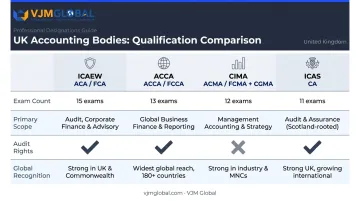
At a Glance: Comparing the Four Bodies
| Body | Designatory Letters | Exams | Primary Scope | Audit Rights |
|---|---|---|---|---|
| ICAEW | ACA / FCA | 14–15 | Public practice, audit, advisory | Yes |
| ACCA | ACCA / FCCA | 13 + EPSM | Public practice, global finance | Yes |
| CIMA | ACMA / FCMA + CGMA | Progressive levels | Management accounting, FP&A | No |
| ICAS | CA | Three levels | Public practice, audit, advisory | Yes |
Other UK Accounting Qualifications Worth Knowing
CIPFA
CIPFA is the only UK accounting body dedicated exclusively to public finance. Its Professional Accountancy Qualification (PAQ) runs across Certificate, Diploma, and Strategic stages, leading to the CPFA designation. CIPFA members work primarily in local government, the NHS, and the non-profit sector.
One important practical note: CIPFA's RQB status for statutory audit was revoked in December 2017, so CPFA members cannot register as statutory auditors.
AAT
The Association of Accounting Technicians is the primary entry-level pathway into UK accounting. It offers a structured route from bookkeeping basics to licensed accountant level, widely used by:
- School leavers starting their finance careers
- Career changers moving into accounting
- Professionals seeking a recognised foundation before pursuing ACA, ACCA, or CIMA
AAT completion can unlock significant exemptions toward higher qualifications. For example, ICAEW offers eligible AAT members up to five credits toward ACA exam modules via its AAT-ACA Fast Track route.
Beyond ACA, the AAT qualification also bridges naturally into specialist areas — including tax and treasury roles, which have their own dedicated credentials.
Tax and Treasury Qualifications
| Qualification | Body | Key Details |
|---|---|---|
| ATT | Association of Taxation Technicians | Entry-level tax qualification; requires practical tax experience for membership |
| CTA | Chartered Institute of Taxation | Highest UK tax credential; open to all but prior accounting/law qualification strongly recommended; Direct Route requires 7 exams and 3 years' experience |
| ACT | Association of Corporate Treasurers | Specialist qualification for corporate treasury and financial risk roles |
ICAEW vs ACCA: Which Qualification Is Better?
Neither the ACA nor the ACCA is objectively superior. The right choice depends on your career goals, how you plan to study, and where you intend to work.
Key Structural Differences
| Factor | ACA (ICAEW) | ACCA |
|---|---|---|
| Training contract | Required with authorised employer | Not required |
| Exam count | 15 (existing) / 14 (from July 2025) | 13 |
| Typical duration | 3–5 years | 3–4 years |
| Study flexibility | Lower — tied to employer pathway | Higher — self-directed possible |
| Audit authority | Yes (RQB and RSB) | Yes (RQB and RSB) |
Market Perception
The ACA carries significant weight in UK public practice: accounting firms, Big Four placements, and audit-focused roles. London-based newly qualified accountants in practice typically earn upwards of £55,000, rising to around £85,000 with a few years of post-qualification experience.
ACCA is more globally distributed, particularly valued in commercial and industry roles across Asia, the Middle East, and Africa. Both qualifications are recognised as Recognised Qualifying Bodies (RQBs) under the UK Companies Act, meaning both authorise members to carry out statutory audit work.
Who Should Choose What
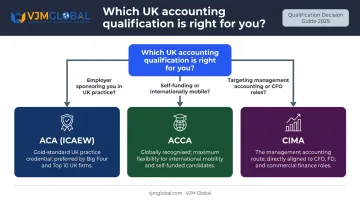
- Employer willing to sponsor you? → Strongly consider ACA for its structured pathway and prestige in UK practice
- Self-funding or international candidate? → ACCA offers more flexibility and global reach
- Career in management accounting or corporate finance? → CIMA is the more targeted choice
What Is the UK Equivalent of CPA?
There is no single exact UK equivalent of the US CPA. The ACA (ICAEW) and ACCA are the closest counterparts in terms of scope, rigour, and professional standing.
The key structural difference: the US CPA is a licensure-based system administered state-by-state, while UK qualifications are granted by professional membership bodies. Both serve as the professional benchmark in their respective jurisdictions.
Regulatory and Technical Differences
- The US CPA covers US GAAP and SEC reporting requirements
- ACA and ACCA are grounded in IFRS and UK-specific regulatory frameworks
- ACCA currently has no mutual recognition agreement with NASBA/AICPA
- ICAEW has a reciprocal membership agreement with CPA Canada (renewed February 2026), though UK audit rights still require additional steps
Cross-Border Relevance
These regulatory differences become practical when businesses operate across both the UK and India. Who can sign off UK statutory accounts versus Indian filings is governed by two entirely separate frameworks — and getting that wrong carries real compliance risk.
VJM Global works with 250+ UK businesses on exactly these questions, covering:
- FEMA advisory and foreign exchange compliance
- Expatriate taxation across both jurisdictions
- The interplay between UK accounting standards and Indian regulatory requirements
How to Choose the Right UK Accounting Qualification
By Career Sector
| Career Path | Recommended Qualification |
|---|---|
| Audit, public practice, Big Four | ACA (ICAEW) or ACCA |
| Management accounting, corporate finance, CFO track | CIMA |
| Public sector, local government, NHS | CIPFA |
| Tax (entry level) | ATT |
| Tax (senior/specialist) | CTA |
| New to accounting, school leaver, career changer | AAT → then progress to ACA, ACCA, or CIMA |
| Corporate treasury | ACT |
By Mode of Study and Access
- Employer-sponsored candidates — ACA offers the most structured, prestigious pathway for UK-based roles
- Self-funded or internationally mobile candidates — ACCA's flexibility and 180-country reach make it the stronger choice
- No finance background yet — start with AAT or CIMA's Certificate in Business Accounting before committing to a full chartered route
Global Mobility Considerations
If international mobility is a priority alongside your choice of study mode, ACCA and ACA both travel well globally. For candidates targeting roles in Asia-Pacific specifically, CPA Australia commands strong regional recognition — but conversion from a UK qualification is not automatic and typically requires an aptitude assessment.
One point applies to all bodies: CPD (Continuing Professional Development) is an ongoing requirement for all members across every UK accounting body — not something that ends once you qualify.
Frequently Asked Questions
What are the accounting bodies in the UK?
The five CCAB member bodies are ICAEW, ACCA, CIPFA, ICAS, and Chartered Accountants Ireland. CIMA is a major body outside CCAB. AAT, ATT, CIOT, and ACT are additional recognised bodies serving technician, tax, and treasury pathways.
What is the UK equivalent of CPA?
The ACA (ICAEW) and ACCA are the closest UK equivalents to the US CPA — both are rigorous professional qualifications recognised internationally. Unlike the CPA's state-based licensure model, UK professional bodies grant qualifications directly — no state-level licensing involved.
Which is better, ICAEW or ACCA?
ACA (ICAEW) is generally preferred for UK public practice and audit careers. ACCA offers greater flexibility and broader global reach, particularly across Asia, the Middle East, and Africa. If you're targeting a Big Four firm in the UK, ACA has the edge; if you plan to work across multiple countries or without employer sponsorship, ACCA is the more practical route.
Is ACCA recognised globally?
Yes. ACCA reports over 257,900 members and 530,100 future members across 180 countries — a reach that puts it among the widest of any single accounting qualification.
What is the CCAB in UK accounting?
The Consultative Committee of Accountancy Bodies (CCAB) is the umbrella body formed in 1974 for the UK's major chartered accounting organisations. "CCAB-qualified" is commonly used by employers as shorthand for holding a professional accounting credential from one of its five member bodies.