Introduction
Many accounting professionals face confusion when considering a move to Singapore — specifically, whether their CPA qualification carries weight there. "CPA" refers to multiple distinct qualifications — the US CPA issued by AICPA and CPA Australia are the two most relevant — and Singapore treats each differently.
Recognition also splits into two distinct categories: employer recognition (which affects hiring and salary) and regulatory recognition (which determines eligibility for Public Accountant registration with ACRA).
This guide clarifies the official status of US CPA and CPA Australia in Singapore, compares both to CA Singapore, and helps you identify the right qualification path for your goals.
Key Takeaways
- US CPA is employer-valued but eligible for PA registration only if your final exam was before 1 January 2019
- CPA Australia is fully recognized by ACRA for PA registration under both pre- and post-2019 pathways
- CA Singapore (SCAQ) is the national benchmark for public accounting practice in Singapore
- Recognition is either regulatory (ACRA PA registration) or commercial (employer demand) — both shape your career
- Choose based on your goal: PA registration, multinational roles, or cross-border advisory work
What Does "CPA Recognized" Mean in the Context of Singapore?
"Recognition" for accountants in Singapore operates on two distinct levels, and conflating them creates unnecessary confusion.
Regulatory Recognition: Public Accountant (PA) Registration
The Accounting and Corporate Regulatory Authority (ACRA) is the sole regulatory body authorized to register Public Accountants under the Accountants Act. PA registration is mandatory for providing public accountancy services, which include:
- Auditing financial statements
- Signing statutory audit reports
- Performing acts required by law to be done by a PA
Only qualifications recognized by ACRA qualify a professional to register as a PA. This typically requires either the Singapore Chartered Accountant Qualification (SCAQ) or a qualification from a body with a reciprocity agreement with the Institute of Singapore Chartered Accountants (ISCA).
Market Recognition: Employer and Career Value
Even qualifications not recognized for PA registration can be highly valued by employers for finance, advisory, tax, and management accounting roles. Multinational corporations, Big Four firms, and US-headquartered companies in Singapore actively seek professionals with specific accounting credentials based on their business needs.
Penalties for Practicing Without Registration
Singapore enforces PA registration requirements strictly:
- First offense: fine up to S$5,000 and/or imprisonment up to 12 months
- Repeat offense: fine up to S$10,000 and/or imprisonment up to 24 months
That said, many accounting roles fall outside the PA registration requirement entirely. Services that do not require PA registration include:
- General accounting and bookkeeping
- Tax preparation and advice
- Corporate advisory
- Financial consulting
Is the US CPA (AICPA) Recognized in Singapore?
ACRA PA Registration Status: A Critical Date Divide
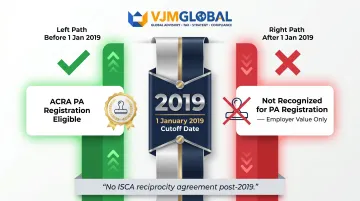
The US CPA's recognition status in Singapore hinges on one critical date: 1 January 2019.
Pre-1 January 2019: The AICPA qualification appears on ACRA's recognized qualifications list for PA registration if you passed your final examination before this date.
Post-1 January 2019: The AICPA qualification does not appear on ACRA's current recognized qualifications list. AICPA lacks a reciprocity agreement with ISCA, which is a prerequisite for post-2019 PA registration recognition. Recent US CPA holders cannot register as public accountants in Singapore through this pathway.
What US CPA Holders Can Still Do in Singapore
That regulatory gap doesn't tell the whole story. US CPA holders remain highly sought after by:
- Multinational corporations with US headquarters or operations
- Big Four accounting firms (Glassdoor lists 23 active "US CPA Big 4" jobs in Singapore as of March 2026)
- Companies requiring US GAAP expertise
- Firms handling cross-border US-Singapore tax and advisory work
Robert Half's 2026 Salary Guide lists CPA among the top in-demand certifications in Singapore's accounting sector, and their 2022 report describes the CPA qualification as the "gold standard" for finance professionals.
That demand stems from what the US CPA actually covers: US GAAP, federal taxation, auditing standards, and business law — knowledge American firms operating regionally depend on. The credential carries global brand recognition and rigorous examination standards that multinational hiring teams recognize regardless of ACRA's registration rules.
The Practical Limitation
The one firm boundary: US CPAs in Singapore cannot sign statutory audit reports or perform functions reserved for registered PAs. Professionals who need those rights must hold a qualification recognized under the post-2019 pathway — such as SCAQ, CPA Australia, or ACCA.
Is CPA Australia Recognized in Singapore?
CPA Australia is recognized by ACRA under both pre- and post-2019 graduation pathways — a coverage few foreign qualifications match. For accountants pursuing Public Accountant (PA) registration in Singapore, this makes it one of the more practical international credentials to hold.
Post-2019 PA Registration Requirements
For professionals who graduated on or after 1 January 2019, CPA Australia holders must have passed the "Advanced Audit and Assurance" module within their Certified Practising Accountant Program to satisfy ACRA's examination requirements. Exemptions from this module — even if granted by CPA Australia based on entry-level degrees — are not accepted for PA registration purposes.
CPA Australia vs. US CPA: A Critical Distinction
Despite sharing the "CPA" acronym, these are entirely separate qualifications:
| Characteristic | US CPA (AICPA) | CPA Australia |
|---|---|---|
| Issuing Body | American Institute of CPAs | CPA Australia |
| Primary Focus | US GAAP, US taxation | International standards, Australian/regional focus |
| Governance Framework | US state boards | CPA Australia professional body |
| ACRA PA Registration (post-2019) | Not recognized | Recognized (with Advanced Audit module) |
ISCA-CPA Australia Mutual Recognition Agreement (MRA)
In October 2023, ISCA and CPA Australia signed a formal Mutual Recognition Agreement, providing pathways for members to join the other body:
CPA Australia to CA (Singapore) pathway:
- Completed the full CPA Program
- Complete SCAQ's Integrative Business Solutions module
- Satisfy applicable qualifications and experience requirements
CA (Singapore) to CPA Australia pathway:
- Completed the SCAQ as a CA (Singapore)
- Held ISCA membership for five consecutive years
- No additional professional or educational requirements apply
Together, ACRA registration eligibility and the ISCA MRA give CPA Australia holders two distinct routes into Singapore's accounting framework — regulatory and professional — without needing to start from scratch.
CPA vs. CA Singapore: Key Differences
Issuing Bodies and Regulatory Framework
CA Singapore (SCAQ) is the national accountancy qualification developed by the Singapore Accountancy Commission (SAC) under the Ministry of Finance. SAC merged with ACRA on 1 April 2023, and SCAQ administration now falls under ACRA. ISCA serves as the "Designated Entity" to confer the Chartered Accountant of Singapore (CA Singapore) designation.
US CPA is issued by the American Institute of Certified Public Accountants (AICPA), with individual state boards governing licensure. It focuses on US GAAP, federal taxation, and American business law.
CPA Australia is issued by CPA Australia, an independent professional body. It carries strong portability across Asia-Pacific markets and is formally recognized by ISCA in Singapore.
Career Scope and Market Focus
CA Singapore professionals typically work in:
- Public accounting firms
- Audit and assurance services
- Tax consultancies
- Finance controller roles in Singapore-based or regional businesses
US CPAs are better suited for:
- Multinational corporations with US operations
- Global finance departments
- Businesses with US-facing compliance requirements
- Cross-border tax and advisory roles
CPA Australia holders have flexibility across:
- Public practice and audit in Singapore
- Corporate finance and advisory
- Regional accounting roles across Asia-Pacific
Membership and Market Reach
ISCA supports over 39,000 members across 40+ countries, with 12 overseas chapters in 10 countries. ISCA is a member of Chartered Accountants Worldwide (CAW), a global community of over 1.8 million members and students in 190+ countries.
Global Portability and Reciprocity Agreements
CA Singapore holders benefit from Reciprocal Membership Agreements with:
- CA ANZ (Chartered Accountants Australia and New Zealand)
- CAI (Chartered Accountants Ireland)
- ICAEW (Institute of Chartered Accountants in England and Wales)
- ICAS (Institute of Chartered Accountants of Scotland)
Full members in good standing via the normal education/training route can leverage these agreements for international mobility.
US CPA is recognized across American-linked businesses globally but lacks direct equivalency agreements with ISCA.
CPA Australia holds a formal reciprocity agreement with ISCA, plus recognition in multiple Asia-Pacific jurisdictions.
Comparison Summary
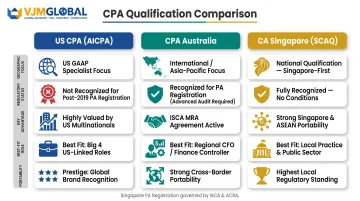
| Aspect | US CPA (AICPA) | CPA Australia | CA Singapore (SCAQ) |
|---|---|---|---|
| Issuing Body | AICPA (US state boards) | CPA Australia | ISCA (Singapore) |
| Primary Focus | US GAAP, US taxation | International standards, regional focus | Singapore regulations, IFRS |
| ACRA PA Registration (post-2019) | Not recognized | Recognized (with Advanced Audit module) | Recognized (national qualification) |
| Global Portability | Strong in US-linked businesses | Strong in Asia-Pacific | Strong via CAW agreements |
| Best Suited For | US multinationals, cross-border US roles | Regional public practice, corporate finance | Singapore public accounting, regional roles |
Other Accounting Qualifications Recognized in Singapore
ACCA (Association of Chartered Certified Accountants)
ACCA is recognized by ACRA for PA registration under the post-2019 pathway, with specific requirements:
- Must pass the Advanced Audit and Assurance module
- Must register as an ACCA student by 26 March 2028 to qualify under post-2019 rules
- Over 210 Approved Employers in Singapore
ACCA also provides a direct route to ISCA membership — opening doors to broader practice rights beyond PA registration alone.
Several other international bodies also meet ACRA's PA registration criteria, primarily serving professionals relocating from English-speaking markets.
Other Recognized Qualifications (ICAEW, ICAS, CAI, CAANZ)
| Qualification | Required Module | Primary User Base |
|---|---|---|
| ICAEW | Advanced Level: Corporate Reporting | UK professionals |
| ICAS | Test of Professional Skills: Assurance and Business Systems OR Advanced Assurance | Scottish professionals |
| CAI | FAE Elective: Advanced Auditing and Assurance | Irish professionals |
| CAANZ | Audit and Assurance OR Audit and Risk | Australian/NZ professionals |
Professionals holding these qualifications still need to complete ACRA's PA registration process and meet Singapore's local experience requirements before practicing independently.
Valued Non-PA Certifications
| Certification | Primary Use Case | Coverage Areas |
|---|---|---|
| CFA (Chartered Financial Analyst) | Wealth management, investment sectors | Portfolio management, investment analysis, economics |
| CIA (Certified Internal Auditor) | Internal audit roles | Risk and compliance |
| CMA (Certified Management Accountant) | Management accounting, strategic finance | Financial analysis, budgeting, strategic assessment |
None of these require ACRA PA registration, making them practical choices for finance professionals focused on advisory, audit, or management roles rather than public accounting practice.
Which Accounting Qualification Should You Pursue?
Decision Framework by Career Goal
If your goal is to work as a public accountant or auditor in Singapore:
- Primary pathways: SCAQ, CPA Australia (with Advanced Audit and Assurance), or ACCA
- Why: These qualifications provide the most direct route to ACRA PA registration, enabling you to sign statutory audits
If your goal is to work for US multinationals in finance, tax, or advisory roles:
- Primary pathway: US CPA
- Why: Strong employer demand (23 Big Four jobs listed on Glassdoor as of March 2026), expertise in US GAAP and federal taxation valued by American firms
If you're relocating to Singapore with an established US CPA credential:
- Strategic approach: Leverage your CPA for corporate finance roles while considering whether to pursue an SCAQ-equivalent module to unlock PA registration
- Consider: Whether your career trajectory requires audit signing authority or focuses on advisory, tax, and strategic finance
If you're pursuing CPA Australia:
- Advantage: You're already well-positioned for Singapore's full range of accounting roles, with clear pathways to both PA registration and CA (Singapore) membership
Geographic and Market Considerations
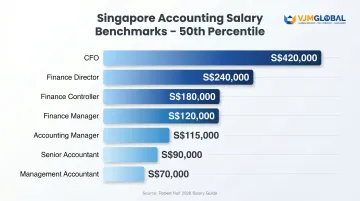
Salary Benchmarks (Robert Half 2026 Salary Guide):
| Role | 50th Percentile Salary (S$) |
|---|---|
| Management Accountant | 70,000 |
| Senior Accountant | 90,000 |
| Accounting Manager | 115,000 |
| Finance Manager | 120,000 |
| Finance Controller | 180,000 |
| Finance Director | 240,000 |
| CFO | 420,000 |
Candidates at the 75th percentile typically hold specialized certifications. The data shows talent shortages in mid-management finance roles and high demand for tax specialists with cross-border expertise, driven by BEPS 2.0 framework adoption.
Cross-Border Accounting Requirements
For businesses that operate across both Singapore and India, the qualification question extends beyond a single jurisdiction. Accounting requirements, tax standards, and compliance obligations differ significantly between the two markets — and in practice, many professionals need working knowledge of both.
This is where cross-border firm experience becomes relevant alongside the credential itself. VJM Global works with multinational companies and foreign investors navigating India-Singapore structures, supporting compliance across both markets. The firm's team of CPAs and Chartered Accountants has worked with 500+ American, 250+ UK, and 250+ Australian businesses managing cross-border financial operations.
Frequently Asked Questions
Is US CPA recognised in Singapore?
US CPA (AICPA) is recognised by employers and highly valued in corporate finance, advisory, and tax roles. For ACRA PA registration, however, it only qualifies professionals who passed their final exam before 1 January 2019. Post-2019 graduates must follow a different pathway.
Is CPA Australia recognised in Singapore?
Yes, CPA Australia is fully recognized by ACRA for PA registration under both pre- and post-2019 pathways. Post-2019 graduates must have passed the Advanced Audit and Assurance module to satisfy examination requirements.
Is CPA valued in Singapore?
CPA — particularly the US CPA — is highly regarded by employers, especially multinationals and US-headquartered firms, for its rigour and breadth. It opens doors to auditing, tax advisory, financial analysis, and corporate finance roles even without PA registration rights.
Can a CPA certify documents in Singapore?
Signing audit reports and other statutory certifications requires registration as a Public Accountant with ACRA. A US CPA without ACRA registration cannot perform these functions. CPA Australia holders who meet ACRA's requirements are eligible to register as PAs.
What is the difference between CPA and CA in Singapore?
CA Singapore (SCAQ) is the national qualification under the Ministry of Finance, focused on Singapore's regulatory environment. CPA refers to either the US qualification (AICPA, US-focused) or CPA Australia — each with different recognition statuses, career scopes, and portability in Singapore.
Can a CA work in Singapore?
Yes, CA Singapore holders can work across Singapore's public and private sectors, including as registered Public Accountants. Foreign CA holders (from ICAEW, ICAS, CAANZ) may also work in Singapore and can register as PAs if their qualification has a reciprocity agreement with ISCA and they meet ACRA's requirements.