Introduction
Miss a quarterly GST F5 deadline and IRAS notices. Misfile an invoice under InvoiceNow's phased mandate and your audit trail unravels. Singapore's compliance environment — IRAS GST obligations, ACRA reporting requirements, and InvoiceNow rollouts running through 2031 — has made manual bookkeeping a genuine liability.
Over 103,579 businesses are GST-registered in Singapore, each required to file accurate quarterly F5 returns within strict deadlines. Spreadsheets leave no margin for error at that scale.
The right accounting software handles the compliance heavy lifting — automating GST calculations, generating audit-ready reports, and flagging errors before they become penalties. This guide breaks down the top 6 options for 2026 so you can match the right tool to your business size, budget, and reporting needs.
Key Takeaways
- VJM Global is the managed alternative to running the software yourself — its team operates your chosen platform and keeps the books audit-ready
- Automates invoicing, expense tracking, GST calculation, and financial reporting for Singapore SMEs
- Top picks include Xero, QuickBooks Online, Zoho Books, ABSS, and FreshBooks
- Singapore compliance requirements — IRAS filings, ACRA-compatible statements, and InvoiceNow/PEPPOL — are required, not optional
- Cloud-based tools offer flexibility for growing SMEs; desktop tools suit local data control needs
- For complex or cross-border needs, a professional accounting partner fills the gaps software can't
Why Small Businesses in Singapore Need Accounting Software
Accounting software covers the financial functions every Singapore business depends on: recording income and expenses, managing payables and receivables, generating financial statements, and supporting GST filings. For Singapore's 369,500 SMEs — 99.6% of all enterprises — the compliance demands make purpose-built software less optional and more essential.
Singapore's Compliance Requirements Make Software Essential
Three specific obligations drive this need:
- IRAS GST reporting: GST-registered businesses must e-file F5 returns via myTax Portal within one month after each accounting period. The GST F5 return covers 15 boxes — standard-rated supplies, output tax, input tax, and net GST payable. Errors exceeding S$3,000 or 5% of total supplies trigger mandatory F7 correction filings.
- InvoiceNow/PEPPOL readiness: The GST InvoiceNow requirement rolls out to all GST-registered businesses by April 2031 across six phases starting November 2025. Businesses must transmit invoice data to IRAS before filing deadlines — PEPPOL-compliant software is the only practical way to meet this.
- ACRA annual returns: All Singapore-incorporated companies must file annual returns within 7 months of financial year-end, with most required to submit financial statements in XBRL format. Late filing penalties reach S$600, and continued non-compliance can result in court summons or director disqualification.
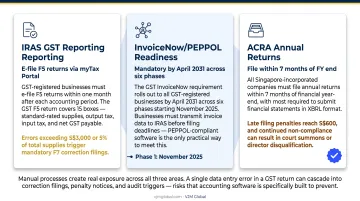
Manual processes create real exposure across all three areas. A single data entry error in a GST return can cascade into correction filings, penalty notices, and audit triggers — risks that accounting software is specifically built to prevent.
Best Accounting Software for Small Businesses in Singapore 2026
We evaluated these platforms based on IRAS/GST compliance, ease of use for non-accountants, scalability, pricing transparency, and integration capabilities. Each profile below covers standout features, pricing, and which business type it suits best — so you can match the right tool to your situation without trawling through trial pages. Ahead of the five platforms sits the managed option, for businesses that would rather not operate the software at all.
VJM Global
Every platform below assumes someone in your business will run it — coding the transactions, reconciling the bank feed, assembling the numbers before your accountant or corporate secretary needs them. VJM Global is the option for businesses that would rather hand that work to an outside team. It is a chartered accountancy and business advisory firm with 30+ years' experience and 100+ Chartered Accountants, CPAs, and company secretaries, and it operates your chosen platform on your behalf rather than selling you a subscription.
That reframes the shortlist below. VJM Global's teams work across Xero, QuickBooks, NetSuite, Zoho, SAP, Sage, and Tally — including every platform ranked here — so the software choice stays open and reversible. The firm handles day-to-day bookkeeping, transaction processing, management reporting, and month-end close, keeping records in the state your GST and ACRA obligations require them to be in. Statutory filing itself stays with your appointed local tax agent or corporate secretary.
VJM Global is a member of EAI International, a global network of independent accounting and tax firms, and reports a 95% client retention rate across a client base that includes 500+ American, 250+ UK, and 250+ Australian businesses. Delivery runs from its Noida headquarters with offices in Mumbai, Bengaluru, and Hyderabad.
| Feature | Details |
|---|---|
| Pricing | Contact for pricing — monthly retainer based on transaction volume and entity count |
| Scope of Engagement | Bookkeeping, transaction processing, management reporting, month-end close, audit-ready record maintenance |
| Platforms Managed | Xero, QuickBooks, NetSuite, Zoho, SAP, Sage, Tally — the platform decision stays yours |
| Best For | Singapore SMEs without in-house finance staff, and businesses that would rather outsource the function than tool it |
Xero
Xero is a cloud-based accounting platform used by more Singapore SMEs than any other cloud-first solution. Its clean interface, GST F5/F7 report generation, and 1,000+ app integrations make it a strong default choice for businesses that want compliance without complexity.
Real-time bank feeds from major Singapore banks, multi-currency support on the Premium plan, and collaborative access for external accountants round out its practical appeal. Xero is listed on the IRAS ASR+ at Tier 2, confirming its regulatory credentials.
| Feature | Details |
|---|---|
| Pricing | Starter: S$39/month; Standard: S$70/month; Premium: S$95/month (80% off first 3 months) |
| Key Features | Bank reconciliation, invoicing, GST reporting, payroll add-on, 1,000+ integrations, multi-currency (Premium only) |
| Best For | Growing SMEs and businesses working with external accountants or using multiple business tools |
QuickBooks Online
For businesses that need deeper reporting than Xero offers, QuickBooks Online brings strong Singapore localisation — including IRAS-compliant GST tracking and customisable financial reports suited to ACRA annual return preparation.
It stands out for project-level and customer-level profitability reporting, a wide network of QuickBooks-trained local accountants, and straightforward mobile expense capture. QuickBooks is listed on IRAS ASR+ at Tier 2.
| Feature | Details |
|---|---|
| Pricing | Simple Start: S$31/month; Essentials: S$57/month; Plus: S$79/month; Advanced: S$124/month (70% off first 3 months) |
| Key Features | GST tracking, bank reconciliation, invoicing, expense management, payroll, multi-currency (Essentials and above) |
| Best For | Service-based SMEs and startups needing detailed reporting and a large advisor support network |
Zoho Books
Zoho Books packs automation, role-based access controls, and tight integration with the broader Zoho ecosystem (CRM, Inventory) into one of the most affordable cloud options available — including a free entry tier that makes it accessible for early-stage businesses.
One important caveat: Zoho Books is not listed on the IRAS Accounting Software Register, so GST report preparation may require additional manual steps or verification before filing.
| Feature | Details |
|---|---|
| Pricing | Free plan available; Standard: S$18/month; Professional: S$36/month; Premium: S$54/month |
| Key Features | Invoicing, bank feeds, expense tracking, inventory, workflow automation, multi-currency (Professional and above) |
| Best For | Startups and digitally-savvy SMEs seeking an affordable, scalable tool, especially those already using Zoho products |
ABSS (formerly MYOB Singapore)
ABSS is a locally built desktop-first accounting system designed specifically for Singapore and Malaysia SMEs, with robust inventory management, GST-compliant invoicing, and InvoiceNow e-invoicing support. It suits businesses that prefer local data storage and traditional in-office workflows over cloud-first access.
The Connect versions add PEPPOL network integration and limited mobile access (Premier Connect only), bridging the gap for businesses that want some cloud flexibility. ABSS holds IRAS ASR+ Tier 1 status — the highest compliance tier available.
| Feature | Details |
|---|---|
| Pricing | Accounting Connect: S$349/year; Premier Connect: S$499/year |
| Key Features | General ledger, multi-currency, inventory tracking, GST reports, InvoiceNow e-invoicing, payroll (add-on) |
| Best For | Small to mid-sized businesses with inventory management needs or a preference for desktop-based accounting |
FreshBooks
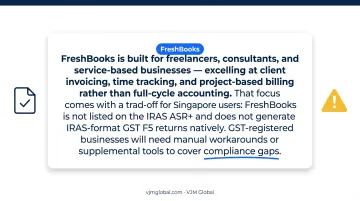
FreshBooks is built for freelancers, consultants, and service-based businesses — excelling at client invoicing, time tracking, and project-based billing rather than full-cycle accounting.
That focus comes with a trade-off for Singapore users: FreshBooks is not listed on the IRAS ASR+ and does not generate IRAS-format GST F5 returns natively. GST-registered businesses will need manual workarounds or supplemental tools to cover compliance gaps.
| Feature | Details |
|---|---|
| Pricing | Lite: US$23/month; Plus: US$43/month; Premium: US$70/month — USD pricing only; no SGD plan available (70% off first 4 months) |
| Key Features | Invoicing, time tracking, expense capture, client portal, project management, basic reporting |
| Best For | Freelancers, solo consultants, and service businesses with straightforward billing needs and lower transaction volumes |
Key Features to Look for in Singapore Accounting Software
Singapore Compliance Readiness
Any software you choose must handle Singapore's core compliance requirements:
- Supports IRAS GST F5/F7 filing and automated GST calculations
- Meets InvoiceNow/PEPPOL e-invoicing standards for invoice transmission
- Generates financial statements compatible with ACRA Annual Return submissions
The InvoiceNow mandate phases in from November 2025 through April 2031, with businesses required to transmit invoice data to IRAS before filing deadlines. Software without PEPPOL integration will require costly workarounds or third-party add-ons.
Integration and Bank Connectivity
Direct bank feeds from DBS, OCBC, and UOB eliminate manual reconciliation. Integration with payroll, expense management, and payment platforms reduces month-end workload by keeping data consistent across all your tools.
Cloud platforms like Xero and QuickBooks typically offer wider integration ecosystems (1,000+ apps for Xero), while desktop tools like ABSS provide solid core functionality but fewer third-party connections.
Scalability and Multi-User Access
Growing SMEs need software that can add users, handle increasing transaction volumes, and support collaboration with external accountants or bookkeepers without requiring a platform switch. All cloud options reviewed here offer multi-user access, with QuickBooks Advanced supporting up to 25 users.
Data Security and Record Retention
Singapore's Personal Data Protection Act (PDPA) requires software to include encryption, access controls, and audit trails. Beyond PDPA, IRAS mandates a minimum 5-year retention of all financial records — electronic or paper — with fines up to S$5,000 for non-compliance.
Look for these data protection features as a baseline:
- Role-based access controls to limit who sees sensitive records
- Automatic audit trails tracking every transaction change
- Cloud backup with encryption at rest and in transit
How to Choose the Right Accounting Software for Your Small Business
Match Software to Your Business Stage
Startups and freelancers with low transaction volumes can start with free or entry-tier tools:
- Zoho Books free plan for very early-stage businesses
- FreshBooks Lite for solo consultants focused on time billing
- ABSS Accounting Connect for inventory-light businesses preferring desktop
SMEs with GST registration and multi-user needs should prioritise IRAS-compliant cloud platforms:
- Xero Standard or Premium for businesses working with external accountants
- QuickBooks Essentials or Plus for service-based businesses needing project tracking
Cloud vs Desktop Decision
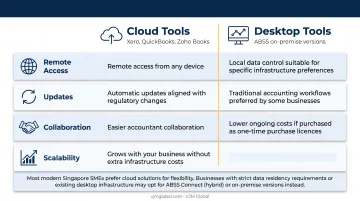
Cloud tools (Xero, QuickBooks, Zoho Books) offer:
- Remote access from any device
- Automatic updates aligned with regulatory changes
- Easier accountant collaboration
- Grows with your business without extra infrastructure costs
Desktop tools (ABSS on-premise versions) offer:
- Local data control suitable for specific infrastructure preferences
- Traditional accounting workflows preferred by some businesses
- Lower ongoing costs if purchased as one-time purchase licences
Most modern Singapore SMEs prefer cloud solutions for flexibility. Businesses with strict data residency requirements or existing desktop infrastructure may opt for ABSS Connect (hybrid) or on-premise versions instead.
Total Cost of Ownership
Go beyond the advertised monthly price:
| Cost Factor | What to Know | Estimated Range |
|---|---|---|
| Per-user fees | QuickBooks Simple Start covers 1 user; 3 users requires Essentials | S$31–S$57/month |
| Add-on modules | Payroll, multi-currency, and advanced features billed separately | S$6–S$45/month extra |
| IT support | Desktop software may need ongoing support for updates and backups | Variable |
| Implementation | Cloud platforms go live in days; desktop setups can take weeks | Time cost only |
The Productivity Solutions Grant (PSG) covers up to 50% of eligible costs, capped at S$30,000, helping SMEs offset software adoption expenses.
When Software Alone Isn't Enough
Many Singapore SMEs—especially foreign-owned businesses or those scaling quickly—benefit from pairing accounting software with professional support. For Singapore-based companies with India operations or expansion plans, VJM Global provides accounting outsourcing, tax compliance, and cross-border financial advisory. With 30+ years of experience and a team of 100+ professionals, the firm helps businesses maintain audit-readiness while navigating both local and international regulatory requirements.
Conclusion
The right accounting software for a Singapore small business depends on size, compliance needs, and growth plans. Here's a quick recap of where each tool fits best:
- VJM Global: Best for businesses that would rather outsource the bookkeeping function entirely than operate a platform in-house
- Xero and QuickBooks: Best for GST-registered businesses needing IRAS-ready cloud tools and broad integration ecosystems
- Zoho Books: A solid pick for budget-conscious startups willing to configure GST reporting manually
- ABSS: Suits inventory-heavy businesses that prefer desktop or hybrid deployment
- FreshBooks: A natural fit for service-focused freelancers with straightforward billing and no GST registration
Before committing, use free trials and demos to stress-test each option against your actual workflows. Pay close attention to Singapore-specific compliance features: GST F5/F7 generation, InvoiceNow/PEPPOL support, and ACRA-compatible reporting should be non-negotiable checkpoints, especially as your business grows.
For foreign companies and international investors looking to establish or expand operations in India alongside their Singapore presence, VJM Global offers outsourced accounting, cross-border tax compliance, and financial reporting support. With 30+ years of experience serving USA, UK, and Australian businesses entering the Indian market, their team of qualified accountants can handle the compliance complexity that stretches beyond any single software platform.
Frequently Asked Questions
Frequently Asked Questions
How much is bookkeeping fees in Singapore?
Outsourced monthly bookkeeping for Singapore small businesses typically runs S$100–S$400/month depending on transaction volume and complexity. GST-registered or multi-entity businesses may pay S$300–S$800+ monthly, while simple sole traders often fall in the S$60–S$150 range.
What accounting software is best for small business in Singapore?
Xero is the most widely used due to its IRAS ASR+ Tier 2 listing, GST F5/F7 compliance, and 1,000+ integrations. The best choice depends on business size, GST registration status, and budget—refer to the comparison in this article for detailed feature breakdowns.
Is Xero for SMEs?
Yes. Xero offers scalable plans (S$39–S$95/month) with IRAS GST support and multi-user accountant collaboration, making it a solid fit for most Singapore SMEs. Very early-stage businesses may find a lighter or free option more cost-effective to start.
Is Zoho Books available in Singapore?
Yes, Zoho Books is available and used in Singapore, offering a free plan and strong automation features. However, it is not on the IRAS Accounting Software Register, so GST F5 report preparation may require additional manual configuration or verification steps.
Which accounting software is mostly used in Singapore?
Xero holds the largest share of Singapore SME adoption, partly because it has one of the biggest networks of local certified advisors and accountants, making it easy to find professional support. QuickBooks and Financio also maintain a notable user base among smaller businesses.
What accounting standard is used in Singapore?
Singapore follows the Singapore Financial Reporting Standards (International) — SFRS(I), which are fully aligned with IFRS. These apply to companies incorporated under the Companies Act and filing with ACRA.