Introduction
Singapore companies expanding to India face a dual-compliance challenge that goes far beyond routine bookkeeping. Managing an India subsidiary means simultaneous compliance with Indian statutory requirements—GST returns, TDS filing, e-invoicing via the Invoice Registration Portal (IRP), and MCA annual filings—while consolidating INR financials into SGD-denominated reports for the Singapore parent under IFRS or Singapore FRS standards.
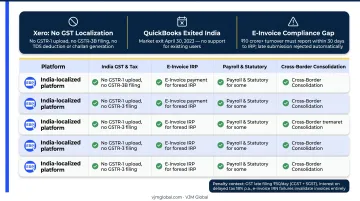
Standard Singapore tools cannot bridge this gap alone. Xero lacks built-in Indian GST localization and has no GSTR-1 upload or TDS module, while QuickBooks discontinued India services on April 30, 2023.
Choosing the wrong ERP creates real exposure. GST filing errors attract ₹50/day in late fees plus 18% annual interest on delayed payments; wrongful input tax credit claims carry up to 24% annual interest.
Beyond penalties, non-compliant systems push finance teams into manual workarounds: parallel spreadsheets for statutory filings, reconciliation gaps between India and Singapore books, and delayed ROC compliance that puts the subsidiary's legal standing at risk.
This article evaluates five ERP platforms available in India against the criteria that matter most to Singapore companies:
- SAP Business One
- Oracle NetSuite
- Zoho Books
- TallyPrime
- Microsoft Dynamics 365 Business Central
Each is assessed on Indian compliance depth, SGD-INR multi-currency capability, consolidated reporting for the Singapore parent, and cloud accessibility for cross-border finance teams.
Key Takeaways
- VJM Global is the managed alternative to running any of these systems in-house — its Chartered Accountants operate the platform you choose and own the GST, TDS and MCA filings that come with it
- Standard Singapore accounting tools cannot handle Indian compliance requirements like GST, TDS, e-invoicing, and ROC filings
- Top India-ready ERPs include SAP Business One, Oracle NetSuite, Zoho Books, TallyPrime, and Microsoft Dynamics 365 Business Central, each suited to different budgets and company sizes
- Key selection criteria: GST/TDS compliance depth, SGD-INR multi-currency support, consolidated reporting capability, and cloud accessibility
- Cloud-based ERPs give Singapore finance teams real-time visibility into India operations
- Pairing ERP implementation with an India-based compliance firm reduces risk and keeps filings on track
Why Singapore Companies Need India-Specific ERP Accounting Software
ERP accounting software for a foreign subsidiary is a centralized system that manages financial transactions, statutory tax filings, payroll, inventory, and reporting across the India entity while feeding consolidated data upstream to the Singapore parent company. It replaces disconnected tools and manual processes with a single source of truth for both local Indian compliance and cross-border financial reporting.
Singapore-popular accounting platforms fail in India for specific technical reasons. Xero has no built-in Indian GST localization—no GSTR-1 upload capability, no GSTR-3B filing module, and no TDS deduction or challan generation. QuickBooks exited the India market entirely on April 30, 2023, leaving existing users without support. These are not minor feature gaps — they directly trigger penalties from Indian tax authorities.
From April 1, 2025, businesses with annual aggregate turnover of ₹10 crore and above must report e-invoices to the Invoice Registration Portal within 30 days, and the IRP automatically rejects late submissions. Most Singapore subsidiaries operating at scale will exceed this threshold.
The financial consequences of non-compliance are concrete:
- GST late filing: ₹50/day (₹25 CGST + ₹25 SGST)
- Interest on delayed tax payments: 18% per annum
- E-invoice non-compliance: IRN generation failures invalidate invoices entirely
The ERP must generate Invoice Reference Numbers (IRN) automatically and integrate directly with India's IRP system — features absent from general-purpose accounting tools.
Given these compliance requirements, Singapore companies operating in India need purpose-built ERP solutions with strong India localization. The following five platforms are the most suitable options, evaluated on exactly these criteria.
Best ERP Accounting Software in India for Singapore Companies
The platforms below were evaluated against five criteria critical for Singapore companies managing India operations:
- India statutory compliance depth (GST, TDS, MCA filings)
- Multi-currency support for SGD-INR transactions
- Cloud accessibility for cross-border finance teams
- Consolidated reporting for Singapore holding companies
- Scalability as India operations grow
Ahead of the five platforms sits a different kind of option — the managed route, for companies that would rather not run the system themselves at all.
VJM Global — Managed Alternative to Running ERP In-House
Every platform below assumes a Singapore company will staff the India finance function: someone configures the GST masters, someone reconciles GSTR-2A/2B, someone prepares the quarterly TDS returns and tracks the MCA calendar. VJM Global is the option for companies that would rather hand that work to an India-based team. It is a chartered accountancy and business advisory firm with 30+ years' experience and 100+ Chartered Accountants, CPAs, and company secretaries, and it runs your chosen platform on your behalf rather than selling you a licence.
Why It Sits Above the Platform Decision: VJM Global's teams work across Xero, QuickBooks, NetSuite, Zoho, SAP, Sage, and TallyPrime — which covers every platform ranked below. The software choice stops being a commitment you have to staff around: select the system that fits your India entity, and VJM operates it. The firm's staff handle day-to-day bookkeeping, GST return preparation and filing, TDS deduction and quarterly returns, ROC and MCA annual filings, and month-end close feeding the Singapore parent's consolidation.
Delivery runs from the firm's Noida headquarters with offices in Mumbai, Bengaluru, and Hyderabad — the same domestic footprint and CA bench that Indian statutory work requires. VJM Global is a member of EAI International, a global network of independent accounting and tax firms, and reports a 95% client retention rate.
| Feature Category | Details |
|---|---|
| Scope of Engagement | Bookkeeping, GST returns, TDS deduction and quarterly returns, ROC/MCA annual filings, month-end close and reporting to the Singapore parent |
| Platforms Managed | Xero, QuickBooks, NetSuite, Zoho, SAP, Sage, Tally — the platform decision stays yours |
| Engagement & Pricing | Contact for pricing — monthly retainer based on transaction volume and entity count |
SAP Business One / SAP S/4HANA
SAP Business One targets mid-market companies while SAP S/4HANA serves larger enterprises. Both are widely deployed by MNCs with India subsidiaries and offer India localization built and maintained by SAP's certified partner network in India. SAP's official India GST localization guide (updated February 28, 2025) covers GST calculation, reporting, compliance workflows, and e-invoicing features.
For Singapore holding companies, SAP's native multi-entity consolidation is the headline capability — Singapore CFOs can pull consolidated P&L statements and balance sheets across entities in different currencies without manual reconciliation. India localization covers GST returns (GSTR-1, GSTR-3B), TDS deductions, e-invoicing via IRP integration, and statutory audit trails that align with both the Indian Companies Act and Singapore FRS standards.
| Feature Category | Details |
|---|---|
| Indian Compliance Coverage | GST (GSTR-1, GSTR-3B, e-invoicing), TDS deduction & challan, MCA-compliant depreciation schedules, Indian audit trail |
| Multi-Currency & Singapore Integration | Native SGD-INR multi-currency; consolidation reports for Singapore parent; integrates with SAP systems already in use at Singapore HQ |
| Deployment & Pricing | Cloud and on-premise options; pricing is customized based on modules and user count—contact SAP partner for India deployment quotes |
Oracle NetSuite
Oracle NetSuite is a cloud-native ERP built for multi-subsidiary, multi-currency businesses — making it a practical fit for Singapore holding companies that need real-time visibility into India subsidiary financials from the head office.
The India Localization SuiteTax Engine SuiteApp handles GST, TDS, TCS, and e-invoicing, with ClearTax preconfigured as the GST Suvidha Provider for IRP integration.
The OneWorld module is where NetSuite earns its place on this list for Singapore CFOs: it allows consolidated reporting in SGD, inter-company eliminations, and real-time access to India cash flow, receivables, and payables — all without manual spreadsheet work.
| Feature Category | Details |
|---|---|
| Indian Compliance Coverage | GST filing support, TDS configuration, India-localized Chart of Accounts, e-invoicing through IRP integration, e-way bill generation using IRN |
| Multi-Currency & Singapore Integration | OneWorld module for multi-subsidiary consolidation; real-time SGD-INR currency conversion; Singapore-based NetSuite users can access India books remotely |
| Deployment & Pricing | 100% cloud-based; annual license model with pricing based on modules and users—typically $25,000 to $250,000+ annually; requires demo and quote from Oracle |
Zoho Books (Zoho Finance Suite)
Zoho Books is among the most popular cloud accounting tools in Singapore and carries one of the strongest India GST compliance modules available in the mid-market. For Singapore SMEs entering India who already use Zoho, this makes it an unusually convenient bridge — same vendor, minimal retraining. Starting at INR 749/month (Standard plan, billed annually), it delivers compliant GST filing at a fraction of enterprise ERP cost.
Zoho Books India includes GSTR filing (GSTR-1, GSTR-3B, GSTR-9), e-invoicing with IRP integration from the Standard plan onwards, TDS deduction, and multi-currency support. Zoho Analytics enables consolidated reporting across Singapore and India books within the same ecosystem — no third-party tools required.
| Feature Category | Details |
|---|---|
| Indian Compliance Coverage | Full GSTR-1, GSTR-3B, GSTR-9 filing via API; e-invoicing (IRP integrated); TDS deduction, challan & returns; India-specific payroll via Zoho Payroll add-on; multi-GSTIN support |
| Multi-Currency & Singapore Integration | Multi-currency support including SGD-INR; Zoho ecosystem integration across Singapore and India entities; Zoho Analytics for cross-entity reporting; multi-organization feature allows Singapore parent to manage both entities within single account |
| Deployment & Pricing | Cloud-based; Standard plan INR 749/month, Professional INR 1,499/month, Premium INR 2,999/month (all billed annually)—among the most affordable options on this list |
TallyPrime
TallyPrime (formerly Tally.ERP 9) is the dominant accounting software used by Indian businesses, CAs, and finance professionals across India. Approximately 75% of Indian SMEs rely on Tally for managing GST, TDS, and inventory. Any India-based accountant, CA firm, or finance hire a Singapore company brings on board will almost certainly already know it.
If your Singapore company plans to engage an India-based CA firm for compliance, there's a practical advantage: those firms work in Tally, so data handoffs are seamless. TallyPrime covers GST returns (GSTR-1, GSTR-3B, GSTR-4, GSTR-9), TDS, e-invoicing with direct IRN and QR code generation via GSP, e-way bill generation, payroll, inventory, and Indian statutory reporting.
TallyPrime Cloud Access (hosted on Oracle Cloud Infrastructure) from INR 600 lets Singapore teams view India financials remotely. The trade-off: its multi-entity consolidation and multi-currency features are more limited than cloud-native ERPs, making it better suited as a standalone India entity tool.
| Feature Category | Details |
|---|---|
| Indian Compliance Coverage | Comprehensive GST (GSTR-1, GSTR-3B, GSTR-9), TDS, e-invoicing (direct IRN generation), e-way bill, India payroll, MCA depreciation, GSTR-2A/2B reconciliation, audit-ready ledgers |
| Multi-Currency & Singapore Integration | Multi-currency available but limited multi-entity consolidation; best used for standalone India entity reporting; Singapore team accesses via TallyPrime Cloud Access or hosted deployment |
| Deployment & Pricing | Desktop (with cloud-hosted option via partners); TallyPrime Silver INR 22,500 (single user), TallyPrime Gold INR 67,500 (multi-user), both perpetual licenses; Cloud Access from INR 600 |
Microsoft Dynamics 365 Business Central
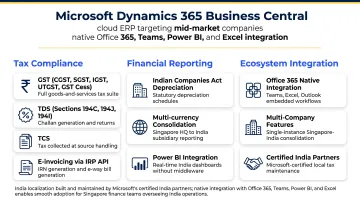
Microsoft Dynamics 365 Business Central is a cloud ERP targeting mid-market companies. It integrates natively with Office 365, Teams, Power BI, and Excel — tools already standard in most Singapore corporate environments — making adoption smooth for Singapore finance teams overseeing India operations.
India localization (built and maintained by Microsoft's certified India partners) covers GST (CGST, SGST, IGST, UTGST, GST Cess), TDS (Sections 194C, 194J, 194I with challan generation and returns), TCS, e-invoicing via IRP API with IRN generation, e-way bill generation, and Indian Companies Act depreciation schedules.
Multi-currency and multi-company features let Singapore headquarters consolidate and report on India subsidiary financials within the same Microsoft ecosystem. Power BI integration delivers real-time India performance dashboards to Singapore leadership without third-party middleware.
| Feature Category | Details |
|---|---|
| Indian Compliance Coverage | GST returns (GSTR-1, GSTR-3B), TDS deduction and returns (Form 26Q, 27Q), TCS returns (Form 27EQ), e-invoicing via IRP with QR code, e-way bill, India-localized Chart of Accounts, fixed assets per Income Tax Act and Companies Act |
| Multi-Currency & Singapore Integration | Native SGD-INR multi-currency; multi-company consolidation; deep integration with Power BI, Power Apps, Power Automate, and Office 365 already used by Singapore HQ teams |
| Deployment & Pricing | Cloud-based (SaaS); Essentials $80/user/month, Premium $110/user/month (paid yearly, US pricing—India pricing may differ) |
Key Indian Compliance Features Singapore Companies Must Look For
GST and E-Invoicing Compliance
GST and e-invoicing compliance: Verify that the ERP supports GSTR-1, GSTR-3B, and GSTR-9 filing directly or via integration with India's GST portal. From April 1, 2025, businesses with annual aggregate turnover of ₹10 crore and above must report e-invoices through the Invoice Registration Portal (IRP) within 30 days — late submissions are automatically rejected.
The ERP must generate Invoice Reference Numbers (IRN) and QR codes automatically. Non-compliance carries ₹50/day late fees plus 18% annual interest on delayed tax payments.
TDS Management
Unlike Singapore, India requires tax deduction at source on vendor payments, rent, salaries, and professional fees. Companies must deposit TDS challans with the government and file quarterly returns — late filing attracts a ₹200/day penalty.
Quarterly TDS return forms include:
- Form 24Q — salary payments
- Form 26Q — resident non-salary payments
- Form 27Q — NRI and foreign payments
The ERP must automate TDS deduction, challan generation, and return preparation to avoid interest and penalty exposure.
Multi-Currency and Inter-Company Transactions
Singapore parent companies regularly transact with their India subsidiaries through shareholder loans, management fees, and royalties. Each transaction type carries distinct tax and transfer pricing implications under Indian law.
The ERP must handle SGD-INR foreign currency revaluation, inter-company eliminations, and transfer pricing documentation so both sets of books stay accurate and audit-ready.
Indian Payroll and Statutory Deductions
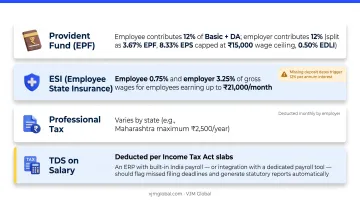
Indian payroll and statutory deductions: India payroll involves:
- Provident Fund (EPF): Employee contributes 12% of Basic + DA; employer contributes 12% (split as 3.67% EPF, 8.33% EPS capped at ₹15,000 wage ceiling, 0.50% EDLI)
- ESI (Employee State Insurance): Employee 0.75% and employer 3.25% of gross wages for employees earning up to ₹21,000/month
- Professional Tax: Varies by state (e.g., Maharashtra maximum ₹2,500/year)
- TDS on Salary: Deducted per Income Tax Act slabs
An ERP with built-in India payroll — or integration with a dedicated payroll tool — should flag missed filing deadlines and generate statutory reports automatically. Missing EPF or ESI deposit dates triggers interest at 12% per annum, so automated reminders are non-negotiable.
Cloud Access and Audit Trail
Singapore finance controllers need real-time access to India books without flying in for every review. Prioritize cloud-based ERPs with:
- Role-based access controls limiting what each team member can view or edit
- Detailed audit logs, which are mandatory under the Indian Companies Act
- Data export capabilities for sharing with Singapore auditors and consolidation teams
How We Chose the Best ERP Accounting Software for Singapore Companies in India
The most common mistake Singapore companies make is selecting ERP based on what works well at Singapore headquarters—Xero, QuickBooks, or FreshBooks—without verifying India compliance depth. The result: parallel manual accounting just for India statutory filings, which defeats the purpose of having ERP in the first place.
Each platform was assessed on four dimensions:
- India statutory compliance: GST filing (GSTR-1, GSTR-3B, GSTR-9), TDS returns, e-invoicing via IRP, payroll with PF/ESI, and MCA-compliant depreciation
- Cross-border reporting: Multi-currency handling (SGD-INR revaluation), consolidated P&L and balance sheets, and inter-company eliminations
- Remote oversight for Singapore teams: Cloud deployment, role-based access, and real-time dashboards accessible without being on-site
- Total cost of ownership: Licensing model (perpetual vs. SaaS), implementation costs with India-certified partners, ongoing compliance support
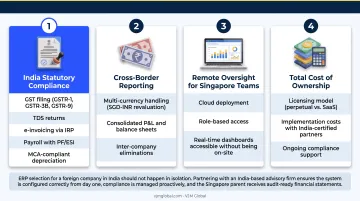
ERP selection for a foreign company in India should not happen in isolation. Partnering with an India-based advisory firm ensures the system is configured correctly from day one, compliance is managed proactively, and the Singapore parent receives audit-ready financial statements.
VJM Global's accounting outsourcing and compliance services are designed to support Singapore and other foreign companies managing their India entity—covering ERP configuration, GST filing, TDS management, and MCA annual filings under one engagement.
Conclusion
Singapore companies operating in India cannot afford to treat ERP selection as an afterthought. The right ERP accounting software determines whether the India entity stays GST-compliant, TDS-compliant, and audit-ready — while giving Singapore leadership real-time financial visibility without manual reporting overhead.
Singapore has been India's largest FDI source for seven consecutive years, with $14.94 billion in 2024-25 alone. Yet many of these subsidiaries still struggle with compliance because their ERP cannot handle India's statutory requirements.
That compliance gap often comes down to implementation, not software choice alone. Evaluate not just software features but also the implementation partner and ongoing compliance support ecosystem in India. The ERP is only as effective as the team configuring and maintaining it against India's regularly evolving tax regulations — a moving target that changes with every Finance Bill and GST council update.
For Singapore companies looking for a trusted partner to manage India accounting, GST compliance, and ERP-aligned financial reporting, VJM Global's team of Chartered Accountants and compliance professionals has 30+ years of experience supporting foreign companies in India. Reach out to discuss how VJM Global can help manage your India entity's accounting, GST filings, and compliance reporting end-to-end.
Frequently Asked Questions
Which ERP is most used in India?
TallyPrime holds the largest share among Indian SMEs and local businesses (approximately 75% of Indian SMEs) due to its deep GST compliance and widespread CA adoption. SAP, Oracle NetSuite, and Microsoft Dynamics 365 dominate among MNCs and foreign-owned companies operating in India.
Which ERP software is best for accounting in India?
The right fit depends on business size and cross-border needs. TallyPrime suits standalone India entity accounting managed locally by Indian CAs. Oracle NetSuite and SAP Business One work better for foreign companies needing consolidated multi-currency reporting alongside Indian compliance.
What are the main ERP systems used in India?
The most widely deployed ERP systems in India include TallyPrime (dominant among SMEs), SAP (manufacturing and large enterprises), Oracle NetSuite (cloud-based multinationals), Microsoft Dynamics 365, Odoo, and Zoho Books — each serving different segments and scales.
Can Singapore companies use Tally for their India subsidiary?
Yes, TallyPrime is a practical choice for the India entity's day-to-day accounting and GST compliance, especially when working with Indian CA firms. However, Singapore parent companies often need a second layer (like NetSuite or consolidation tools) to convert India financials into consolidated SGD-based reports.
What Indian compliance features should ERP software have for foreign companies?
Essential compliance features include:
- GST return filing (GSTR-1, GSTR-3B, GSTR-9)
- E-invoicing via IRP integration with automatic IRN generation
- TDS deduction and quarterly return filing (24Q, 26Q, 27Q)
- India payroll with PF/ESI calculations
- Companies Act depreciation schedules
- Audit trail logging as required under the Companies Act
Do Singapore companies need separate ERP systems for their India and Singapore operations?
Many Singapore companies use one global ERP (like NetSuite or SAP) that handles both entities through multi-subsidiary modules. Others maintain a separate India-specific tool (like TallyPrime) for local compliance and feed data into the Singapore consolidation system — the right choice comes down to company size, IT budget, and reporting complexity.