Introduction
UAE investment into the UK reached £7.0 billion in stock value at the end of 2024, up 2.3% on the previous year, according to the UK government's UAE trade and investment factsheet.
That investment keeps growing, helped by the long-standing UAE-UK Double Taxation Agreement and a UK market that has stayed open and stable through Brexit and beyond. A UK-GCC Free Trade Agreement has concluded negotiations, but it is not signed or ratified—so treat it as a future signal, not a live planning assumption.
UAE parents still struggle with the points generic registration guides skip: ring-fencing liability, using the tax treaty in practice, and stopping dual-jurisdiction compliance from falling apart. This article covers all three, plus the governance mistakes that undo the benefits.
Key Takeaways
- Choose a subsidiary over a branch to ring-fence liability while keeping 100% UAE parent ownership.
- Limited liability, UK market credibility, and treaty-based tax efficiency are the three core benefits worth structuring for.
- Companies House incorporation can complete in 24-48 hours, but banking, VAT, and PAYE take longer.
- Poor governance or UAE–UK documentation gaps can erase liability protection.
- Cross-border advisory support from the start avoids expensive restructuring later.
What Is a UK Subsidiary Company?
A UK subsidiary is a UK-incorporated company, almost always a Private Limited Company (Ltd), registered with Companies House. Under Companies Act 2006, Section 1159, it counts as a subsidiary when a parent holds a majority of voting rights, controls board appointments, or otherwise directs it through another subsidiary.
For a UAE parent, this means:
- Full ownership is possible. There's no residency requirement for directors or shareholders, so a UAE company can hold 100% of the shares as a wholly owned subsidiary.
- It's a distinct legal person. The subsidiary has its own tax obligations, liabilities, and accounts.
- It differs from a branch. A UK branch (a UK establishment of an overseas company) isn't separately incorporated—it's an extension of the UAE company and shares its legal liability.
For UAE parents, that separate legal personality is the point: you get a UK market-entry vehicle while containing risk inside the subsidiary rather than on the parent’s balance sheet.
Key Advantages of Setting Up a UK Subsidiary from the UAE
These advantages aren't abstract. They translate into measurable outcomes: lower risk exposure, better market access, a lower effective tax rate, and faster time-to-market. That matters more than usual here, because a UAE parent is managing two regulators (Companies House and HMRC alongside UAE authorities) and two tax regimes simultaneously.
Limited Liability Protection - Ring-Fencing the UAE Parent's Risk
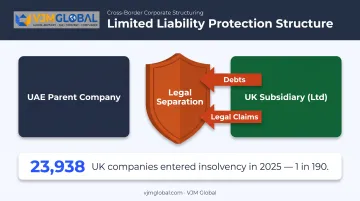
Because the UK subsidiary is a separate legal entity, its debts and legal claims generally stay within the UK company. They don't automatically transfer to the UAE parent. Incorporating as an Ltd creates a distinct pool of assets and liabilities, and maintaining proper UK corporate governance keeps that separation intact.
Company failure is not a rare event in the UK. 23,938 companies entered insolvency in England and Wales in 2025, a rate of 52.5 per 10,000, or roughly 1 in 190 companies on the register, according to the Insolvency Service's 2025 commentary. Companies House itself is candid that limited status "is not 100% protection," particularly where fraud or improper conduct is involved.
Proper structure is what makes that protection real. If the UK venture faces disputes, losses, or insolvency, a properly governed subsidiary shields the UAE parent's global assets and reputation from the fallout.
KPIs impacted:
- Risk exposure
- Asset protection
- Credit risk when seeking financing or partnerships
This advantage matters most when entering regulated UK sectors, signing higher-risk contracts, or testing the market with unfamiliar UK partners.
Enhanced Market Credibility and Access to UK & European Markets
A UK-incorporated entity reads as local. UK clients, suppliers, and banks treat it differently than a foreign-registered company operating remotely. A UK trade presence, VAT number, and UK bank account let the subsidiary sign contracts and bid for work in its own name, not the parent's.
That local standing has weight behind it. The UK ranked second in Europe for FDI projects in 2025, attracting 730 projects and generating the highest job total in Europe among disclosed figures, per EY's 2026 UK Attractiveness Survey. The UK actively courts foreign investors.
For public-sector tenders and trust-sensitive B2B relationships, local incorporation often functions as an unwritten prerequisite rather than a nice-to-have.
KPIs impacted:
- Contract win rate
- Partnership opportunities
- Client and supplier trust
This matters most for businesses targeting UK government contracts or industries where clients simply won't engage a foreign-registered entity.
Tax Efficiency Through UAE-UK Treaty Benefits and UK Corporate Structuring
The UK subsidiary pays UK corporation tax on its own UK profits. Current bands look like this:
| Taxable Profit | Rate |
|---|---|
| Up to £50,000 | 19% (small-profits rate) |
| £50,000 - £250,000 | 25% main rate, less marginal relief |
| Above £250,000 | 25% main rate |
R&D-intensive businesses have additional options. Since April 2024, the merged R&D expenditure credit offers a 20% taxable credit. Loss-making, R&D-intensive SMEs can claim up to a 186% deduction through Enhanced R&D Intensive Support, provided qualifying R&D spend is at least 30% of total expenditure.
On repatriation, the UAE-UK Double Taxation Agreement generally exempts dividends paid to a UAE-resident beneficial owner from UK withholding tax. Property-income investment vehicles are the notable exception, capped at 15%.
On the UAE side, qualifying foreign dividends can be shielded from UAE corporate tax under the participation exemption. Conditions typically include minimum 5% ownership, a 12-month holding period, and a minimum 9% foreign tax rate.
KPIs impacted:
- Group effective tax rate
- Repatriated cash flow
- Compliance cost
This advantage compounds for profitable or scaling operations, groups with IP or royalty flows, and businesses managing several international entities at once.
Fast Incorporation and Full Operational Independence
UK company formation moves quickly by global standards. Online registration through Companies House is usually completed within 24 hours for a £100 fee. Historical World Bank data placed the UK's broader starting-a-business process at 4.5 days, well ahead of the 9.2-day OECD high-income average.
Setup is also lightweight on paper. Share capital can be as little as £1, and there's no requirement for a UK-resident director or shareholder, though the company does need a natural person director and a UK registered office.
Once formed, the subsidiary can run on its own terms:
- Faster market testing without waiting on multi-country approvals
- Independent hiring once the entity exists
- A UK bank account opened in the subsidiary's own name, not routed through the parent
KPIs impacted:
- Time-to-market
- Operational autonomy
- Hiring speed
Speed and independence count most in competitive, first-mover situations, or whenever the goal is genuine UK operations rather than a branch tied to the parent.
What Happens When UAE Companies Get the UK Structure Wrong
Structure mistakes are rarely dramatic. They're quiet, and they surface at the worst possible moment.
- Choosing a branch when liability protection was needed. A branch is legally the same entity as the UAE parent. Debts and disputes flow straight back home, exposing global assets a subsidiary would have protected.
- Skipping formal governance. Missing UK board minutes and arm's-length transfer pricing documents invite HMRC penalties. They can also undermine limited liability if the separation is challenged in court.
- Leaving UAE-side documentation incomplete. A missing Certificate of Good Standing or unlegalised incorporation papers routinely delays UK bank account opening, VAT registration, and PAYE setup by weeks.
None of these are unusual failures. They're the predictable result of treating UK incorporation as a one-off form-filling task instead of an ongoing dual-jurisdiction commitment.
How to Set Up Your UK Subsidiary the Right Way
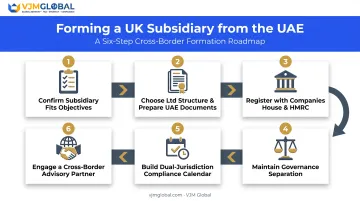
Getting structure and compliance right from day one avoids costly rework later. Use this sequence when you form a UK subsidiary from the UAE.
- Confirm the subsidiary fits your objectives. Before incorporating, check that a subsidiary—not a branch or representative office—matches your long-term UK growth plan.
- Choose the Ltd structure and prepare UAE documents. Set share allocation (100% UAE ownership is allowed), then legalise your UAE incorporation papers and Certificate of Good Standing for Companies House and UK bank KYC.
- Register with Companies House and HMRC promptly. Apply for your Unique Taxpayer Reference, and register for VAT and PAYE as turnover and hiring plans require.
- Maintain genuine governance separation. Hold formal UK board meetings, document intercompany deals with transfer pricing support, and keep UK subsidiary finances fully separate from the UAE parent’s books.
- Build a dual-jurisdiction compliance calendar. Track UK filings (confirmation statement, Corporation Tax return, annual accounts) beside UAE parent reporting—one missed deadline can delay banking, licences, or related processes.
- Use a cross-border advisory partner. Coordinating separate UAE and UK advisors often slows formation. VJM Global works in both markets and can cover entity setup, tax registration, transfer pricing files, and ongoing compliance through one contact.
Conclusion
Limited liability, market credibility, and treaty-based tax efficiency don't appear the moment you incorporate. They compound over time, and only if the UK subsidiary is properly governed from day one.
Cross-border compliance is an ongoing obligation, not a one-time filing. It means calendars that track two jurisdictions, structuring that stays treaty-aware as rules shift, and governance that holds up if HMRC or Companies House ever tests it.
If UK expansion is on your roadmap, lock the structure and compliance plan before you incorporate—not after you have to unwind a weak setup. Restructuring later costs far more than planning properly now.
VJM Global supports UAE groups with UK subsidiary formation, treaty-aware tax positioning, and ongoing dual-jurisdiction compliance so governance is sound from day one.
Frequently Asked Questions
What does "subsidiary company" mean in the UK?
A UK subsidiary is a separate legal entity, usually a Private Limited Company registered with Companies House, that's majority or wholly owned by a parent company such as a UAE business. It has its own liabilities and tax obligations.
Can a UAE company own 100% of a UK subsidiary?
Yes. There's no residency restriction on shareholders, so a UAE parent can hold 100% of the shares and operate the subsidiary as a wholly owned entity.
What is the difference between a UK branch and a UK subsidiary for a UAE parent company?
A branch is simply an extension of the UAE parent, sharing its legal liability. A subsidiary is a separately incorporated UK company, giving the UAE parent limited liability protection.
How long does it take a UAE company to set up a UK subsidiary?
Companies House incorporation can complete within 24-48 hours once documents are ready. Full operational readiness, including banking, VAT, and PAYE registration, typically takes several weeks longer.
Does the UAE-UK tax treaty reduce double taxation on profits repatriated to the UAE?
Generally, yes. The UAE-UK Double Taxation Agreement helps prevent the same profits being taxed twice on repatriation, provided the structuring meets the treaty's beneficial ownership and residency conditions.
Do I need a UK-resident director to run my UK subsidiary from the UAE?
No. The company needs at least one director who is a natural person, but that director isn't required to be UK-resident. The company does need a UK registered office address.