Most "business ideas in Dubai" articles stop at the idea. They skip the harder questions: which entity type actually works for a US citizen, what the IRS still expects from you, and how UAE compliance rules interact with your American tax return.
This guide covers the top business categories for US entrepreneurs in 2026, how to choose between free zone and mainland setup, and the US-specific tax and compliance factors you need to plan for before you file a single form.
Key Takeaways
- Dubai issued licenses to 787 new US companies between January and September 2025 alone
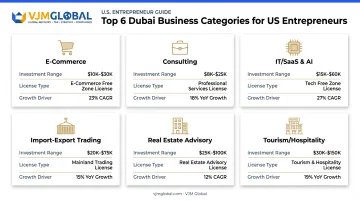
- E-commerce, consulting, IT/SaaS, trading, real estate advisory, and hospitality offer the strongest openings for US founders
- Free zones suit remote and export-focused businesses; mainland suits local UAE market access
- UAE's 0% personal income tax doesn't cancel your US filing obligations: FATCA and FBAR still apply
- No comprehensive US-UAE tax treaty exists, making entity structure decisions upfront critical
Why Dubai Is a Top Destination for US Entrepreneurs in 2026
Dubai sits at the crossroads of Western and Asian commerce. For US founders who want a low-tax base with real global reach—not just a foreign address on the letterhead—it is one of the strongest entry points available.
The momentum is measurable. 787 new US companies joined the Dubai Chamber of Commerce between January and September 2025, pushing the total active American member base to 3,690 companies by the end of September 2025, according to Dubai Chambers. That pace points to a sustained pipeline of American founders choosing Dubai over other offshore hubs.
The sections below rank the business categories that fit a US founder entering Dubai in 2026—scored on demand, remote-setup ease, and profit potential.
Top Business Ideas to Start in Dubai from the USA in 2026
Four filters shaped every category below:
- Demand from a US-founder lens
- Ease of remote setup
- Licensing availability
- Realistic profit potential
E-Commerce & Cross-Border Retail
Dubai's logistics infrastructure and port access make it a natural launchpad for selling into the GCC and beyond.
The UAE e-commerce market is valued at $12.30 billion in 2026, growing to a projected $21.01 billion by 2031 at an 11.29% CAGR, according to Mordor Intelligence.
For Americans, the appeal is practical: low entry barrier, the ability to run operations from the US while a local team handles fulfillment, and tax-free profit repatriation.
| Investment Range | Ideal License Type | Demand Driver |
|---|---|---|
| ~$2,450–$13,600 (AED 9,000–50,000) | DMCC trading or service license | UAE e-commerce market growing at 11.29% CAGR |
Management, Tax & Business Consulting Services
Dubai's SME ecosystem is dense and growing. The Dubai International Financial Centre (DIFC) reported 8,844 active companies in 2025, up 28% year over year. That client pool rewards specialized advisory skills.
A US CPA license or MBA still carries weight here. Low overhead, the ability to serve US and Gulf clients simultaneously, and fast investor-visa eligibility make this one of the easiest categories to launch remotely.
| Investment Range | Ideal License Type | Demand Driver |
|---|---|---|
| ~$2,450–$13,600 (AED 9,000–50,000) | DMCC service license or DET mainland professional license | DIFC active companies up 28% YoY |
IT, SaaS & AI Startups
Dubai is actively positioning itself as a global AI hub. DIFC counted 1,677 AI and FinTech organizations in 2025, up 35%. Startups in its ecosystem collectively raised over $4.5 billion regionally.
For US founders, this means access to a funding ecosystem, the ability to serve MENA and Western clients from one base, and favorable IP and data regulations under the DIFC's common-law framework.
| Investment Range | Ideal License Type | Demand Driver |
|---|---|---|
| $1,500/yr (DIFC Innovation License, subsidized) to ~$8,450 (AED 31,000, DMCC AI Centre) | DIFC Innovation License or DMCC AI package | AI/FinTech orgs up 35% YoY at DIFC |
Import-Export & International Trading
Dubai's ports and free zones remain a global trade gateway. UAE non-oil foreign trade hit AED 1.937 trillion in H1 2026, up 13.1% year over year, with non-oil exports climbing 23.9%.
Streamlined customs, free zone duty exemptions, and established logistics corridors make this one of the more capital-efficient categories for American traders sourcing goods across Africa and Asia.
| Investment Range | Ideal License Type | Demand Driver |
|---|---|---|
| ~$5,525–$21,600 (AED 20,285–79,265 annually) | DMCC trading or General Trading license | Non-oil trade up 13.1% YoY, exports up 23.9% |
Real Estate Advisory & Property Investment
Dubai real estate continues pulling in foreign capital, including a steady flow of US buyers chasing yield and Golden Visa eligibility. Knight Frank reports residential yields of 5%–7% for apartments and 4.5%–6% for villas and townhouses — well above what most US markets offer.
Tax-free rental income and a Golden Visa path tied to property investment (minimum AED 2 million) add extra pull for advisory-focused founders, not just buyers.
| Investment Range | Ideal License Type | Demand Driver |
|---|---|---|
| Varies — DET license + DLD activity approval, no fixed published minimum | DLD Real Estate Licensing (consultancy) | Yields of 5–7%, well above comparable US markets |
Tourism, Hospitality & F&B Concepts
Dubai welcomed 19.59 million international overnight visitors in 2025, up 5% from the prior year, with hotel occupancy at 80.7%. That kind of footfall creates real room for niche US-style concepts, from fast-casual chains to specialty coffee.
Government tourism initiatives and strong demand for imported American brand concepts give this category a built-in audience.
| Investment Range | Ideal License Type | Demand Driver |
|---|---|---|
| Varies widely by concept and premises | DET business/tourism license (plus hotel classification if applicable) | 19.59M visitors in 2025, occupancy at 80.7% |
How to Set Up Your Business: Free Zone, Mainland & Key Steps
The free zone vs. mainland decision shapes almost everything else about your Dubai entity—ownership, market access, and banking—so choose it before you file.
Free zone setups suit remote and export-focused businesses. You get 100% foreign ownership, simplified setup, and a structure built for cross-border work when you don’t need to sell directly into the UAE mainland market. Most of the categories above — e-commerce, consulting, IT/SaaS, trading — fit comfortably here.
Mainland setups suit businesses that need direct access to the local UAE market or government contracts. More than 1,000 commercial and industrial activities now permit full foreign ownership under UAE mainland rules, a shift from the older majority-Emirati-shareholder requirement.
A typical setup sequence looks like this:
- Select your activity and jurisdiction — match your business model to a specific free zone (DMCC, DIFC, RAKEZ) or mainland Department of Economic Development (DED) license
- Register your trade name and secure initial approval
- Apply for your license — trading, service, or industrial, depending on activity
- Open a corporate bank account — requirements vary by jurisdiction and entity structure
- Apply for your investor visa if you plan to reside in the UAE, or skip this step if you're running the business remotely
Most of the business ideas above can be launched by a US founder without relocating, provided you choose the right free zone and a bank that supports remote account opening. That last part trips people up more than the licensing itself. VJM Global supports US founders on UAE free zone and mainland formation—activity and jurisdiction fit, licensing, and documentation banks typically expect—so remote setup stays coordinated end to end.
Tax & Compliance Considerations for US Entrepreneurs in Dubai
This is the section most "Dubai business idea" articles skip entirely, and it's the one that determines whether your venture is actually profitable after both governments take their share.
UAE Corporate Tax Basics
The UAE applies 0% corporate tax on taxable income up to AED 375,000, with 9% above that threshold. Personal income tax remains 0% for individuals. That's a favorable setup, but it only tells half the story for a US owner.
Your US Obligations Don't Disappear
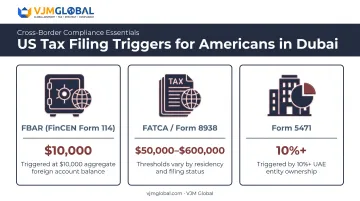
UAE tax exemption does not remove your US tax obligations. US citizens and US-formed entities must still report worldwide income, regardless of where the business operates. Specific triggers include:
- FBAR (FinCEN Form 114): Required if your foreign account balances exceed $10,000 at any point in the year
- FATCA/Form 8938: Thresholds range from $50,000 (US residents, single filers) up to $600,000 (qualifying expats, joint filers)
- Form 5471: Can be triggered by UAE entity ownership thresholds of 10% or more, separate from any dollar amount
Why Structuring Matters More Here
The UAE does not have a comprehensive income tax treaty with the United States on the IRS treaty list. Without treaty protection, ownership structure from day one determines whether you face double taxation exposure or a clean setup.
Bring in multi-jurisdiction tax and entity advice before formation, not after. VJM Global supports American owners at this stage across entity formation, accounting, and dual-country compliance, drawing on 30+ years in cross-border tax and advisory work.
Common mistakes US founders make:
- Mismatched entity and license — choosing a free zone license when the business needs mainland market access, forcing a costly restructure later
- Missed FBAR or FATCA deadlines — easy to overlook when attention is on UAE compliance, but IRS penalties can be steep
- Unclear beneficial ownership disclosures — UAE UBO filings and US Form 5471 reporting don't always align, and gaps create audit risk on both sides
Frequently Asked Questions
What are the best businesses to start in Dubai?
E-commerce, consulting, IT/SaaS, import-export trading, real estate advisory, and hospitality currently offer the strongest combination of demand and ease of setup for foreign founders in 2026.
How can I earn $30,000 per month in Dubai?
That income level typically comes from scaling a service, trading, or e-commerce business with recurring international clients, not a single-location retail concept. Niche selection and execution matter more than the industry itself.
Can a US citizen own 100% of a business in Dubai?
Yes. 100% foreign ownership is permitted in UAE free zones and across most mainland commercial activities under current regulations, with limited exceptions for strategic sectors.
Do US citizens have to pay tax in both the US and Dubai?
The UAE has no personal income tax, but US citizens must still file US taxes on worldwide income regardless of where they live or operate a business.
Is a free zone or mainland license better for a US-owned startup?
Free zone licenses suit remote, export-focused businesses like e-commerce or consulting. Mainland licenses suit businesses needing direct access to local UAE customers or government contracts.
How much does it cost to start a business in Dubai as an American?
Free zone registration typically starts around $2,450 (AED 9,000), with annual license fees ranging up to $13,600 (AED 50,000) depending on the zone, activity, and visa allocation.
Conclusion
Dubai offers US entrepreneurs a broad range of profitable business categories in 2026. But the idea itself is only half the equation. Success depends on matching the right business model to the right jurisdiction, license type, and entity structure from the outset.
Before you finalize anything, evaluate your tax exposure and compliance obligations in both the US and the UAE, not just the business concept. That's the part most founders underestimate until an FBAR deadline or a mismatched license forces an expensive fix.
VJM Global works with US entrepreneurs entering the Dubai market on exactly this kind of cross-border groundwork, from entity formation and accounting to multi-jurisdiction tax compliance, so the structure holds up before you scale.