
Introduction
India ranks as Singapore's 7th largest trading partner, and Singapore consistently sits among India's top FDI source countries. That relationship is backed by real policy momentum — 100% foreign ownership is now permitted in many sectors via the automatic FDI route, removing one of the biggest barriers Singapore-based founders once faced.
India's expanding consumer base of over 1.4 billion people, combined with rapid digital infrastructure adoption, is generating measurable demand across sectors from fintech to manufacturing. The India-Singapore Comprehensive Economic Cooperation Agreement (CECA) and Double Taxation Avoidance Agreement further reduce friction and cost for cross-border business entry.
This guide covers the best business sectors for Singapore-based investors in India in 2026, along with practical factors to consider before entering the market.
Key Takeaways
- India's GDP growth and digital adoption make it one of Asia's most attractive markets for Singapore entrepreneurs in 2026
- Top sectors: IT services, e-commerce/D2C, fintech, edtech, PLI-linked manufacturing, healthcare, and renewable energy
- Singapore investors benefit from CECA, favourable tax treaties, and established capital flow infrastructure
- Most sectors allow 100% FDI via automatic route, simplifying foreign entry
- Getting RBI, FEMA, GST compliance and entity structure right from the start is critical
Why Singapore Entrepreneurs Are Investing in India in 2026
Singapore holds an advantageous position in India's FDI landscape. India is Singapore's 7th largest trading partner, while Singapore consistently ranks among India's top three FDI source countries.
This relationship is built on strong institutional frameworks — the India-Singapore CECA provides preferential market access, and the Double Taxation Avoidance Agreement (DTAA) reduces tax liability on cross-border income.
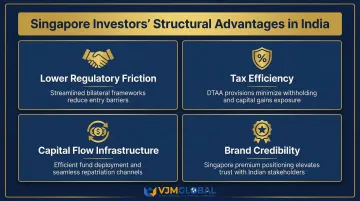
Singapore's role as Southeast Asia's financial and business gateway to India creates natural synergies. Singapore-based investors benefit from:
- Lower regulatory friction through established bilateral frameworks
- Tax efficiency via DTAA provisions that prevent double taxation
- Capital flow infrastructure enabling seamless fund deployment and repatriation
- Brand credibility as Singapore entities carry premium positioning in India's market
The sectors below are where these structural advantages translate most directly into business opportunity.
Best Businesses to Start in India from Singapore in 2026
Each business below was evaluated on market size, FDI accessibility, India-specific demand, and the structural advantages Singapore investors hold — so you can match opportunities to your capital position and risk appetite.
IT & Tech Services / Software Development
India's position as a global IT outsourcing hub remains unmatched. The country's IT sector is projected to reach $350 billion by 2026, driven by a massive pool of English-speaking tech professionals and labour costs significantly lower than Singapore. India produces over 1.5 million engineering graduates annually, creating deep access to skilled talent.
Singapore-headquartered tech companies can establish wholly-owned Indian subsidiaries to access R&D talent, leverage Production Linked Incentive (PLI) schemes for electronics manufacturing, and tap domestic Indian demand.
The cost arbitrage — combined with time-zone compatibility across Asia-Pacific — makes India a practical base for Singapore tech firms building scalable development capacity for global clients.
| Investment Range | FDI Route | Profit Potential |
|---|---|---|
| ₹30–80 lakhs for initial setup (office, recruitment, compliance) | 100% FDI via automatic route | Gross margins of 30–40% for IT services; net margins of 12–18% at scale |
E-commerce & D2C Consumer Brands
India's e-commerce market is projected to reach $200 billion by 2027, fuelled by rising middle-class purchasing power, smartphone penetration exceeding 750 million users, and digital payment adoption via UPI. Consumer demand spans fashion, beauty, wellness, home goods, and specialty products.
Singapore investors are well-positioned in this space due to:
- Strong brand positioning and design capabilities
- Access to capital and supply chain expertise
- Premium appeal of Singapore-origin D2C brands in India
- Logistics and fulfilment knowledge applicable to India's complex distribution environment
| Investment Range | FDI Route | Profit Potential |
|---|---|---|
| ₹50 lakhs–₹2 crore (inventory, platform development, marketing) | 100% FDI in B2B e-commerce; B2C marketplace models have specific conditions (inventory-based retail allowed with conditions) | Gross margins of 40–60% for branded D2C; net margins of 8–15% after marketing costs |
Fintech & Digital Financial Services
India is home to one of the world's largest fintech ecosystems, projected to reach $420 billion by 2029. The market is driven by UPI's scale (21.7 billion monthly transactions as of January 2026), a large unbanked population, and rapid growth in digital lending, insurance distribution, and payments infrastructure.
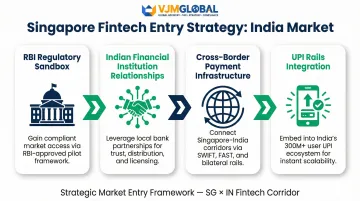
Singapore-based fintech companies enter this market with a structural edge — regulatory experience, institutional relationships, and cross-border payment infrastructure that maps directly onto India's digital finance stack. Key entry points include:
- India's regulatory sandbox programmes (RBI's 'On Tap' facility)
- Existing relationships with Indian financial institutions
- Cross-border payment infrastructure aligned with Singapore's digital finance ecosystem
- Access to India's mature UPI rails for instant payment integration
| Investment Range | FDI Route | Profit Potential |
|---|---|---|
| ₹2–10 crore (depending on sub-sector: payments, lending, NBFC licensing) | FDI varies by sub-sector; NBFCs allow 100% FDI with capitalization norms (₹0.5M–₹50M USD depending on ownership stake); Payment Aggregators require RBI authorization with ₹15–25 crore net worth | EBITDA margins of 10–15% for established fintechs; top-quartile revenue growth of 70%+ annually |
EdTech & Online Education
India has the world's second-largest student population — over 250 million school-going children, plus millions more seeking skill development, test preparation, coding education, and professional upskilling. The edtech market is projected to exceed $10 billion by 2026, driven by affordable digital learning and rising aspirations for quality credentials.
Singapore's education system reputation gives founders a credibility advantage in India's premium segment. Areas of opportunity include:
- Professional certification and upskilling platforms
- K-12 online learning and test prep
- Coding and STEM education for children
- Corporate training and enterprise learning solutions
| Investment Range | FDI Route | Profit Potential |
|---|---|---|
| ₹40 lakhs–₹1.5 crore (technology platform, curriculum development, marketing) | 100% FDI via automatic route | Gross margins of 50–70% for digital content delivery; net margins of 15–25% at scale |
Manufacturing (PLI-Aligned Sectors)
India's Production Linked Incentive (PLI) scheme covers 14 sectors including electronics, pharmaceuticals, textiles, auto components, and food processing, with a total outlay exceeding ₹1.97 lakh crore. The scheme provides incentives ranging from 4% to 6% of incremental sales for manufacturers meeting production and investment thresholds.
Singapore-based companies in electronics, specialty chemicals, medical devices, or food processing can tap India's low-cost manufacturing ecosystem while earning PLI incentives. The India-Singapore corridor also enables re-export of manufactured goods to Southeast Asia, leveraging India as a production base for regional supply chains.
Key advantages for Singapore investors:
- Access to lower manufacturing costs (labour, land, utilities)
- PLI incentives reducing effective capital expenditure
- India's free trade agreements enabling export to ASEAN, Middle East, and Africa
| Investment Range | FDI Route | Profit Potential |
|---|---|---|
| ₹1–5 crore+ depending on sector and scale | 100% FDI via automatic route in most PLI sectors; sectoral caps apply in defence and pharmaceuticals | Net margins of 8–20% depending on sector; PLI incentives add 4–6% on incremental revenue |