The account you choose determines how fast you can invoice UK customers, pay local staff, and stay compliant with HMRC and Companies House. In FY2023/24, the United States was the UK's largest source of inward foreign direct investment, with 376 projects and 19,341 new jobs created, according to the UK Department for Business and Trade. This guide breaks down the accounts that actually work for US-owned UK entities, and where the real bottlenecks tend to show up.
TL;DR
- UK business accounts split into digital/fintech providers and traditional high-street banks, each suited to different startup profiles
- Most banks care about UK company registration, not founder residency — that's the real eligibility gate
- Wise, HSBC, Airwallex, Barclays, and Revolut stand out on fees, multi-currency support, and onboarding speed
- Solid UK entity setup and docs upfront—work VJM Global does for foreign-owned companies—speeds bank approval
Overview of UK Business Banking for US Startups
A UK business bank account operates under a different regulator (the FCA, not the SEC or OCC), a different default currency, and a different compliance regime than anything a US founder has dealt with domestically. That distinction matters more than most founders expect going in.
The UK's business banking market has shifted over the past decade. Challenger banks and fintechs now account for a majority of new SME lending activity. Two markers of that change stand out:
- Roughly 750,000 UK small businesses already use open-banking tools to manage payments, per a 2025 government call for evidence
- The Competition and Markets Authority's 2024 survey ranked digital-first providers Monzo and Starling above traditional high-street names for business banking service quality
For US founders, this expanded field is good news. There are more legitimate options than five years ago, but not every provider is built for internationally-owned entities. The list below evaluates each one specifically through that lens.
Top Business Bank Accounts in the UK for US Startups
The comparison weighs four factors that matter most to US-linked founders:
- Acceptance of internationally owned UK companies
- Multi-currency (USD/GBP) support
- Onboarding speed
- Accounting software integrations
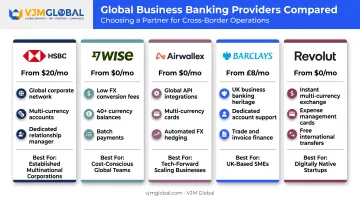
HSBC Business Account
HSBC brings decades of experience supporting foreign-owned UK subsidiaries, including plenty of US parent companies setting up their first UK entity. It's the closest thing to a "safe default" in this list.
You get dedicated relationship managers on larger accounts, true foreign currency accounts, and an international transfer network few digital challengers can match.
| Aspect | Details |
|---|---|
| Monthly Fee | Free for 12 months, then £5.99 plus VAT/month |
| Key Features | Foreign Currency Account (USD/GBP and more), in-app lending access, international payment tools |
| Best For | US startups wanting a globally recognised bank with in-branch and international support |
Wise Business
Wise isn't a traditional bank; it's an e-money institution built for cross-border businesses. That makes it a natural fit for a US-owned UK entity juggling two currencies.
You get local account details in 22 currencies, including USD and GBP, with FX conversion fees starting around 0.24%. Onboarding is fully digital and typically much faster than a high-street bank.
| Aspect | Details |
|---|---|
| Monthly Fee | None (one-off £50 setup fee for multi-currency account details) |
| Key Features | Multi-currency balances, batch payments, accounting software integrations |
| Best For | US startups needing to hold or receive USD and GBP without forced conversion |
Airwallex
Airwallex is a global fintech built around API-first, automated international payments. It leans heavily toward tech-driven founders who want banking that plugs into their existing software stack.
Global Accounts give you local receiving details in multiple currencies, and the Platform API lets you manage payments at scale rather than manually.
| Aspect | Details |
|---|---|
| Monthly Fee | From £19/month, waived with a £10,000+ deposit balance |
| Key Features | Multi-currency wallets, expense cards, Bill Pay, accounting integrations |
| Best For | Tech-driven US startups wanting automated, API-first international payments |
Barclays Business Account
Barclays pairs traditional high-street banking with a genuine startup proposition through Eagle Labs, its network of mentoring, investor access, and entrepreneurial community events.
Foreign currency accounts are available with no minimum balance requirement, and the in-branch support helps founders who still want a human to call when something goes wrong.
| Aspect | Details |
|---|---|
| Monthly Fee | Free for the first 12 months, then £8.50/month |
| Key Features | Foreign currency accounts, Eagle Labs access, 24/7 support, lending subject to eligibility |
| Best For | US founders wanting traditional banking plus mentorship as they establish a UK presence |
Revolut Business
Revolut is an app-based neobank built for teams that operate across borders. It supports 25+ currencies, making it useful for startups with distributed teams spending in multiple markets.
Card issuance is generous too: up to 3 physical and 50 virtual corporate cards per team member, depending on plan.
| Aspect | Details |
|---|---|
| Monthly Fee | From £10/month (Basic), scaling to £30 (Grow) and £90 (Scale) |
| Key Features | Multi-currency cards, expense management, payroll add-ons |
| Best For | US startups with distributed teams needing multi-currency card issuance |
Key Challenges US Founders Face When Opening a UK Business Account
Here's where most US founders get stuck. The blocker is rarely the bank. It's the paperwork that has to exist before the bank will even look at your application.
UK company registration comes first. Nearly every provider on this list requires a UK-registered company via Companies House before you can open an account, regardless of where the founder or director lives. HSBC asks for a Companies House registration number outright; Revolut requires a valid registration number as a baseline condition.
Proving a UK nexus is harder than it sounds. Banks and fintechs often want evidence of:
- A UK trading address (not just a registered office)
- Local business activity: UK invoices, contracts, or a UK-facing website
- At least one UK-resident signatory in some cases
A brand-new entity with no UK invoices, contracts, or operational footprint yet can struggle here. Expect extra questions or an outright decline from some providers.
KYC and AML checks take longer for US-based directors. The FCA requires firms to identify customers and beneficial owners and verify their identities. When those directors live in the US, that verification process (proof of address, photo ID, sometimes notarized documents) tends to add days or weeks compared to a UK-resident applicant.
That missing paper trail is what stalls most applications. VJM Global handles UK entity formation, registered address setup, and the compliance documentation banks expect, so US founders show up with a local footprint instead of an empty file — often the difference between a fast approval and weeks of back-and-forth.
How to Choose the Right Account for Your US-Owned UK Startup
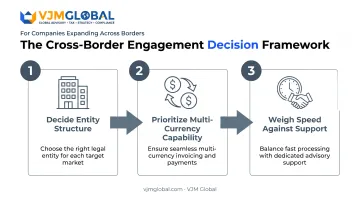
Before comparing fee schedules, settle the structural question first.
- Decide on entity structure. A fully UK-incorporated subsidiary and a US branch registration have different bank eligibility outcomes. Sort this out with your formation advisor before applying anywhere.
- Prioritize multi-currency capability. If money will keep moving between the US and UK, GBP/USD accounts with low FX fees (Wise and Airwallex lead here) will save real money over a year.
- Weigh speed against support. Digital providers approve faster and cost less upfront. High-street banks offer lending access and in-person relationship management once you're established, which helps when you start hiring or seeking credit.
There's no single "best" answer. A pre-revenue SaaS startup and a UK-based services subsidiary hiring local staff have genuinely different banking needs.
Conclusion
The best UK business bank account for a US startup depends on your entity structure, currency needs, and growth stage, not brand recognition alone. HSBC and Barclays suit founders who want traditional banking relationships. Wise and Airwallex suit those who prioritise currency flexibility and speed.
Whichever direction you go, sort out UK incorporation and compliance documentation early. That step is consistently the biggest bottleneck between a US founder and an approved account.
VJM Global has supported 250+ UK businesses across formation, accounting, and tax compliance. A registered address, HMRC registration, and proper documentation are what make UK bank account approval smoother for US startups entering the market.
Frequently Asked Questions
Which business bank account is best for startups in the UK?
Wise, HSBC, and Barclays are consistently strong options for internationally owned startups. Choose Wise for lower FX costs; choose HSBC or Barclays when you want deeper relationship support. Your currency mix and growth stage decide the fit.
Is there a free business bank account available in the UK?
Yes. Wise and Starling charge no monthly fee, and Tide offers a free plan too. High-street banks like HSBC and Barclays offer fee-free introductory periods, typically 12 months.
Can a US company open a UK business bank account without incorporating in the UK?
Generally, no. Most UK providers require a UK-registered entity. The usual path is forming a UK subsidiary or registering a branch of the US company through Companies House.
What documents do US founders need to open a UK business account?
You'll typically need Companies House registration details, director identification and proof of address, and evidence of UK business activity such as invoices or contracts. Requirements vary by provider.
How long does it take for a non-UK resident to open a UK business account?
Digital providers can approve accounts within days once documentation is in order. High-street banks may take several weeks, particularly when verifying US-based directors or beneficial owners.
Is FSCS protection available to US-owned UK businesses?
Yes, for eligible deposits at UK-licensed banks. Protection is currently £120,000 per entity as of December 2025, regardless of the owner's nationality. E-money institutions like Wise use a different safeguarding model, not standard FSCS deposit protection.