Introduction
US entrepreneurs are incorporating UK limited companies to reach European customers, win GBP-denominated contracts, and build a foothold outside the US market. Once that UK entity exists, a UK business credit card becomes one of the first tools you need for software subscriptions, contractor payments, and everyday running costs.
Here's the catch: a strong US personal or business credit score means nothing to a UK card issuer. US credit history doesn't cross the Atlantic, so newly incorporated founders start from zero.
This article ranks the UK startup credit cards most realistic for a newly formed entity, covers what US founders need before applying, and flags the mistakes that slow approval the most.
Key Takeaways
- US credit history does not carry over — you build a separate UK credit file from scratch
- Approval hinges on a registered UK Ltd or LLP, not on citizenship or residency status
- iwoca and Capital on Tap are the strongest fits for entities with no UK trading history
- Get the UK entity, bank account, and paperwork in place first to speed up approval
Overview: UK Business Credit Cards and the US Entrepreneur's Challenge
US founders often assume a strong personal credit score travels with them. It doesn't. To a UK lender, a newly incorporated company with an American director can look like a borrower with no credit history—even when the founder's US record is flawless.
A business credit card is a revolving line of credit issued to a registered company rather than an individual, though a director's personal profile often factors into approval. You spend up to an agreed limit, repay monthly or over time, and interest applies to any balance carried forward.
Can a US citizen get a UK business credit card? Yes, if you have a UK-registered business entity. Citizenship is irrelevant. Lenders care whether the company appears on Companies House and whether the director has any UK-linked credit footprint.
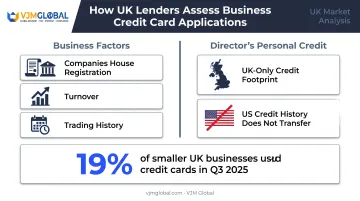
Most providers assess two things:
- Business factors: turnover, Companies House registration status, and trading history
- The director's personal credit history—but only the UK portion
Experian UK is direct about the gap: when someone moves between countries, credit data doesn't transfer, and reports aren't usually available to lenders across borders.
Credit cards were used by 19% of smaller UK businesses in Q3 2025, according to the British Business Bank, making them the most commonly used finance product alongside overdrafts.
So which cards actually work for a brand-new UK entity with zero UK trading history? Below is a rundown of the five most realistic options, ranked by accessibility rather than brand size.
Top Startup Business Credit Cards in the UK
Selection comes down to four things: accessibility for a brand-new entity, fee transparency, whether you need an existing UK banking relationship, and whether rewards add real value. Only two cards below are realistic day-one options for most US founders; the rest fit better once you have a UK address, bank account, or trading history.
iwoca Credit Card
iwoca is a UK fintech lender built specifically for SMEs, issuing its credit card through Enfuce UK Limited on FCA-regulated Visa rails.
iwoca is the strongest starting point for a US founder. Applications are accepted regardless of company age, and a director's personal credit history feeds into the assessment when the company has no track record yet.
The applicant still needs to be a UK-based director of a limited company or LLP. Sole traders don't qualify.
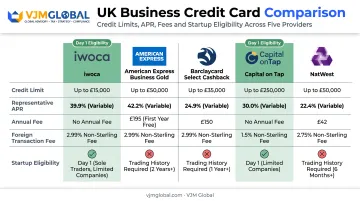
| Feature | Details |
|---|---|
| Credit Limit | Up to £250,000, subject to status; no minimum company age |
| APR/Fees | From 14.99% (35.40% representative APR variable); £0 annual, FX, or late fees |
| Startup Eligibility | UK Ltd/LLP of any age; applicant must be a UK-based director |
American Express Business Gold Card
Amex's Business Gold Card is a familiar name for founders who value Membership Rewards points and travel perks, with spending based on circumstances rather than a fixed limit.
It looks generous on paper: no pre-set spending limit and no annual fee in year one. The fine print matters, though. Applicants need a permanent UK home address and a UK bank account, which rules out a founder still based full-time in the US.
Apply once you, or a UK-resident co-director, are established locally.
| Feature | Details |
|---|---|
| Credit Limit | No pre-set limit; based on financial circumstances, repaid monthly |
| APR/Fees | £0 annual fee in year one (£195 after); 2.99% non-sterling fee |
| Startup Eligibility | Requires UK home address, UK bank account, and LTD/LLP directorship |
Barclaycard Select Cashback Business Credit Card
Barclaycard's Select Cashback card offers uncapped cashback with no annual fee, aimed more at established SMEs than day-one startups.
A new-business plan is accepted in place of trading history, and a free accounting software plan adds practical value. Annual turnover (or a projected plan) still needs to sit between £10,000 and £6.5 million, so this fits better once you have some UK revenue to show.
| Feature | Details |
|---|---|
| Credit Limit | From £1,000; higher subject to status |
| APR/Fees | 25.5% representative APR variable; £0 annual fee; 2.99% non-sterling fee; £12 late fee |
| Startup Eligibility | UK-based business; turnover or new-business plan of £10,000-£6.5m |
Capital on Tap Business Credit Card
Capital on Tap is a specialist UK card provider offering cashback or Avios rewards, with flexible approval criteria rather than a bank's usual box-ticking.
For a US founder, this is one of two realistic day-one options. There's no minimum trading period. Approval leans on the director's personal credit profile and an active UK business bank account rather than months of turnover history.
The applicant needs to be an active UK director or hold a 25%+ shareholding.
| Feature | Details |
|---|---|
| Credit Limit | Up to £250,000, subject to status |
| APR/Fees | From ~13.86% APR variable; £0 annual fee; £0 FX fees |
| Startup Eligibility | No minimum trading period; UK director or 25%+ shareholder; business bank account required |
NatWest Business Credit Card
NatWest's business credit card is the predictable, low-cost option from a major high-street bank, designed for businesses under £2 million turnover.
The catch for American founders: it requires an existing NatWest business bank account under the same company name before the card is even considered, plus a UK-resident director. You would need to open a NatWest account first (itself slower for non-resident applicants) before this card becomes an option at all.
| Feature | Details |
|---|---|
| Credit Limit | Minimum £500; upper limit based on status |
| APR/Fees | 24.3% representative APR variable; £30 per card (waived year one and with £6,000+ annual spend); 2.95% non-sterling fee |
| Startup Eligibility | Existing NatWest business account required; UK-resident director; turnover under £2m |
Building Your UK Foundation: What US Entrepreneurs Need Before Applying
Almost every card above assumes one thing: a UK-registered Limited Company or LLP with active Companies House status. A US entrepreneur can't apply as an individual, and a US LLC or C-corp doesn't count - the entity has to exist on the UK register.
The second barrier catches people out even after incorporation. NatWest, Lloyds, and HSBC all require an existing business bank account with that same bank before they'll even review a credit card application. If you've incorporated but haven't opened a UK account yet, several cards above simply aren't reachable.
Then there's the credit file problem covered earlier. Since UK credit reference agencies don't pull in US credit history, a US entrepreneur's UK company starts with a blank file. Early approvals therefore tend to hinge on the director's personal UK-linked circumstances, a personal guarantee, or a provider like iwoca or Capital on Tap that will look past the absence of trading history.
Before applying for any UK business credit card, have these ready:
- Certificate of incorporation from Companies House
- A UK registered office address
- Proof of director identity (passport or equivalent)
- Projected UK turnover figures for the first 12 months
Getting this foundation right is where most delays happen. VJM Global provides UK entity formation, registered address, and compliance support for founders at this stage.
The firm has completed entity setup and ongoing compliance for 250+ UK businesses, covering Companies House registration through Corporation Tax registration, UTR setup, and recurring filings (Confirmation Statements, annual accounts, and CT600 returns). The aim is a company that is incorporated and tax-ready quickly enough that paperwork gaps do not block a card application.
On timing: standard online Companies House registration is usually completed within 24 hours, but a non-resident director should budget longer for the bank account that follows - anywhere from a few days with a digital provider to several weeks with a traditional bank. Build that into your plan before you apply for a card so you do not lose time later.
How to Choose the Right Card and Avoid Common Mistakes
The single biggest mistake US founders make is assuming a strong US personal or business credit score will influence a UK lender's decision. It won't. UK providers can't see it. Plan as if you're starting from zero, because in credit-file terms, you are.
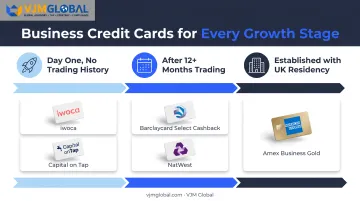
The next mistake is chasing a brand name instead of matching the card to your stage:
- Day one, no UK trading history: iwoca or Capital on Tap — both can weigh a director's personal profile when the company has no track record
- After 12+ months of UK trading: Barclaycard Select Cashback or NatWest, once turnover and a banking relationship exist
- Once established with a UK-resident presence: Amex Business Gold, for founders who value rewards and have the address and banking requirements sorted
Also watch foreign transaction fees. If you pay US-dollar suppliers, cloud software, or contractors on a UK card, a 2.95–2.99% non-sterling fee (Amex, Barclaycard, NatWest) adds up fast.
iwoca and Capital on Tap charge £0 on foreign transactions. That gap matters once monthly USD spend climbs.
Conclusion
The right UK startup credit card depends on whether your UK entity, bank account, and paperwork are actually in place. A US founder chasing an Amex or NatWest card before that groundwork exists will get turned down, not because of nationality, but because the boxes aren't ticked yet.
Before committing, weigh trading history requirements, annual fees, and FX costs against how you'll actually spend day to day. A card with a £0 FX fee is worth more than a rewards card if you're paying US suppliers weekly.
If entity formation and compliance feel like the slower part of this process, VJM Global can handle UK incorporation, the registered office requirement, and ongoing tax and filing obligations so those prerequisites are in place when you apply.
Frequently Asked Questions
Can a US citizen get a UK credit card?
Yes. Approval depends on having a UK-registered business, not on citizenship. Most providers assess the UK entity and, where relevant, the director's UK-linked credit profile rather than any US credit history.
What are the best business credit cards for startups in the UK?
iwoca and Capital on Tap are the most accessible for brand-new entities with no trading history. Barclaycard, Amex, and NatWest suit businesses with some UK trading record and an existing banking relationship.
What is the 7 year rule on credit cards?
This usually refers to how long negative marks like defaults or CCJs stay on a credit file. In the UK, that's typically six years, not seven, so US entrepreneurs should check UK credit reference agency guidelines directly rather than assuming US rules apply.
Which bank is best for startup businesses in the UK?
It depends on whether you already hold a UK business account. Challenger and fintech providers are generally more accessible to newly incorporated, companies founded by non-residents than traditional high-street banks.
Do I need a UK company to get a UK business credit card as a US entrepreneur?
Yes. Virtually every provider requires a UK-registered Limited Company or LLP before considering an application. Forming that UK entity is the first step for most US founders starting from scratch.
How long does it take a US entrepreneur to build UK business credit?
There's no fixed published timeframe, but responsible card use and consistent on-time repayments over several months typically start building a usable UK credit file. Positive payment history reported to UK credit reference agencies is what builds that file.