Introduction
India's finance and accounting BPO market generated USD 3.2 billion in 2025 revenue, with a projected growth rate of 13.1% annually through 2033. For UK businesses, this is a well-established, fast-growing outsourcing market — and one with direct implications for how you structure and budget your India operations.
UK businesses operating in India — whether through a subsidiary, branch office, or outsourced partner — face compliance requirements that go well beyond basic bookkeeping. Many companies entering the market underestimate this complexity.
They budget for data entry, then discover they also need GST filing, TDS reconciliation, MCA annual compliance, and management reporting in pounds sterling. Each requirement adds to the monthly bill.
Understanding these costs upfront prevents budget surprises later. This guide covers current bookkeeping charge ranges in India, the factors that drive costs up or down, what UK businesses commonly overlook, and how to choose the right pricing model for your India operations.
Key Takeaways
- Bookkeeping charges in India range from ₹5,000–₹15,000/month (
£39–£117) for basic services to ₹35,000–₹80,000+/month (£273–£624+) for full-service subsidiary support - Pricing depends on transaction volume, entity type, compliance scope (GST, TDS, MCA), and whether you need dual reporting for your UK parent
- UK-owned subsidiaries typically need more than standard bookkeeping — factor in statutory compliance, payroll, and audit support from day one
- Choosing on price alone often creates compliance gaps — penalty costs routinely exceed whatever you saved upfront
How Much Does Bookkeeping in India Cost?
Bookkeeping charges in India vary based on business size, entity structure, transaction volume, and the scope of compliance work required. There is no fixed rate — and the range is wider than most UK businesses expect.
The typical mistake is assuming India will simply be cheap. Base bookkeeping rates are lower, but India-specific compliance layers (GST, TDS, FEMA, ROC filings) push a full-service engagement for a UK subsidiary closer to a small UK accountancy retainer than a basic bookkeeper.
Typical Cost Range
Entry-level / basic bookkeeping: Approximately ₹5,000–₹15,000/month (~£39–£117). Covers transaction recording, bank reconciliation, and basic reports. Market data confirms entry packages starting at ₹15,000/month and per-transaction models from ₹999/month for up to 100 entries.
What's typically included: Chart of accounts setup, daily transaction recording, bank reconciliation, basic trial balance.
What's excluded: GST compliance, TDS filing, payroll, statutory audit support, MCA/ROC filings, management reporting for UK parent.
Mid-range / standard package: Approximately ₹15,000–₹35,000/month (~£117–£273). Bundles bookkeeping with GST returns, TDS compliance, and payroll for small teams. Industry benchmarks place standard monthly plans at ₹30,000–₹35,000 with detailed reporting and compliance management.
What's typically included:
- Core bookkeeping
- Monthly GST return filing (GSTR-1, GSTR-3B)
- Quarterly TDS returns
- Basic payroll processing (up to 10-15 employees)
- Simple management reports in INR
Full-service / foreign subsidiary support: Approximately ₹35,000–₹80,000+/month (~£273–£624+). Most UK-owned entities land here — mandatory MCA/ROC filings, statutory audit requirements, FEMA reporting, and dual-currency management accounts all push costs into this range.
What's typically included:
- All mid-range services
- Annual ROC/MCA filings (MGT-7, AOC-4)
- FEMA compliance reporting (FC-GPR, FLA returns)
- Management reporting in GBP for UK parent
- Statutory audit coordination
- Dedicated account management
Pricing Models Available
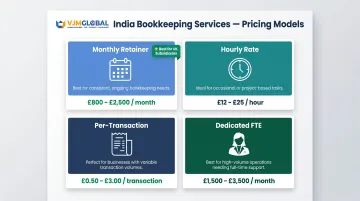
UK businesses will encounter three main pricing models:
| Pricing Model | Best For | Typical Cost |
|---|---|---|
| Monthly retainer | Ongoing compliance and recurring bookkeeping — most UK subsidiaries use this | Varies by tier (see above) |
| Hourly rate | Catch-up work, one-off tasks, advisory projects | ₹560–₹1,100/hour for bookkeeping; ₹1,400–₹2,300/hour for tax work; roughly £5.50–£12/hour for international outsourcing engagements |
| Per-transaction | High-volume, simple-entry businesses with predictable monthly activity | From ₹999/month for up to 100 entries, scaling with volume |
| Dedicated FTE | Larger businesses needing a full-time bookkeeper via an outsourcing firm | ₹25,000–₹45,000/month — above the average bookkeeper salary of ₹20,497/month to cover firm margin and management |
Key Factors That Affect Bookkeeping Charges in India
Pricing in India is shaped by a combination of operational, structural, and compliance-driven factors. Understanding each one helps UK businesses budget accurately from the outset.
Entity Type and Compliance Burden
A UK company's Indian entity type directly determines the compliance calendar and therefore the bookkeeping cost.
| Entity Type | Tax Rate | Compliance Burden | Key Filings |
|---|---|---|---|
| Wholly Owned Subsidiary (Pvt Ltd) | ~25% + surcharge/cess | Highest | MGT-7, AOC-4, FC-GPR, FLA, statutory audit |
| Branch Office | ~40% + surcharge/cess | Moderate-High | FC-3, FC-4, statutory audit, annual activity certificate |
| Liaison Office | N/A (no income permitted) | Moderate | FC-3, FC-4, annual activity certificate, nil returns |
| LLP | 30% + surcharge/cess | Moderate | Form 8, Form 11, FDI LLP-I/II if foreign-funded |
Subsidiaries (private limited companies) carry the highest compliance burden — ROC filings, statutory audit, board resolutions, and FEMA reporting. The 15-percentage-point tax rate spread between a wholly owned subsidiary (~25%) and a branch office (~40%) makes entity selection one of the most critical cost decisions a UK business makes when entering India.
Transaction Volume and Business Complexity
Higher monthly transaction volumes, multi-currency transactions (INR and GBP), inventory management, or inter-company billing between the UK parent and India entity all increase the time and expertise required. A subsidiary processing 50 transactions monthly will pay significantly less than one processing 500, even with the same entity structure.
Scope of India-Specific Compliance
Bookkeeping in India goes beyond recording transactions. It must align with:
- GST return filing cycles: Monthly or quarterly depending on turnover (GSTR-1, GSTR-3B)
- TDS schedules: Quarterly filing deadlines (24Q for salaries, 26Q for non-salary payments, 27Q for non-resident payments)
- Advance tax instalments: Four annual instalments (15% by 15 June, 45% by 15 September, 75% by 15 December, 100% by 15 March)
- Payroll compliance: Monthly PF (12% employer contribution) and ESI (3.25% employer contribution) remittances with wage ceilings at ₹15,000/month (PF) and ₹21,000/month (ESI)
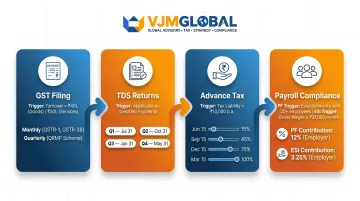
UK businesses frequently underestimate how many of these obligations apply to them. Payroll alone triggers automatically at 20 employees for PF and 10 employees for ESI — thresholds reached quickly once hiring begins in India.
Dual Reporting Requirements
This is a cost driver unique to UK parent companies. Indian books are maintained under Indian Accounting Standards (Ind AS or IGAAP) in INR, while the UK parent typically requires management accounts in GBP and IFRS-aligned reporting for consolidation.
Ind AS is converged with IFRS but includes carve-outs and carve-ins specific to the Indian legal environment, creating reconciliation work that standard bookkeepers aren't equipped to handle.
Providers who offer this translation and consolidation service charge a premium — expect dual reporting to add 20–40% to the base bookkeeping cost.
Provider Type and Expertise Level
Three common provider types serve the market:
Freelance/individual bookkeepers:
- Lowest cost (₹5,000–₹15,000/month)
- Limited compliance coverage
- No dedicated FEMA expertise
- Minimal UK parent reporting capability
- Best suited for very small operations with simple needs
Local CA firms in India:
- Mid-range cost (₹15,000–₹40,000/month)
- Strong Indian statutory compliance knowledge
- Variable cross-border expertise
- May lack UK GAAP/IFRS fluency
- Suited for India-focused entities with limited UK reporting needs
Specialist outsourcing firms serving UK clients:
- Higher cost (₹35,000–₹80,000+/month)
- Foreign subsidiary reporting expertise
- FEMA compliance awareness
- Dual-currency reporting capability
- Dedicated account management
- UK business hours overlap
For most UK businesses, specialist firms justify their higher fees through compliance accuracy — a single missed FEMA filing or incorrect TDS return can result in penalties that dwarf several months of bookkeeping costs.
What's Included in the Cost: A Full Breakdown for UK Businesses
The quoted monthly retainer is rarely the full picture. For UK businesses operating an India entity, costs split across core bookkeeping, statutory compliance, payroll, and reporting — and providers bundle these differently. Knowing what's included versus add-on prevents budget surprises.
Core Bookkeeping
One-time setup:
- Chart of accounts configuration for India operations
- Opening balance migration
- Accounting software setup (Tally, Zoho Books, QuickBooks)
Recurring monthly:
- Daily/weekly transaction recording
- Bank and credit card reconciliations
- Accounts payable and receivable tracking
- Monthly trial balance preparation
- Basic financial reports in INR
Software costs: Confirm whether software licences (typically ₹1,000–₹3,000/month) are bundled or billed as a separate line item.
Statutory Compliance Work
Recurring — monthly/quarterly/annual:
- GST return filing: GSTR-1 and GSTR-3B filed monthly for turnover above ₹5 crore; under the QRMP scheme, returns are quarterly but tax payments via PMT-06 remain monthly.
- TDS return filing: Form 24Q (salaries), Form 26Q (non-salary payments), Form 27Q (payments to non-residents). All filed quarterly with deadlines on 31 July, 31 October, 31 January, and 31 May.
- Advance tax calculations and deposits: Four instalments across the financial year.
- ROC/MCA annual filings: MGT-7 (annual return) and AOC-4 (financial statements) for private limited companies. Additional fee of ₹100 per day applies to late filings with no upper cap.
When evaluating providers, ask directly whether these filings are included in the retainer or quoted separately — the answer significantly affects your annual cost.
Payroll Processing
Recurring monthly (if applicable):
- Salary calculations
- PF and ESI contributions and remittances
- Professional tax compliance
- Payslip generation
- Form 16 issuance at year-end
Typical per-employee costs range from ₹300–₹800/month depending on complexity and headcount. Employers must budget for statutory contributions: 12% PF (plus 1% admin charges), 3.25% ESI, adding 13-16% to gross wage costs.
Management Reporting and Audit Support
Periodic/Annual:
- Management accounts in GBP for UK parent
- Dual-currency reconciliation (INR to GBP)
- Year-end financial statements
- Statutory audit coordination and support
Expect ₹40,000–₹1,50,000 annually depending on entity size and reporting complexity. This is typically quoted separately from the monthly retainer.
Low-Cost vs. Full-Service Bookkeeping in India — What's the Difference?
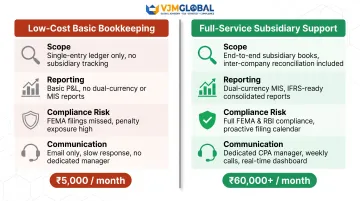
Choosing between a ₹5,000/month bookkeeper and a ₹60,000/month full-service firm comes down to scope, compliance coverage, and what your India operation actually needs from day one.
| Dimension | Low-Cost Basic Bookkeeping | Full-Service Subsidiary Support |
|---|---|---|
| Scope | Data entry, bank reconciliation, basic ledger maintenance | End-to-end India compliance: GST, TDS, payroll, ROC filings, FEMA reporting |
| Reporting | INR-only ledgers, basic trial balance | Dual-currency management accounts (INR and GBP), IFRS-aligned reporting for UK parent consolidation |
| Compliance risk | Limited awareness of FEMA, transfer pricing, withholding tax obligations | Proactive compliance management, penalty avoidance, audit-ready documentation |
| Communication | Email-only, limited availability | Dedicated account manager, UK business hours overlap, proactive advisory |
Penalty Costs That Outpace Bookkeeping Fees
UK businesses that start with low-cost basic bookkeeping often face catch-up costs, penalty payments for missed filings, and expensive clean-up projects before audits. Consider the penalty economics:
- GST late filing: ₹50/day per return (₹25 CGST + ₹25 SGST), plus 18% annual interest on late tax payments
- TDS late filing: ₹200/day under Section 234E, capped at the TDS amount, plus potential ₹10,000–₹1,00,000 penalty under Section 271H
- ROC annual filing delays: ₹100/day with no cap on additional fees, plus penalty proceedings up to ₹2,00,000
- FEMA violations: Penalties up to 3 times the sum involved, plus ₹5,000/day for continuing contraventions
A six-month delay on a single ROC filing generates ₹18,000 in additional fees before penalty proceedings begin. At prevailing professional rates of ₹15,000–₹35,000/month, full-service compliance costs less than a single ROC adjudication — which means the upgrade pays for itself the first time a deadline is missed.

How to Budget Right — and What UK Businesses Often Get Wrong
UK businesses benchmark India bookkeeping costs against their UK accounting fees and assume India will simply be "a fraction of the price". Whilst base bookkeeping is cheaper, the additional India compliance layers (GST, TDS, ROC, payroll) mean a full-service engagement for a UK subsidiary is more comparable to a small UK accountancy retainer than a basic bookkeeper.
Key Questions to Answer Before Requesting a Quote
Answer these five questions to receive an accurate quote:
- How many monthly transactions does the India entity generate? (Under 50, 50–200, 200–500, 500+)
- What entity type is registered in India? (Pvt Ltd subsidiary, branch office, liaison office, LLP)
- Is payroll required, and for how many employees? (Triggers PF/ESI compliance at 10–20 employees)
- Does the UK parent need consolidated/GBP reporting? (Adds dual-currency reconciliation and IFRS alignment work)
- Is a statutory audit required? (Mandatory for most entity types; requires audit-ready books)
Each answer directly drives pricing. A 10-employee subsidiary with 200 monthly transactions needing GBP reporting will cost significantly more than a liaison office with 30 monthly transactions filing nil returns.
How VJM Global Helps UK Businesses Budget Accurately
That cost gap is precisely where scoping discipline matters. VJM Global — which has served 250+ UK businesses across India operations — builds quotes around entity type and compliance calendar rather than generic rate cards.
Right-sizing from day one means bundling the exact mix of services a business actually needs:
- Bookkeeping and GST/TDS compliance calibrated to transaction volume
- Payroll processing scaled to headcount and PF/ESI triggers
- GBP/INR dual-currency reporting for UK parent consolidation
- Audit-ready books where statutory audit applies
This prevents both overpaying for services you don't need and the mid-year scramble when previously excluded compliance suddenly becomes urgent. With 30+ years of experience and a team of Chartered Accountants and CPAs, VJM Global provides transparent, upfront pricing tailored to each UK business's India footprint.
Frequently Asked Questions
What are typical bookkeeping charges in India?
Basic bookkeeping ranges from ₹5,000–₹15,000/month (£39–£117) for simple transaction recording and bank reconciliation. Full-service compliance packages for foreign-owned entities cost ₹35,000–₹80,000+/month (£273–£624+). The right tier depends on transaction volume, entity type, and compliance scope.
What is the monthly accounting fee for a small business in India?
A small business with basic needs typically pays ₹10,000–₹30,000/month (~£78–£234), covering bookkeeping, GST filing, and basic compliance. Costs rise for companies with payroll obligations, TDS requirements, or multi-currency reporting for foreign parent companies.
How much does a CPA cost in India?
India's equivalent of a CPA is the Chartered Accountant (CA). CA-led bookkeeping and compliance services are typically included within monthly package rates of ₹15,000–₹80,000 (£117–£624). Senior CA advisory or audit work is billed separately at approximately ₹1,400–₹2,300/hour (£11–£18).
Which is better, CA or CPA in India?
For India-based bookkeeping and compliance, a CA (ICAI-qualified) is the relevant credential. CAs are trained in Indian tax law, GST, Companies Act compliance, and statutory audit requirements. A CPA qualification is US-focused and not a recognised credential for statutory accounting purposes under Indian law.
Can a CA do a cost audit in India?
Yes, but cost audits are a specialised service required only for certain manufacturing or regulated industries above specific turnover thresholds (₹35 crore general, ₹25 crore for regulated sectors). Most UK subsidiaries in services or technology will not require a cost audit.
What bookkeeping tasks are typically outsourced to India by UK companies?
The most commonly outsourced tasks include transaction recording, bank reconciliation, GST and TDS return filing, payroll processing, management account preparation in GBP for the UK parent, and year-end financial statement preparation for statutory audit.