Introduction
The UK-India technology partnership has grown sharply, with total bilateral trade in goods and services exceeding £40 billion in 2024. UK businesses increasingly rely on Indian SaaS vendors, outsourcing partners, and India-based operations. For many, that dependency now comes with a compliance requirement: SOC 2.
SOC 2 (System and Organization Controls 2) is a voluntary framework developed by the American Institute of CPAs (AICPA) that validates how organisations protect customer data. If you're working with Indian tech partners or managing an India-based subsidiary, understanding what a SOC 2 audit actually costs in India — and what drives that cost — is essential for accurate budgeting.
This guide covers India-specific cost ranges, the factors that move the number up or down, and how to budget for the full scope of compliance — not just the audit fee itself.
Key Takeaways
- India-based Type 1 audits typically range from £3,600–£7,300 (INR 4,00,000–8,00,000), whilst Type 2 audits run £5,300–£11,400 (INR 5,85,000–12,50,000) for growth-stage companies
- The audit fee covers only 30–50% of total cost; readiness, remediation, tooling, and internal labour routinely double or triple the overall budget
- AICPA-licensed auditors based in India deliver valid SOC 2 reports at significantly lower rates than UK or US firms, provided they hold proper CPA credentials
- Scope, company size, and readiness maturity are the three biggest cost drivers — over-scoping Trust Service Criteria inflates costs unnecessarily
How Much Does a SOC 2 Audit Cost in India?
There is no single fixed price for a SOC 2 audit in India. Costs vary significantly based on audit type (Type 1 vs. Type 2), company size, the scope of Trust Service Criteria selected, and the auditing firm chosen. Many UK businesses underbudget by focusing solely on the auditor's quoted fee whilst overlooking readiness, tooling, and remediation expenses.
Typical Cost Ranges
Entry-level / Type 1 audit (small organisation, Security criterion only):
- INR 4,00,000–8,00,000 (approximately £3,600–£7,300)
- Based on market research from India-based GRC firms
Mid-range / Type 2 audit (growth-stage company, 1–2 Trust Service Criteria):
- INR 5,85,000–12,50,000 (approximately £5,300–£11,400)
- Reflects complexity of operating effectiveness testing over 6–12 months
Complex / Type 2 audit (larger organisation, multiple criteria, multi-system):
- INR 25,00,000–84,00,000 (approximately £24,000–£80,000+)
- Applies to enterprises with distributed teams, multi-cloud environments, or full TSC scope
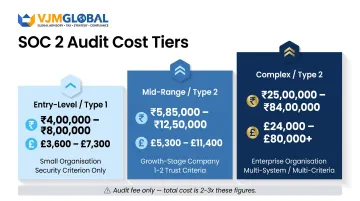
These figures cover audit fees only. Factor in readiness assessments, gap remediation, compliance tooling, and internal staff time — the true total typically runs 2–3 times the base audit fee.
Understanding which audit type fits your situation helps narrow the budget significantly. Here's how they compare:
Type 1: Design-Only Snapshot
A Type 1 audit captures a point-in-time view of your controls — whether they are designed correctly, not whether they work consistently over time. It typically includes:
- Point-in-time review of control design
- Readiness assessment and documentation review
- Audit report issued by an AICPA-licensed CPA firm
- Excludes ongoing monitoring, tooling, and extensive training
Type 1 works well for UK businesses needing a quick trust signal for a specific client contract, organisations new to SOC 2 that want a stepping stone before Type 2, and companies with straightforward technical environments and an already-mature security posture.
Type 2: Sustained Operating Effectiveness
Type 2 goes further — auditors review both control design and whether those controls operated consistently across a 6–12 month observation window. The scope includes:
- Evidence collection and auditor testing throughout the observation period
- Multiple rounds of interviews and sample testing
- Comprehensive attestation report covering design and operating effectiveness
This is the standard for UK businesses serving enterprise clients, and effectively required in fintech, healthtech, or B2B SaaS where data protection is non-negotiable. Any client demanding annual re-certification will expect Type 2.
Key Factors That Affect SOC 2 Audit Costs in India
Two organisations of similar size can face dramatically different quotes based on their technical setup, readiness maturity, and scope choices. Each factor below directly shapes how much you'll spend — and where you can control that spend.
Audit Type and Trust Service Criteria Scope
Each additional Trust Service Criterion beyond the mandatory Security criterion expands the number of controls the auditor must test. Adding Availability, Confidentiality, Processing Integrity, or Privacy typically increases audit complexity and cost by 15–30% per criterion.
Key principle: UK businesses should only include TSCs that clients contractually require. Over-scoping consistently inflates costs — and it's entirely preventable. If your enterprise customers demand only Security, adding Privacy "for completeness" unnecessarily bloats the budget.
Organisation Size and System Complexity
Larger teams mean more employee records to sample, more systems to test, and more interviews to conduct. These factors compound quickly:
- Microservices or multi-cloud architectures multiply control testing surface
- Distributed UK-India teams add sampling and interview overhead
- Poorly defined system boundaries force auditors to cast wider nets
Smaller, leaner operations with a consolidated tech stack and a well-defined system boundary will typically sit at the lower end of the cost range.
Readiness Maturity at the Start of the Engagement
Organisations with documented policies, active access controls, and centralised logging already in place move through readiness faster — those starting from scratch face higher remediation costs and longer timelines.
Benchmark: Readiness gap remediation typically adds approximately £18,000–£64,000 (roughly INR 20,00,000–70,00,000) to total SOC 2 costs, depending on the scope of gaps identified.
Auditor Firm Type and Licensing
Critical point for UK businesses: SOC 2 is an AICPA standard, meaning only licensed CPA firms can issue valid SOC 2 reports. Some India-based firms are directly licensed or partner with licensed US CPA firms, whilst others are not qualified to issue recognised reports.
Before engaging any India-based auditor, verify the following:
- Confirm direct AICPA licensing or a named US CPA firm partnership
- Request the CPA licence number and cross-check on the AICPA directory
- Ensure the final report carries the licensed CPA firm's signature
An India-based firm operating under a verified US CPA licence can deliver the same legally valid report at a fraction of what a US-domiciled firm charges.
Annual Renewal and Ongoing Compliance Costs
SOC 2 is not a one-time certification. Type 2 reports require annual re-audits plus continuous monitoring throughout the year.
Annual renewal cost ranges (based on company size):
- Startups (10–50 employees): approximately £12,000–£28,000
- Mid-market (50–250 employees): approximately £24,000–£48,000
- Enterprise (250+ employees): approximately £40,000–£80,000+
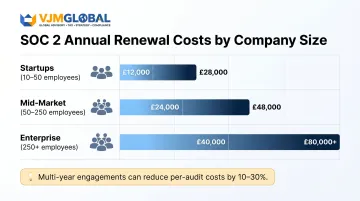
Multi-year engagements with the same auditor can reduce per-audit costs by 10–30%.
Full Cost Breakdown: What UK Businesses Actually Pay
The audit invoice is just one line item. The total cost of SOC 2 compliance in India includes several additional components that UK businesses frequently overlook when budgeting.
Readiness Assessment / Gap Analysis
One-Time | INR 4,00,000–12,00,000 (approximately £3,600–£11,000)
A pre-audit review identifies gaps in policies, controls, and documentation. This helps avoid costly surprises mid-audit and provides a roadmap for remediation.
Remediation Work
One-Time (or periodic) | Variable, often exceeds audit fee
Costs incurred fixing gaps identified in the readiness assessment cover updating policies, deploying access controls, configuring centralised logging, and implementing encryption. Organisations with minimal existing controls can face remediation costs that exceed the audit fee itself — making this the most variable line item in the budget.
Compliance Tooling and Software
Recurring (Annual) | INR 2,50,000–40,00,000 (approximately £2,300–£36,000)
Compliance automation platforms, monitoring tools, and MDM software collect evidence and maintain audit readiness. Common platforms include:
- Sprinto (India-headquartered): $4,000–$25,000/year (approx. £3,200–£20,000)
- Drata: $7,500–$50,000+/year (approx. £6,000–£40,000)
- Vanta: $10,000–$100,000+/year (approx. £8,000–£80,000; scales with company size)
Compliance automation can reduce total costs by 30–50% through efficiency gains and reduced audit timelines.
Internal Labour and Project Management
Recurring (throughout engagement) | Often the most underestimated cost
Internal costs accumulate quickly across teams. Typical demands include:
- Compliance lead: 50–100% of their time over 4–6 months
- Cross-functional input from IT, HR, legal, and operations throughout the engagement
- 100–300 staff hours for Type 1; 200–500 hours for Type 2
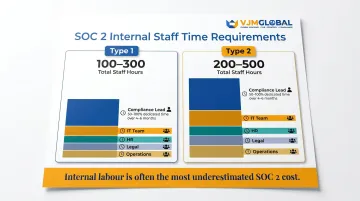
For UK businesses with lean India-based teams, this labour burden is often the largest indirect cost in the engagement.
VJM Global has supported 250+ UK businesses managing India-based operations. Their audit preparation and compliance support services — covering documentation review, regulatory filings, and auditor liaison — help lean teams reduce the hours spent on SOC 2 groundwork.
India-Based vs. UK/US-Based Auditors: Cost Comparison
Location and firm structure significantly impact SOC 2 audit pricing. A US-domiciled CPA firm and an India-based AICPA-licensed firm can issue equally valid SOC 2 reports, but at very different price points due to differences in operating costs and billing rates.
Cost and Quality Comparison
UK/US-domiciled CPA firms with local teams:
- Audit fees: approximately £16,000–£120,000 (median ~£24,000; USD equivalent: $20,000–$150,000)
- Big Four firms: £80,000+ and can reach seven figures for complex engagements
- High credibility, established client acceptance
- Longer turnaround times due to capacity constraints
- Best for: Large enterprises requiring brand-name auditors
India-based firms with AICPA partner licensing:
- Audit fees: INR 4,00,000–12,50,000 (approximately £3,600–£11,400)
- Significant cost savings (40–70% lower than UK/US-domiciled firms)
- Equally valid SOC 2 reports when properly licensed
- Faster turnaround times with dedicated capacity for international clients
- Best for: Growth-stage companies, cost-conscious UK businesses with India operations
Hybrid compliance platforms with vetted auditor networks:
- All-in costs: approximately £8,000–£64,000+ (USD equivalent: $10,000–$80,000+)
- Bundled pricing including automation tools and audit
- Faster preparation through platform automation
- Suited to: Startups and mid-market companies prioritising a streamlined process
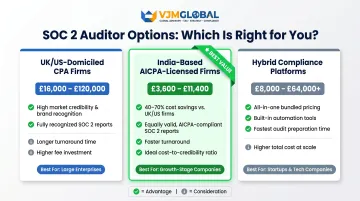
The cost differences above are real — but they only hold if the resulting report passes scrutiny from your enterprise clients.
The Critical Validation Check
UK businesses must confirm the auditing firm is registered or partnered with a licensed AICPA CPA firm. Without this confirmation, a lower fee can create a compliance gap that costs far more to remedy later.
Verification steps:
- Request proof of AICPA CPA licensing or partnership agreement
- Confirm the firm is enrolled in the AICPA Peer Review Programme
- Verify the firm issues reports directly under AICPA AT-C Section 205
VJM Global has completed compliance engagements for 250+ UK businesses in India, working with qualified AICPA audit partners throughout. That existing relationship structure shortens the verification process and reduces the risk of report acceptance issues with enterprise clients.
How to Budget Smartly — and Avoid Common Mistakes
Getting the right SOC 2 budget means planning for total cost of compliance, not just the audit fee quote. For UK businesses approaching this for the first time, a realistic budget prevents mid-engagement surprises and timeline delays.
Factors to Consider When Setting the Budget
Audit type and intended scope:
- Start with Security-only Type 1 if speed is the priority and client requirements allow
- Progress to Type 2 only when client contracts demand proof of sustained effectiveness
- Add additional Trust Service Criteria only when contractually required
Current readiness maturity:
- If policies, access controls, and documentation are not in place, budget an additional 50–100% allocation for remediation before committing to an audit timeline
- Conduct a gap analysis first to understand true readiness costs
Internal team capacity:
- Account for staff time, especially for lean India-based operations where the same people handle operations and compliance
- Outsourcing to an India-based advisory partner can reduce hidden labour costs whilst maintaining quality
VJM Global supports UK businesses through audit preparation, documentation management, and readiness reviews — reducing the burden on internal teams who are already stretched across operations. Contact VJM Global to discuss your India compliance requirements.
Common Budgeting Mistakes to Avoid
Focusing only on the auditor's quoted fee:
- Total cost is typically 2–3 times the base audit fee
- Budget for readiness, tooling, training, remediation, and legal review
Choosing the cheapest India-based vendor without verifying AICPA licensing:
- An unrecognised report delivers no value to UK enterprise clients
- Verification upfront prevents wasted investment and timeline delays
Over-scoping Trust Service Criteria beyond what clients actually require:
- Each additional TSC inflates both cost and timeline by 15–30%
- Review client contracts carefully and scope only what's contractually necessary
SOC 2 in India offers a real cost advantage — but only when the scope is right and the auditor is properly credentialed. Getting those two things wrong erases the savings. With 250+ UK businesses served across technology, financial services, and healthcare, VJM Global brings the cross-border context that makes the difference between a compliant report your UK clients accept and one they question.
Frequently Asked Questions
What is the cost of a SOC 2 audit in India?
Type 1 audits typically range from INR 4,00,000–8,00,000 (approximately £3,600–£7,300), whilst Type 2 audits cost INR 5,85,000–12,50,000 (roughly £5,300–£11,400) for growth-stage companies. Costs vary based on scope, firm, and readiness maturity.
What is the average cost of a SOC 2 audit?
Globally, SOC 2 audits average £16,000–£48,000 (approximately $20,000–$60,000 USD). India-based AICPA-licensed firms typically charge 40–70% less whilst delivering the same valid SOC 2 report, making them a practical option for cost-conscious UK businesses.
How much does a SOC 2 Type 2 audit cost?
In India, Type 2 audits typically cost INR 5,85,000–12,50,000 (approximately £5,300–£11,400). Type 2 costs more than Type 1 because it includes an extended 6–12 month observation period and greater evidence volume. Annual renewal audits are required to maintain compliance.
Is SOC 2 mandatory in India?
No, SOC 2 is not legally mandated in India. However, it is increasingly required by US and UK enterprise clients as a contractual condition before engaging Indian SaaS vendors, outsourcing partners, or service providers, making it effectively essential for companies serving global markets.
Can a UK business use an India-based auditor for SOC 2?
Yes, provided the auditing firm is AICPA-licensed or works with an AICPA-registered CPA firm. The report's validity depends on auditor accreditation, not the country of the firm's operations. Verification of licensing is essential before engagement.
How long does a SOC 2 audit take in India?
Type 1 typically takes 4–8 weeks once controls are in place. Type 2 requires a 6–12 month observation period plus 1–3 months of preparation. Organisations starting from scratch should budget 9–15 months for a full Type 2 cycle, depending on readiness maturity.