Introduction
Brazil is Latin America's largest economy — and one of its most demanding operating environments. For German companies eyeing market entry, the opportunity is real: a population of over 212 million, a GDP of USD 2.28 trillion, and surging infrastructure investment through the government's New PAC programme totalling R$ 1.9 trillion. But the regulatory environment is just as complex.
Without a trusted local representative, German businesses routinely encounter compliance failures, missed administrative deadlines, and contracts that are unenforceable under Brazilian law. Portuguese-language legal proceedings, multi-layered tax obligations, and mandatory local registrations are not processes that can be managed remotely from Frankfurt or Munich.
Before engaging a representation partner, German companies need to understand the available legal structures, compliance steps, services to expect, and the criteria that separate reliable partners from costly mistakes.
Key Takeaways
- German companies need a locally registered representative for tax, legal, and administrative interactions in Brazil
- Multiple structures are available — liaison arrangements, branches, and fully incorporated subsidiaries — each carrying distinct cost and compliance obligations
- All German corporate documents must be apostilled and sworn-translated into Portuguese before use in Brazil
- Brazil's "Custo Brasil" tax burden makes professional accounting representation non-negotiable
- Choosing a partner with cross-border, multi-jurisdictional experience reduces entry risk and accelerates market access
Why German Businesses Are Expanding to Brazil
Why German Businesses Are Expanding to Brazil
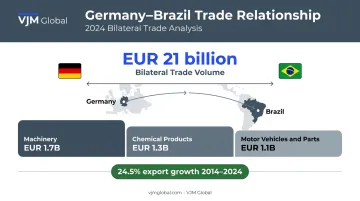
Among European nations, Germany is Brazil's top trading partner. According to the DIHK/AHK 2025 World Business Outlook special evaluation, bilateral trade between Germany and Brazil stands at approximately EUR 21 billion. Between January and July 2024 alone, German exports to Brazil reached EUR 8.0 billion — a 24.5% increase compared to the same period a decade earlier.
The top export categories driving that growth:
- Machinery — EUR 1.7 billion
- Chemical products — EUR 1.3 billion
- Motor vehicles and parts — EUR 1.1 billion
These are the sectors where German Mittelstand companies hold a competitive edge. Brazil's demand for precision engineering goods, infrastructure equipment, and industrial machinery aligns directly with German export strengths.
What Brazilian Market Entry Actually Requires
Brazil's regulatory environment makes remote management impractical. Three factors stand out:
- Language barrier — All legal, tax, and administrative processes operate in Portuguese
- Local registration requirements — Tax filings, commercial registry acts, and regulatory submissions require a locally constituted entity or representative
- Sector-specific approvals — Industries like healthcare (ANVISA), food production, and technical goods (INMETRO) require in-country representation before products can be sold
These aren't procedural hurdles you can defer. Germany's New PAC infrastructure investment programme has opened immediate procurement opportunities for German capital goods exporters — but bids, contracts, and approvals require an entity already constituted in Brazil. Setting up that representation is the first practical step before any commercial activity can begin.
Business Representation Structures Available in Brazil
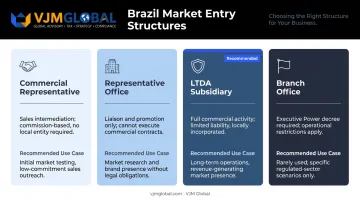
German companies have four structural options when entering Brazil. Each carries different obligations, costs, and permitted activities.
The four options at a glance:
- Commercial Representative — intermediates sales; suits export and distribution
- Representative Office — liaison and market intelligence only; no contracts
- LTDA Subsidiary — fully incorporated entity for long-term operations
- Branch Office — formal branch with Executive Power authorisation; rarely used
Commercial Representative (Representante Comercial)
Governed by Law No. 4,886/1965, amended by Law No. 8,420/1992, this is an independent individual or legal entity that intermediates product sales on behalf of the German company. The representative must be registered with the relevant Regional Council of Commercial Representatives (CORE) and the federal body CONFERE.
The representative must remain legally autonomous. If the foreign company exercises subordination — setting work hours, dictating methods, or exercising employer-like control — Brazilian courts may reclassify the arrangement as an employment relationship, triggering significant labour law obligations.
Representative Office (Escritório de Representação)
Functions as a market liaison and showroom. It can identify suppliers and customers, gather market intelligence, and facilitate introductions. It cannot directly negotiate or execute commercial contracts on behalf of the foreign company. This makes it suitable for market-testing phases, not commercial operations.
LTDA Subsidiary (Sociedade Limitada)
A fully incorporated Brazilian legal entity giving the German company direct operational control. The LTDA can conduct all commercial activities, hire employees, sign contracts, and hold assets. It requires greater upfront investment and more complex ongoing compliance, but provides the most operational flexibility.
Branch Office
Establishing a formal branch requires Executive Power authorisation under Civil Code Article 1,134. In practice, most companies bypass this route entirely — the LTDA subsidiary offers equivalent operational scope with a more straightforward setup process.
Structure Comparison
| Feature | Commercial Representative | Representative Office | LTDA Subsidiary | Branch Office |
|---|---|---|---|---|
| Permitted activities | Sales intermediation | Liaison/market intelligence only | Full commercial activity | Full commercial activity |
| Can execute contracts | No (on principal's behalf) | No | Yes | Yes |
| Registration body | CORE/CONFERE | Junta Comercial | Junta Comercial | Executive Power + Junta Comercial |
| Tax obligations | Commission-based | Minimal (no revenue) | Full Brazilian tax regime | Full Brazilian tax regime |
| Recommended use case | Export sales, distribution | Market entry exploration | Long-term operations | Rarely used in practice |
Legal and Compliance Requirements German Companies Must Meet
CNPJ Registration
The Cadastro Nacional da Pessoa Jurídica (CNPJ) is Brazil's federal tax identification number. Foreign legal entities must obtain a CNPJ when they hold specified assets, rights, or interests in Brazil. The Receita Federal's guidance for legal entities domiciled abroad requires a Brazil-domiciled legal representative or attorney to act on the foreign entity's behalf throughout the registration process.
Power of Attorney Requirements
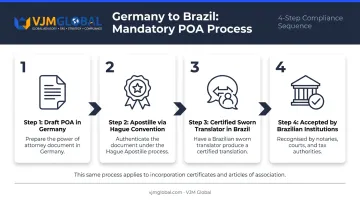
German companies must issue a Procuração (power of attorney) appointing their Brazilian representative. Every step in the process is mandatory and must follow this sequence:
- Draft the POA in Germany
- Apostille the document through Germany's Hague Convention process
- Submit to a certified sworn translator (tradutor juramentado) in Brazil
- Only then will Brazilian institutions — notaries, courts, tax authorities — accept the document
The same apostille and sworn-translation process applies to the certificate of incorporation, articles of association, and authorized signatory identification.
Commercial Representation Contract Obligations
Brazilian law mandates a written contract between the German company and its commercial representative. The contract must specify territory, exclusivity terms, and commission structures — but one clause routinely catches German companies off guard: termination indemnity.
Under Law No. 8,420/1992, terminating a representative without just cause triggers mandatory compensation of no less than 1/12 of total commissions earned across the entire representation period. For long-standing arrangements, this is a material financial liability worth quantifying before signing.
Ongoing Compliance Obligations
Beyond the contract itself, ongoing tax and regulatory obligations begin the moment the entity is active. A German company's Brazilian presence faces:
- Federal taxes: PIS/COFINS (now transitioning to CBS/IBS under Constitutional Amendment No. 132/2023)
- State tax: ICMS on goods movement
- Municipal tax: ISS on services
- Junta Comercial: Annual or event-triggered filings with the commercial registry
- Sector approvals: ANVISA for healthcare and food products; INMETRO for technical goods subject to conformity requirements
Companies in regulated industries should verify sector-specific approvals before engaging any representative.
What Business Representation Services Include
A professional representation partner does far more than receive mail on a company's behalf. Here is what a full-service engagement covers:
Administrative and Regulatory Representation
- Representation before the Receita Federal (federal tax authority) via the DTE electronic domicile system
- Filings with the Junta Comercial (commercial registry)
- CNPJ administration and updates
- Interaction with cartórios (notary offices) for document authentication
- Regulatory agency submissions (ANVISA, INMETRO, ANATEL, and others by sector)
Without this, German companies cannot respond to administrative notices within Brazilian legal deadlines — missing one can result in fines, penalties, or enforcement proceedings.
Market Entry and Local Liaison
Effective representation eliminates the language and cultural distance that makes direct remote management impractical:
- Supplier identification and due diligence
- Customer prospecting and qualification
- Portuguese-language communication with Brazilian counterparts
- Market intelligence and competitor monitoring
- Participation in procurement procedures on the foreign company's behalf
Accounting, Tax Compliance, and Financial Reporting
Brazilian tax compliance runs on its own calendar and logic — and a representation partner must produce output the German parent can actually use for consolidation. Look for firms that bridge local statutory requirements with the parent's reporting framework, whether that runs on IFRS, HGB, or US GAAP.
Typical services include:
- Bookkeeping under Brazilian standards (NBC TG / CPC)
- Payroll processing, if local employees are hired
- Local tax return preparation (SPED, ECF, EFD-Contribuições)
- Management reports formatted for the parent's consolidation cycle
Intellectual Property and Trademark Representation
German companies registering trademarks or patents with Brazil's INPI (National Institute of Industrial Property) must appoint a local representative via power of attorney. Under Law No. 9,279/1996, Article 217, a person domiciled abroad must maintain a duly qualified attorney domiciled in Brazil with authority to receive judicial summons. This applies to all licensing, franchise, and distribution arrangements involving German brands in the Brazilian market.
Challenges German Businesses Face in Brazil
Brazil's Tax Complexity — the "Custo Brasil"
Brazil operates one of the most complex tax regimes in the world. Federal, state, and municipal indirect taxes apply simultaneously to most commercial transactions. A 2023 MDIC consultation estimated the structural cost burden — the "Custo Brasil" — at R$ 1.7 trillion, approximately 19.5% of Brazilian GDP.
The World Bank's Doing Business 2020 report ranked Brazil 184th out of 190 economies on the Paying Taxes indicator, with a medium-sized São Paulo company requiring 1,501 hours per year to comply with major taxes. A tax reform is underway — Constitutional Amendment No. 132/2023 and Complementary Law No. 214/2025 are introducing IBS, CBS, and IS to replace the current fragmented system — but the transition itself creates new compliance planning requirements.
Legal System Differences
German businesses are accustomed to the Bürgerliches Gesetzbuch (BGB) civil law framework. Brazil also operates a civil law system, but the practical divergences are significant:
- Brazilian labour law offers employees substantially stronger protections than German companies typically build into contracts
- Mandatory contract clauses under Brazilian commercial law cannot be waived by agreement
- Enforcement procedures differ considerably, particularly around arbitration and dispute resolution timelines
Non-compete clauses and fixed-term notice periods, for example, are common points of failure — provisions that hold under German law often don't survive Brazilian judicial scrutiny without specific local drafting.
Operational Distance and Time Zone Gaps
Germany operates on CET (UTC+1) or CEST (UTC+2) depending on the season. São Paulo and Brasília operate on BRT (UTC-3), creating a 4-5 hour time difference that leaves only a few hours of shared working time each day.
Brazilian administrative deadlines don't pause for time zone differences. Situations that require same-day local action include:
- Government filing deadlines and penalty notices
- Supplier dispute responses with short statutory windows
- Labour authority notifications requiring immediate acknowledgment
- Banking and regulatory correspondence tied to business hours in Brazil
A representation partner with dedicated local infrastructure handles these situations without waiting for a German business day to begin.
Choosing the Right Business Representation Partner
Key Selection Criteria
- Local legal registration: The commercial representative must be registered with the appropriate CORE and CONFERE
- Bilingual capability: Portuguese-German or Portuguese-English fluency across legal, accounting, and commercial functions
- Experience with European mandates: Familiarity with European parent-company governance and reporting standards
- Regulatory relationships: Established working relationships with Receita Federal, Junta Comercial, and sector-specific agencies
- Integrated accounting capability: Ability to handle local compliance and translate outputs for the German parent's consolidation cycle
Common Pitfalls to Avoid
- Using a single individual agent without a formal written contract — creates both legal exposure and operational fragility
- Failing to define exclusivity clearly — under Law No. 8,420/1992, if a zone exclusivity is granted, the representative earns commissions on all business from that territory, even deals the German company closes directly
- Engaging a representative who also represents competing brands without explicit agreement
- Skipping the CORE/CONFERE registration verification — an unregistered commercial representative lacks legal standing under Brazilian commercial representation law
What Depth of Expertise Actually Looks Like
Avoiding the pitfalls above is a floor, not a ceiling. The stronger filter is whether a partner can operate fluently on both sides of the arrangement — Brazilian compliance requirements and German parent-company expectations simultaneously.
In practice, that means:
- Producing financial reports the German finance team can work with directly
- Responding to regulatory notices within Brazilian statutory deadlines
- Anticipating compliance obligations before they escalate into problems
- Translating local accounting outputs into formats compatible with the parent's consolidation cycle
VJM Global brings 30+ years of experience helping international businesses — including European and German-parent companies — navigate cross-border compliance, entity setup, and ongoing regulatory obligations in complex markets. For German businesses evaluating representation partners, the practical question is whether the firm can work as fluently with your Frankfurt finance team as it does with Receita Federal.
Frequently Asked Questions
Can a foreigner obtain a CNPJ in Brazil?
Foreign legal entities can obtain a CNPJ when they hold specified assets or rights in Brazil. The Receita Federal's process requires apostilled and sworn-translated corporate documents, plus a Brazil-domiciled legal representative. Foreign individuals do not obtain a CNPJ; that register is for legal entities only. Individuals use the CPF instead.
Is Germany a trading partner with Brazil?
Yes. Germany is Brazil's largest trading partner in Europe. According to the DIHK/AHK 2025 data, bilateral trade stands at approximately EUR 21 billion, concentrated in machinery, motor vehicles, and chemicals. German exports to Brazil grew 24.5% between 2014 and 2024.
What is the difference between a representative office and a subsidiary in Brazil?
A representative office can only perform liaison and market-intelligence functions; it cannot execute commercial contracts or generate revenue. A subsidiary (LTDA or S/A) is a fully incorporated Brazilian entity that conducts all commercial activities, with greater capital commitment and compliance obligations.
What documents does a German company need to appoint a business representative in Brazil?
At minimum: certificate of incorporation, articles of association, identification of authorised signatories, and a power of attorney. All documents issued in Germany must be apostilled under the Hague Convention and sworn-translated into Portuguese by a certified tradutor juramentado before Brazilian institutions will accept them.
Do German businesses need a local partner to operate in Brazil?
Full ownership of a Brazilian subsidiary is permitted; no mandatory local equity partner requirement exists. That said, German companies still need a locally registered representative for tax filings, administrative acts, and legal proceedings, making a professional representation services provider practically essential even for wholly-owned entities.
How long does it take to set up business representation in Brazil?
Engaging a commercial representative typically takes a few weeks once documents are apostilled and translated. Incorporating an LTDA subsidiary takes considerably longer: Junta Comercial registration, CNPJ issuance, and sector-specific approvals can collectively extend the timeline to several months.