
Skilled talent, state-backed incentives, and direct links to global markets are why entrepreneurs, NRIs, OCIs, and foreign firms keep circling back to Bangalore when they scout India entry points. Karnataka had 16,335 DPIIT-recognized startups as of November 2024, and the state government has openly stated its ambition to push toward a much larger economy in the years ahead, according to a PIB press release on Karnataka's startup growth.
This guide covers the most profitable business ideas in Bangalore right now, how to register a company, which structure fits your situation, and the compliance steps that keep your business running smoothly after incorporation.
TL;DR
- Bangalore's strongest opportunities span tech, food delivery, real estate, education, and foreign subsidiary setup
- Your business structure (OPC, LLP, Pvt Ltd, or subsidiary) shapes liability, tax exposure, and growth path
- Registration runs through DSC, DIN, name approval, and SPICe+ filing, plus post-incorporation GST compliance
- Foreign investors and NRIs face extra FDI and RBI rules needing specialized handling
- Working with experienced consultants cuts delays, rejected filings, and compliance penalties
Top Profitable Business Ideas to Start in Bangalore
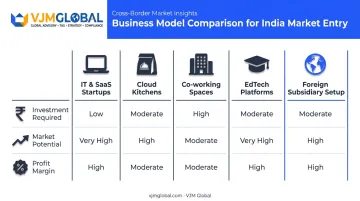
We selected these five ideas using four filters: current market demand, how well the model scales, the investment-to-return ratio, and fit with Bangalore's existing economic strengths.
Information Technology & SaaS Startups
Bangalore's dense concentration of engineering talent, IT parks, and venture capital access makes it a natural home for software, SaaS, and IT consulting businesses. Recurring revenue and easy access to global clients are what set SaaS apart from most other local business models.
| Metric | Detail |
|---|---|
| Investment Required | ₹15-50 lakhs depending on team size and infrastructure |
| Market Potential | India's SaaS revenue is projected to grow from US$7.18B in 2023 to US$62.93B by 2032, a 27.3% CAGR, per IBEF's analysis of India's SaaS sector |
| Profit Margin | Early-stage SaaS and IT consulting firms typically run 15-30% margins |
Karnataka also ranks first nationally for software and service exports, which tells you where the client relationships and infrastructure already exist.
Cloud Kitchens & Food Delivery Business
Bangalore's working population, long commute times, and app-heavy lifestyle have made delivery-first food businesses genuinely profitable. No dine-in space means lower rent and staffing costs, and partnerships with delivery apps handle customer acquisition.
| Metric | Detail |
|---|---|
| Investment Required | ₹8-25 lakhs including kitchen equipment and licensing |
| Market Potential | India's cloud-kitchen market hit ₹9,747 crore in 2024, growing at a 16.7% CAGR through 2030 |
| Profit Margin | Mid-sized operators typically see 10-20% net margins monthly |
This is a lower-risk entry point compared to a full-service restaurant, mainly because the fixed-cost burden is so much smaller.
Co-working Spaces & Commercial Real Estate
Bangalore has one of the highest startup densities in the country, and that density drives constant demand for flexible office space. Beyond rent, operators earn from cafes, meeting room bookings, and printing or event services layered on top.
| Metric | Detail |
|---|---|
| Investment Required | ₹50 lakhs to ₹2 crore, depending on location and size |
| Market Potential | CBRE named Bangalore the largest flex-office-stock market in APAC in 2024, and Bengaluru's total office net absorption rose 63.6% YoY in 2024 to an all-time high |
| Profit Margin | Established operators typically earn 20-35% margins once occupancy stabilizes |
EdTech & Online Education Platforms
Bangalore's education-focused population creates steady demand for competitive-exam prep and skill-based tutoring. Digital delivery keeps overhead low, which makes this attractive for solo founders or small teams without deep pockets.
| Metric | Detail |
|---|---|
| Investment Required | ₹10-30 lakhs for content, platform, and marketing |
| Market Potential | India's EdTech market is projected to grow from US$7.5B in 2024 to US$29B by 2030 |
| Profit Margin | Niche EdTech ventures often run 15-25% monthly profit margins |
Indian Subsidiary or Branch Office Setup for Foreign Companies
Foreign companies, NRIs, and OCIs increasingly treat Bangalore as their entry point into India's consumer and tech markets, choosing a subsidiary, branch, or liaison office rather than outsourcing to a third party. This route gives you direct market access, full control over your intellectual property, and a structure that scales with you.
| Metric | Detail |
|---|---|
| Investment Required | Statutory capital plus compliance costs vary by structure; branch offices need a parent net worth of at least US$100,000 |
| Market Potential | Karnataka captured 13% of India's FDI equity inflows in FY2024-25, per a PIB release on India's FY25 FDI performance |
| Profit Margin | Varies by sector, but a wholly owned subsidiary allows full profit repatriation under RBI guidelines |
Getting the structure and compliance right from day one matters here. Firms like VJM Global that specialize in India entry can help foreign companies choose the right entity type and stay compliant with FEMA and RBI requirements.
How to Register a New Business in Bangalore: Step-by-Step Process
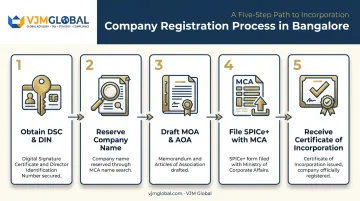
Company registration in Bangalore runs through the Ministry of Corporate Affairs (MCA) and follows a fixed sequence. Skipping steps or filing incomplete documents is the fastest way to add weeks to your timeline.
- Get your DSC and DIN. Every proposed director needs a Digital Signature Certificate and a Director Identification Number before anything else can move forward.
- Reserve your company name. Use the RUN or SPICe+ service on the MCA portal, and check for trademark conflicts first, since a name too close to an existing mark gets rejected.
- Draft your charter documents. The Memorandum of Association (MOA) and Articles of Association (AOA) spell out your business objectives and internal governance rules.
- File SPICe+ with the MCA. Attach PAN, ID proof, and address verification for all directors and shareholders at this stage.
- Receive your Certificate of Incorporation from ROC Bangalore. Then open a dedicated business bank account within the required window.
Once incorporation clears, timing becomes the next concern. A 2022 government release stated that the Central Registration Centre processed name-reservation and incorporation applications within one day as an official benchmark. In practice, most founders should plan for a longer runway, since name rejections and document mismatches are common causes of delay.
Documentation issues that trip up foreign and NRI applicants most often:
- Passports not notarized by the relevant foreign authority or the Indian Embassy
- Foreign-language documents missing a notarized English translation
- Address proof that doesn't exactly match the application form
- Utility bills or bank statements older than 2-3 months
VJM Global's registration team reviews filings for these exact mismatches, catching issues before they reach ROC scrutiny. Timing adds another layer of risk: approved company names stay valid for only 20 days, so any delay in your subsequent SPICe+ filing can force you to restart the name reservation process.
Choosing the Right Business Structure for Your Investment
Your structure decides how much personal liability you carry, how you're taxed, and how easily you can move money in and out of India.
For domestic founders:
- Sole Proprietorship works for very small, low-risk ventures with no liability protection
- Partnership suits two or more founders comfortable sharing unlimited liability
- LLP protects partners from personal liability while keeping compliance lighter than a company
- OPC (One Person Company) gives solo founders limited liability without needing co-shareholders
- Private Limited Company supports up to 50 shareholders and is the go-to choice for startups planning to raise investment
For foreign investors, three structures apply:
- Wholly Owned Subsidiary (WOS) is an Indian-incorporated company that receives FDI directly, offering full control and repatriation rights
- Branch Office requires the parent company to show 5 years of profitability and US$100,000 minimum net worth
- Liaison Office is limited to representation and communication only, with a lower US$50,000 net worth requirement, but cannot generate Indian income
Both branch and liaison offices route through an AD Category-I bank under RBI and FEMA rules, and certain sectors or applicant countries require prior government approval rather than the automatic route.
VJM Global's team of Chartered Accountants and business setup professionals works directly with foreign investors, NRIs, and OCIs to weigh liability exposure, taxation, and repatriation goals before recommending a structure. The firm's cross-border specialists handle Bangalore-specific filings alongside FEMA and RBI compliance for clients across the US, UK, and Australia.
Compliance and Licensing Essentials Post-Registration
Incorporation is just the starting point. Most businesses in Bangalore need several additional registrations before they can bill customers, open banking channels, or list on marketplaces.
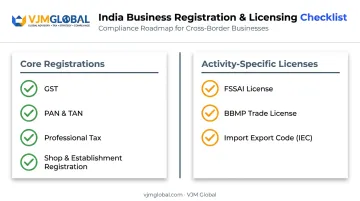
Core registrations nearly every business needs:
- GST – mandatory once turnover crosses ₹40 lakh for goods or ₹20 lakh for services in Karnataka
- PAN and TAN – required for tax filings and payroll deductions
- Professional Tax – employers must register and deduct this for liable employees
- Karnataka Shop & Establishment registration – filed within 30 days of starting operations, renewed every 5 years
Certain business activities call for extra licensing beyond these baseline filings.
Activity-specific licenses to plan for:
- FSSAI registration or license for any food business, including cloud kitchens
- BBMP trade license for businesses operating from physical premises in Bangalore
- Import Export Code (IEC) for businesses trading across borders
Missing even one of these can delay your GST billing, hold up your bank account activation, or block your listing on e-commerce marketplaces. Building a compliance checklist alongside your incorporation plan, rather than after the fact, saves weeks of avoidable back-and-forth. VJM Global's business setup team tracks these Karnataka-specific rules daily and flags exactly which licenses your business model needs.
Conclusion
Bangalore's profitability spans tech, food, real estate, education, and foreign subsidiary investment. Returns, however, depend heavily on picking the right idea and matching it to the right legal structure. Before you finalize anything, weigh long-term scalability, ongoing compliance costs, and repatriation needs if you're investing from abroad.
If you're a foreign business owner, NRI, or OCI planning your entry into Bangalore, getting this groundwork right matters more than the business idea itself. VJM Global's business setup and compliance team can help you navigate incorporation, FDI rules, and post-registration filings, keeping your entry smooth and fully compliant.
Frequently Asked Questions
Which business is most profitable in Bangalore?
IT and SaaS ventures, cloud kitchens, real estate-linked businesses, and EdTech platforms consistently show strong margins thanks to Bangalore's tech-driven economy and educated consumer base.
How do I set up a business in Bangalore?
Choose your business structure, obtain DSC and DIN for directors, reserve your company name, file SPICe+ with the MCA, and complete GST and Professional Tax registration once incorporated.
What business can I start with $50,000 in Bangalore?
Roughly ₹40-42 lakhs comfortably covers a co-working space, an EdTech platform, or a subsidiary setup including initial compliance costs.
Which business structure is best for foreign investors setting up in Bangalore?
A Wholly Owned Subsidiary or Private Limited Company gives foreign investors the strongest control, liability protection, and profit repatriation flexibility under FEMA.
How long does it take to register a company in Bangalore?
Official benchmarks show name reservation and incorporation processed within one day at the Central Registration Centre, though real-world timelines often extend further due to name rejections or incomplete documentation.
Do foreign nationals need special approval to start a business in India?
Most sectors allow 100% FDI under the automatic route with no prior approval needed, though sectors like defense, telecom, and media require government clearance before entry.