A One Person Company (OPC) changes that. Introduced under the Companies Act, 2013, an OPC is a corporate entity formed and managed by a single individual, combining the legal protection of a private limited company with the simplicity of solo ownership. For NRIs looking to formalise their India operations, it's now an option too — a change introduced via the 2021 amendment rules.
Despite growing adoption, the registration process trips up many first-time founders. Eligibility rules are misunderstood, documents get rejected, and post-registration compliance catches people off guard. This guide covers everything: what an OPC is, who qualifies, what documents you need, how the SPICe+ registration works step by step, and what compliance obligations kick in once you're incorporated.
Key Takeaways
- OPC is defined under Section 2(62) of the Companies Act, 2013 as a company with only one person as a member — registered as a private limited company
- Only a natural person who is an Indian citizen (resident or NRI) can form an OPC; a nominee must be appointed at incorporation
- Registration is completed online via SPICe+ on the MCA portal and typically takes 13–15 days end-to-end
- Post-registration, OPCs must conduct a statutory audit, file AOC-4 and MGT-7A annually, and hold at least two board meetings per year
- Best suited for solo founders who want full control — not ideal if you plan to add co-founders or raise equity investment
What Is a One Person Company in India?
Statutory Definition and Legal Nature
Under Section 2(62) of the Companies Act, 2013, a One Person Company is defined as "a company which has only one person as a member." Section 3 further classifies it as a private company — meaning its registered name must end with "(OPC) Private Limited."
This structure gives a solo founder full corporate protections without needing multiple shareholders or directors.
How OPC Differs from Sole Proprietorship
A sole proprietorship and an OPC might look similar on the surface: one person, one business. But the legal distinction is substantial.
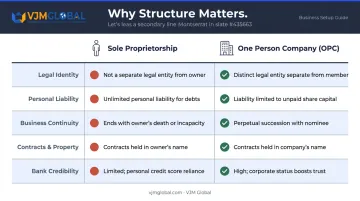
| Feature | Sole Proprietorship | One Person Company |
|---|---|---|
| Legal identity | No separate identity | Separate legal entity |
| Personal liability | Unlimited | Limited to share capital |
| Business continuity | Ends with owner | Perpetual via nominee |
| Contracts/property | In owner's name | In company's name |
| Credibility with banks | Lower | Higher |
The nominee mechanism is a key OPC feature: the memorandum must name a person who steps in if the sole member dies or becomes incapacitated. The nominee assumes management rights immediately, preserving the business without court intervention or delays.
OPC vs. Private Limited Company
An OPC is a private company by law, but it has meaningful distinctions from a standard Private Limited Company:
- One person can hold both the shareholder and director roles simultaneously
- No Annual General Meeting (AGM) required — Section 96 explicitly excludes OPCs
- Annual returns filed on MGT-7A (abridged form) rather than the standard MGT-7
- Financial statements due within 180 days of financial year close, longer than the standard deadline
- Cannot invite public subscription to securities
- Cannot undertake Non-Banking Financial Investment activities, including investment in securities of any body corporate
Key Benefits of Registering as an OPC
Limited Liability and Separate Legal Identity
The core benefit is liability protection. As a sole proprietor, a ₹50 lakh court judgment against your business comes out of your personal assets. As an OPC member, your exposure is limited to the capital you've invested in the company. Your home, savings, and personal accounts are shielded.
Beyond protection, the separate legal identity gives the business real standing. The OPC can:
- Own property and open bank accounts in its own name
- Enter contracts independently
- Sue and be sued without involving the member personally
- Build a credit history as a corporate entity
This credibility matters when dealing with larger clients, government tenders, and institutional lenders.
Compliance Advantages Over Other Corporate Structures
OPCs carry a lighter compliance load than Private Limited Companies — but they're not compliance-free. Here's what OPCs are specifically exempt from:
- No Annual General Meetings required (Section 96 exemption)
- No cash flow statements in financial filings (proviso to Section 2(40))
- Shorter annual return via MGT-7A instead of the full MGT-7 form
These exemptions reduce annual compliance costs meaningfully — a real advantage for a solo business owner managing without a full back-office team.
Access to Formal Funding
Banks and NBFCs treat an incorporated company differently from a sole proprietor.
An OPC can obtain business loans in its own name, build a business credit profile, and when ready, convert to a Private Limited Company to bring in equity investors. The conversion route via Form INC-6 means OPC isn't a dead end — it's a structured path for founders who expect to grow beyond a single-member setup.
Who Can Register an OPC? Eligibility and Pre-Requisites
Citizenship and Residency Requirements
The MCA's OPC FAQ confirms that only a natural person who is an Indian citizen — whether resident in India or not — can be the sole member or nominee of an OPC.
"Resident in India" is currently defined as having stayed in India for at least 120 days during the immediately preceding financial year. This threshold was reduced from 182 days by the Companies (Incorporation) Second Amendment Rules, 2021 (effective 1 April 2021). That same amendment opened OPC registration to NRIs for the first time.
The One-OPC Rule and Nominee Requirement
Four eligibility rules every applicant must know:
- A person can be a member in only one OPC at any given time
- A person can serve as a nominee in only one OPC at any given time
- If someone becomes a member of a second OPC through nomination (for example, if the original member dies), they must resolve the dual membership within 180 days
- Minors cannot be members or nominees
The memorandum must name a nominee — with their prior written consent (Form INC-3) — at the time of incorporation. The nominee steps in only if the member dies or becomes legally incapable of managing the company — they hold no ownership or management rights otherwise.
Documents Required for OPC Registration
Director and Nominee KYC Documents
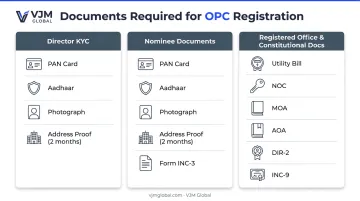
Both the proposed director and the nominee must provide an identical set of documents:
- PAN card (mandatory)
- Aadhaar card
- Recent passport-size photograph
- Address proof — electricity bill, bank statement, or mobile bill not older than 2 months
All documents must be self-attested. The nominee additionally submits a signed Form INC-3 confirming consent to take over the OPC if required.
Registered Office and Constitutional Documents
Registered office proof:
- Recent utility bill (not older than 2 months) showing the address
- No Objection Certificate (NOC) from the property owner, where the premises are not owned by the company
Constitutional documents:
- Memorandum of Association (MOA) — covering name, registered state, business objects, liability, capital, and nominee clause
- Articles of Association (AOA) — setting out internal governance rules, including director appointment procedures and decision-making authority
Both must be drafted on stamp paper and executed before a notary, with applicable stamp duty paid. Stamp duty rates vary by state: Delhi lists ₹10 for an MOA and ₹15 when accompanied by an AOA, while Karnataka's rate for an MOA with AOA is ₹1,000.
Statutory Forms
| Form | Purpose |
|---|---|
| DIR-2 | Director's consent to act as director |
| INC-3 | Nominee's consent |
| INC-9 | Declaration by subscriber/director (no legal offences) |
VJM Global's Chartered Accountants and Company Secretaries handle preparation and review of all these documents, including MOA and AOA drafting tailored to each client's specific business activities.
How to Register a One Person Company: Step-by-Step
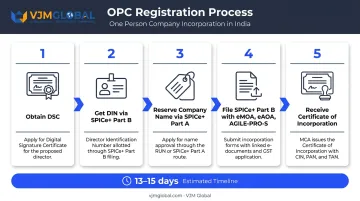
OPC registration is entirely online via the MCA portal. No physical document submission is required. VJM Global's process runs approximately 13–15 days from initial onboarding to receipt of the Certificate of Incorporation.
Step 1: Obtain a Digital Signature Certificate (DSC)
The proposed director needs a DSC to digitally authenticate the SPICe+ application. DSCs are issued by MCA-licensed Certifying Authorities. The application can be Aadhaar-based (if the mobile number is linked) or PAN-based.
After submission, a video verification link is sent to the registered email — this must be completed before the DSC is issued.
Step 2: Obtain Director Identification Number (DIN)
DIN can be applied for directly within the SPICe+ Part B form — there's no need to file a separate Form DIR-3 for a new company. MCA allots the DIN upon verification.
Step 3: Reserve the Company Name
Name reservation is done via SPICe+ Part A. The proposed name must end with "(OPC) Private Limited." Once approved, the name is reserved for 20 days, during which SPICe+ Part B must be filed.
Two constraints apply: the name cannot resemble existing companies, and certain words are prohibited under the Companies Act. VJM Global guides clients through this to avoid rejections that delay the process.
Step 4: File SPICe+ Part B with eMOA, eAOA, and AGILE-PRO-S
The main incorporation application is filed in SPICe+ Part B alongside:
- eMOA (INC-33) and eAOA (INC-34) — electronic constitutional documents
- AGILE-PRO-S — simultaneous application for PAN, TAN, EPFO, ESIC, optional GST registration, and bank account opening
This integrated approach means founders don't need separate applications for each registration. MCA confirms that OPC incorporation is processed through this SPICe+ Part B workflow.
Step 5: Receive the Certificate of Incorporation
After MCA verification, the Registrar of Companies (ROC) issues the Certificate of Incorporation along with PAN and TAN. The company is now legally incorporated.
There is one immediate post-incorporation obligation: file Form INC-20A (Declaration of Commencement of Business) within 180 days of incorporation. Missing this deadline attracts penalties — VJM Global's post-incorporation support includes handling this filing to ensure the deadline is met.
Mandatory Compliance Requirements After OPC Registration
OPC compliance is lighter than other corporate structures — fewer meetings, simplified filings — but the obligations are real and penalties for missing them are serious. Here's what's required annually:
Annual ROC Filings
- Form AOC-4 (financial statements) — within 180 days from the close of the financial year
- Form MGT-7A (abridged annual return) — within 60 days of the AGM date, or from the date the AGM should have been held (OPCs are AGM-exempt, so this triggers from a deemed date)
Board Meetings and Statutory Audit
- Minimum two board meetings per year, with a gap of at least 90 days between them
- First auditor must be appointed by the Board within 30 days of incorporation
- Statutory audit by a qualified Chartered Accountant is mandatory annually
Note: The two-meeting requirement does not apply to an OPC with only one director — if the sole member is also the sole director, this obligation is effectively waived.
Income Tax and Director KYC
- Income tax return must be filed annually; a tax audit is mandatory if turnover exceeds the prescribed threshold
- DIR-3 KYC — directors must complete KYC by 30 September each year to keep their DIN active; failure deactivates the DIN
Non-compliance carries consequences beyond fines. Under Section 164(2), a director faces disqualification if the company fails to file financial statements or annual returns for any continuous period of three financial years. The ROC can also strike the company off the register under Section 248.
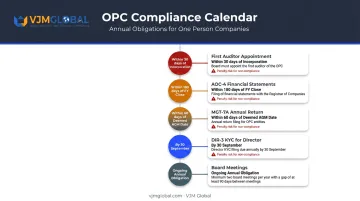
For founders who'd rather not track these deadlines themselves, VJM Global handles ongoing ROC filings, statutory audits, and income tax compliance for OPC clients — from the first auditor appointment through annual return submissions.
Frequently Asked Questions
How much does it cost to register a One Person Company in India?
Government incorporation fees start at ₹2,000 for OPCs with nominal share capital up to ₹10,00,000 (per the Companies Registration Offices and Fees Rules). Stamp duty on MOA and AOA varies by state. Adding DSC costs and professional fees, total registration costs typically fall in the ₹5,000–₹15,000 range — use the MCA's fee enquiry tool to calculate government fees for your state.
How do I register a One Person Company in India?
The process runs entirely online through the MCA portal:
- Obtain a Digital Signature Certificate (DSC)
- Apply for DIN via SPICe+ Part B
- Reserve the company name via SPICe+ Part A
- File SPICe+ Part B with eMOA, eAOA, and AGILE-PRO-S
- Receive the Certificate of Incorporation from MCA
File Form INC-20A within 180 days to commence business.
Can a single person form a One Person Company in India?
Yes — that's exactly what an OPC is designed for. The person must be a natural individual, an Indian citizen (resident or NRI), and must appoint a nominee at incorporation. Minors are not eligible as members or nominees.
Should I register an OPC or a Private Limited Company?
OPC suits solo founders who want full control, limited compliance, and no external investors in the near term. Private Limited is better for businesses expecting co-founders, equity funding rounds, or growth beyond a single-member structure. An OPC can be voluntarily converted to a Private Limited Company via Form INC-6 when circumstances change.
Can an NRI register an OPC in India?
Yes. Since the Companies (Incorporation) Second Amendment Rules, 2021, NRIs are permitted to incorporate OPCs in India. The earlier restriction requiring the member to be a resident Indian was removed, with residency now defined as 120 days in India during the preceding financial year.
What happens if I don't comply with OPC annual filing requirements?
Non-compliance attracts monetary penalties under the Companies Act, 2013. Persistent defaults — failing to file financial statements or annual returns for three consecutive years — can result in director disqualification under Section 164(2). The ROC may also strike the company off the register under Section 248.