
Canada and the UAE recorded $3.5 billion in two-way merchandise trade in 2025, a figure that reflects just how established this business corridor has become. The regulatory framework supports it too — the two countries share both a Foreign Investment Promotion and Protection Agreement (FIPA) and a separate income tax treaty.
This guide covers the full process: choosing a structure, registering your company, obtaining a Business Number, navigating banking, and understanding costs and compliance obligations. It's written specifically for people starting this from the UAE.
Key Takeaways
- UAE residents can legally incorporate a Canadian company as non-residents — no local partner required
- British Columbia and Ontario have no Canadian resident director requirement, making them the practical first choice
- You can complete the full registration process online, though banking often requires an in-person visit to Canada
- First-year setup costs typically range from CAD $500 to CAD $3,000, depending on the province and professional fees
- Incorporating in Canada does not grant residency; you must pursue immigration pathways separately
What It Means to Start a Business in Canada from the UAE
UAE-based entrepreneurs can form a Canadian company as non-residents, with 100% foreign ownership permitted in most sectors. No Canadian shareholder, local partner, or citizenship is required.
There are two main paths:
| Option | What It Creates | Best For |
|---|---|---|
| Provincial/Federal Corporation | A new, separate Canadian legal entity | Most UAE founders seeking limited liability and full control |
| Branch of UAE Company | The UAE parent operating directly in Canada | Testing the market or executing a specific contract only |
Most UAE founders choose a provincial corporation, typically incorporated in BC or Ontario. This structure creates a clean legal separation between the Canadian entity and the UAE parent — which matters for liability, tax treatment, and treaty protections.
Two bilateral agreements reinforce that structure. The Canada-UAE FIPA (signed November 2025, in force May 2026) provides legally binding investment protection rights for cross-border investors. A separate income tax convention, in force since 2004, governs double taxation between the two countries.

Why UAE Entrepreneurs Are Choosing Canada
Canada's appeal goes beyond just corporate registry access. The World Justice Project ranks Canada 13th globally in the 2025 Rule of Law Index, and WIPO places it 17th in the Global Innovation Index — both useful benchmarks for founders who care about contract enforceability and IP protection.
The core business advantages:
- No minimum share capital requirement to incorporate
- A globally recognized corporate identity that helps with fundraising and client credibility
- Clear corporate law with predictable compliance obligations
- Strong IP protection framework for technology and content businesses
These structural advantages are just the starting point. For UAE founders thinking beyond a single market, one benefit stands out in particular.
The CUSMA Gateway Effect
A Canadian entity gives you preferential access to the US and Mexican markets through CUSMA (the Canada-US-Mexico Agreement, formerly NAFTA). That makes Canada a gateway to North America as a whole, not just a single market.
CBSA notes that preferential tariff treatment requires a CUSMA certification of origin, so incorporation alone doesn't guarantee tariff benefits — but having a Canadian entity positions you to pursue them.
The Tax Picture
Canada's federal corporate tax rate is 15% (net general rate, after abatement and general tax reduction). The rate structure for private corporations looks like this:
- 15% — standard federal rate for most corporations
- 9% — reduced rate for Canadian-Controlled Private Corporations (CCPCs) on the first CAD $500,000 of active business income
Non-resident-controlled corporations typically do not qualify as CCPCs. UAE-based founders should not assume the small business rate automatically applies to their new entity.
Choosing the Right Business Structure in Canada
This is the most consequential early decision. Structure determines director requirements, liability exposure, compliance burden, and how easily you can open a bank account or attract investors.
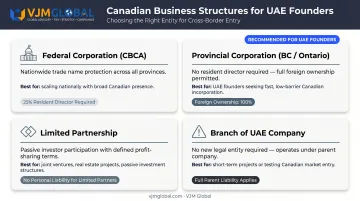
Federal Corporation (CBCA)
Federal incorporation provides nationwide name protection and a degree of prestige, but it comes with a real constraint. Under the Canada Business Corporations Act, at least 25% of directors must be Canadian residents (or at least one director if the board has fewer than four members). For UAE-based founders with no Canadian connections, this is a genuine obstacle.
Provincial Corporation — BC, Ontario, or Alberta
This is where most UAE founders land. All three provinces removed Canadian resident director requirements:
- Ontario — effective July 5, 2021
- Alberta — effective March 29, 2021
- British Columbia — no resident director requirement under current registry rules
BC and Ontario are the most commonly recommended for UAE entrepreneurs due to established digital registries, strong business ecosystems, and straightforward compliance structures. Alberta is worth considering if cost and simplicity are priorities.
Limited Partnership (LP)
Useful for joint ventures, investment structures, or when pairing a corporate general partner with passive UAE investors. Not the standard first choice for most operating businesses.
Branch of UAE Company
Registering an extra-provincial branch (a foreign entity registered to operate in Canada) avoids creating a new legal entity. However, the UAE parent remains fully liable for all Canadian obligations. This structure suits market testing or a specific contract, not long-term operations.
Each structure carries different trade-offs in liability, control, and compliance overhead. For most UAE founders seeking full control and limited liability without a Canadian director requirement, a provincial corporation in BC or Ontario is the practical starting point.
How to Register a Company in Canada from the UAE — Step by Step
The entire registration process can be completed online from the UAE. Typical incorporation timelines run 3–10 business days once documents are in order. Banking, not registration, is usually where the real complexity begins.
Step 1 — Choose Your Structure and Province
Decide between federal and provincial incorporation based on director residency rules and operational plans. For UAE founders: BC or Ontario, provincial corporation.
Step 2 — Reserve Your Company Name
- Federal: Order a NUANS report to confirm name uniqueness (though online CBCA incorporation no longer requires a NUANS report pre-filing)
- Provincial: Run a name check through the relevant provincial registry
- Alternative: Incorporate under a numbered company name and register a trade name separately for branding
Step 3 — Appoint a Registered Agent and Obtain a Registered Office Address
Every Canadian company must have a registered office within its chosen province for receiving legal notices. Non-resident founders use registered agents, law firms, or formation service providers.
Typical annual fees:
- Registered/records office services: approximately CAD$350–$600/year (private provider examples; confirm current rates directly)
Step 4 — Prepare and File Incorporation Documents
What you'll need:
- Articles of Incorporation (share structure, director details)
- Director and shareholder identification (UAE passport, Emirates ID)
- Proof of UAE address
- ISC (Individuals with Significant Control) information
Where to file:
- Federal: Corporations Canada online portal — CAD$200, processed in approximately 1 business day
- BC: Corporate Online — CAD$380 (CAD$350 incorporation + CAD$30 name approval)
- Ontario: Ontario Business Registry — CAD$300
Step 5 — Obtain a Business Number and Register Tax Accounts
Once incorporated, register for a Business Number (BN) with the Canada Revenue Agency through Business Registration Online. Use the BN to open accounts for:
- Corporate income tax
- GST/HST (mandatory once annual revenues exceed CAD$30,000 over four consecutive calendar quarters)
- Payroll deductions, if hiring
Step 6 — Apply for Required Business Licenses
Use the federal BizPaL tool or provincial resources to identify sector-specific licensing requirements. Most consulting, technology, and e-commerce businesses face minimal licensing requirements. Financial services, healthcare, and food businesses, however, require additional permits before operating.
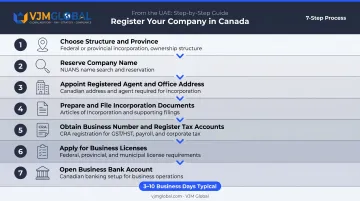
Step 7 — Open a Business Bank Account
This is where most UAE-based founders encounter their first real friction. Major Canadian banks have strict KYC requirements for non-resident founders, and most require at least one authorized signatory to appear in person at a branch for identity verification. Key institutions include:
- RBC, TD, Scotiabank, BMO, CIBC — traditional banks with full business account services but in-person verification requirements for non-residents
Fintech alternatives can bridge the gap while traditional banking is arranged:
- Airwallex — offers a Canadian business account with multi-currency capabilities; useful as a complement to a traditional account
- Wise Business — worth exploring, though UAE-resident owners of Canadian corporations should confirm eligibility directly before applying
Practical advice: Plan your banking strategy before incorporating, not after. If you can time a Canada visit around bank onboarding, do it.
Key Costs and Ongoing Compliance
First-Year Setup Costs
| Item | Approximate Cost (CAD) |
|---|---|
| Government incorporation filing | $200–$380 |
| Registered agent / office (annual) | $350–$600 |
| Professional/legal advisory fees | $500–$2,000+ |
| CRA registration (BN, tax accounts) | No fee |
| Total first-year estimate | $1,000–$3,000+ |
Costs vary based on structure, province, and how much professional support is used.
Annual Compliance Obligations
- Federal annual return (CBCA): due within 60 days of anniversary; online fee CAD$12
- BC annual report: CAD$43.39; failure to file for two consecutive years can result in dissolution
- Ontario annual return: $0 fee; filed through Ontario Business Registry
- T2 corporate income tax return: filed with CRA within 6 months of tax year-end
- GST/HST filings: if registered
- ISC register: maintain records for any individual owning/controlling 25%+ of voting shares or fair market value — includes full legal name, date of birth, citizenship, tax residence, and residential address
Non-compliance with the ISC register under the CBCA can result in fines up to CAD$100,000 and potential administrative dissolution.
A Note on Cross-Border Tax Complexity
If your Canadian company and UAE entity are related — say, a UAE trading company paired with a Canadian holding or operating company — coordinated advisory across both jurisdictions becomes necessary. Transfer pricing, intercompany transaction structuring, and DTAA analysis each carry real tax exposure if handled inconsistently between the two sides.
Getting this right requires advisors who understand both regulatory environments, not just one.
VJM Global works with international founders managing exactly this kind of dual-entity structure. With 30+ years in cross-border tax, DTAA advisory, and intercompany financial reporting, the team helps founders avoid compliance gaps when operating across UAE and Canadian entities simultaneously.
Common Challenges and How to Overcome Them
Banking Delays
Enhanced due diligence for non-resident corporate founders is the single most reported friction point. Expect the process to take weeks, not days. Preparation helps:
- Have all KYC documents ready before incorporation is complete
- Be prepared to travel to Canada for in-person identity verification
- Consider opening accounts at multiple institutions — one traditional bank plus a fintech
Director Residency Workarounds
If for any reason you're incorporating federally (CBCA), you'll need to address the 25% resident director requirement. Options:
- Choose BC or Ontario instead — the simplest fix
- Nominee director services — available, but nominees owe fiduciary duties to the company, not to you; understand the governance and liability risks before committing
Double Taxation and Central Management Risk
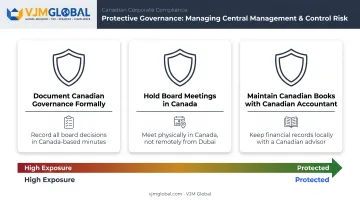
If your Canadian company's central management and control is exercised from the UAE — board decisions made in Dubai, strategic direction set by UAE-resident directors — the CRA may treat the corporation as non-resident for tax purposes or as a dual resident. UAE authorities may simultaneously view it as locally managed.
This creates real exposure on both sides of the equation and catches many founders off guard.
Where tax is actually paid comes down to documented governance. Protect your structure by:
- Documenting all Canadian governance decisions formally
- Holding board meetings in Canada, not remotely from Dubai
- Maintaining Canadian books with a Canadian-based accountant
Conclusion
Starting a business in Canada from the UAE is legally straightforward. With the right structure — a provincial corporation in BC or Ontario — the registration process is remote, predictable, and can be completed in a few weeks.
The filing steps are the easy part. The decisions that shape long-term outcomes come before and after registration:
- Which province suits your operational and tax profile
- How to manage tax residency without triggering unintended Canadian liability
- What banking hurdles to anticipate and prepare for
- Whether ongoing compliance is structured correctly from day one
Get these right, and the Canadian entity works as a genuine business asset. Miss them, and you're managing compounding problems instead of building the business.
Frequently Asked Questions
Is there a tax treaty between Canada and the UAE?
Yes. The Canada-UAE income tax convention (signed 2002, in force June 2004) caps withholding tax on dividends at 15% (5% with 10%+ voting control), interest at 10%, and royalties at 10%. A separate FIPA covering investment protection entered force in May 2026. The two agreements serve different purposes.
Can a foreigner set up a business in Canada?
Yes. UAE residents can incorporate a Canadian company with 100% foreign ownership — no citizenship or residency required for shareholders. Director residency rules vary: federal incorporation (CBCA) requires 25% Canadian-resident directors, while BC, Ontario, and Alberta have no such requirement.
How much does it cost to set up a business in Canada?
Government filing fees are modest: CAD $200 federally, CAD $380 in BC, CAD $300 in Ontario. Total first-year costs including registered agent fees, professional services, and CRA registration typically range from CAD $1,000 to CAD $3,000+, depending on structure and the level of advisory support involved.
Do I need to be physically present in Canada to register a company?
Incorporation itself is fully remote and online. However, opening a business bank account often requires at least one authorized signatory to visit a Canadian bank branch in person for identity verification. Plan for this before you incorporate.
Which Canadian province is best for UAE entrepreneurs?
British Columbia and Ontario are the most practical choices: no Canadian resident director requirement, established digital registries, and strong business ecosystems. Alberta has had no director residency requirement since 2021 and offers simpler compliance structure and lower costs.
Can starting a business in Canada lead to permanent residency?
Incorporating a company does not automatically grant residency or a work permit. Separate pathways exist — including the Start-Up Visa Program, Provincial Nominee Program entrepreneur streams (BC and Alberta are active), and Intra-Company Transfer permits. Consult an immigration specialist, as this is a distinct process from business registration.