Introduction
The UAE has become one of the most accessible destinations for foreign entrepreneurs to build a company — and Singapore-based founders are among the most active participants. The process involves choosing a jurisdiction (free zone or mainland), selecting an entity type, and obtaining a trade licence, with 100% foreign ownership now permitted under UAE law.
Since 2021, Federal Decree-Law No. 32 has allowed foreigners to hold full ownership across most mainland sectors — no Emirati partner required.
Singapore passport holders also benefit from visa-free entry for up to 90 days, which makes initial setup visits and in-person meetings with authorities straightforward.
This guide walks through the full registration process — from choosing the right jurisdiction to avoiding the delays that catch most first-time applicants off guard.
Key Takeaways
- 100% foreign ownership is permitted — Singapore nationals can fully own UAE businesses in most sectors across free zones and mainland.
- Three main setup options: free zone (FZE/FZCO), mainland (LLC), or offshore company — each with distinct market access and compliance trade-offs.
- Registration follows six steps: define your activity, choose a jurisdiction, reserve a trade name, draft the MOA, secure an office address, and obtain your licence.
- Costs range from AED 14,900 to AED 50,000+ (USD 4,050 to USD 13,600+) depending on free zone, office type, and visa requirements.
- Most steps can be completed remotely from Singapore — visa processing is the exception, requiring physical presence for medical tests and biometrics.
Why Singapore-Based Entrepreneurs Are Expanding Into the UAE
The UAE sits at the crossroads of the Middle East, Africa, and South Asia — regions difficult to serve from Singapore alone. By establishing a UAE presence, Singapore businesses gain access to over 2.5 billion consumers within a four-hour flight radius.
Trade Framework: Singapore-GCC FTA
Singapore and the UAE operate under the Singapore-GCC Free Trade Agreement, in force since 2013, which provides duty-free access for goods traded between the two nations. While a bilateral Comprehensive Economic Partnership Agreement (CEPA) between the two countries is not yet in place, the GCC FTA has driven bilateral merchandise trade to SGD 27.9 billion in 2025 — a figure that reflects how well-established this trade corridor already is.
Tax-Competitive Environment
Federal Decree-Law No. 47 of 2022 introduced a corporate tax structure that remains competitive with Singapore:
- 0% tax on taxable income up to AED 375,000 (approx. USD 102,000)
- 9% tax on income above that threshold
- No personal income tax
- Full profit repatriation permitted

The UAE dirham is pegged to the US dollar at a fixed rate of AED 3.6725 per USD, providing currency stability for businesses managing multi-currency treasury operations.
Choosing Your Business Structure: Free Zone, Mainland, or Offshore
Free Zone Companies (FZE / FZCO)
The UAE has approximately 46 free zones across seven emirates, each governed by its own authority. Free zone entities offer:
- 100% foreign ownership
- Customs duty exemptions on imports/exports
- Sector-focused communities (for example, DMCC for commodities trading, JAFZA for logistics)
- Corporate tax benefits depending on the zone
Free zones issue two main entity types: an FZE (Free Zone Establishment) for a single shareholder, or an FZCO (Free Zone Company) for two or more shareholders.
Limitation: Free zone companies cannot trade directly with the UAE domestic market without additional mainland licensing or a local distributor.
Mainland Companies (LLC)
Mainland companies are registered with the Department of Economic Development (DED) of the relevant emirate (Dubai DET, Abu Dhabi ADDED, etc.). Since 2021 reforms, 100% foreign ownership is permitted in most sectors.
Advantages:
- Unrestricted access to the UAE domestic market
- Eligibility for government contracts
- Wider range of commercial licences (over 2,000 activities in Dubai alone)
For certain regulated activities, a local service agent may still be required for administrative purposes — they handle government liaison but hold no equity in the company.
Offshore Companies
Available in select free zones (for example, JAFZA, RAK ICC), offshore entities are designed for:
- International holding structures
- Asset protection
- Cross-border trading outside the UAE
Offshore entities cannot conduct business within the UAE, obtain a UAE trade licence for local operations, or sponsor UAE residency visas. They are purely international vehicles.
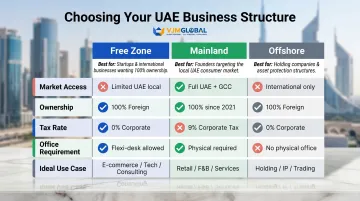
Comparison Table
| Dimension | Free Zone | Mainland | Offshore |
|---|---|---|---|
| Market access | International + limited UAE | Full UAE market access | International only |
| Ownership | 100% foreign | 100% foreign (most sectors) | 100% foreign |
| Tax | 0%–9% depending on zone | 0%–9% standard rate | Typically 0% |
| Office requirement | Flexi-desk or serviced office | Physical address mandatory | Registered address only |
| Ideal use case | Regional trade, logistics, e-commerce | UAE-focused sales, services | Holding, IP, international trade |
Which Option Suits Singapore Founders?
The right structure depends on where your customers are — not just where you want to incorporate. Use this as a starting point:
- Choose a free zone if you're targeting regional or international markets. DMCC is a natural fit for Singapore commodity traders; JAFZA suits logistics and import/export businesses. The 2022 Singapore-UAE CEPA also makes free zone incorporation especially practical for Singapore-based entities expanding westward.
- Choose mainland if you're selling directly to UAE businesses or consumers, or bidding on government contracts. The 2021 ownership reforms make this a straightforward option in most sectors.
- Choose offshore if you need a holding structure for assets, IP, or international contracts with no plans to operate inside the UAE.
When in doubt, free zone setup is the faster, lower-cost path to market — mainland conversion is always possible later as your UAE presence grows.
Step-by-Step: Registering a Business in the UAE from Singapore
Step 1 — Define Your Business Activity and Legal Structure
The UAE offers over 2,000 licensed business activities, categorised by licence type:
- Commercial (trading, import/export)
- Professional (consulting, advisory, IT services)
- Industrial (manufacturing, processing)
- Tourism, Agricultural, Occupational
Your chosen activity determines:
- The type of licence you need
- Which legal forms are eligible (LLC, FZE, branch office, etc.)
- Which free zones or emirates will permit your activity
Choosing the wrong activity code creates downstream delays — confirm your activity code before proceeding to Step 2.
Step 2 — Select a Jurisdiction and Free Zone (or Mainland Emirate)
Each free zone has different:
- Fee structures
- Industry focus
- Visa quotas
- Office space requirements
Popular free zones for Singapore-based businesses:
| Free Zone | Best For | Key Feature |
|---|---|---|
| DMCC | Commodities, gold, tech, crypto | Largest free zone by membership; Dubai-based |
| JAFZA | Logistics, manufacturing, F&B | Adjacent to Jebel Ali Port; customs-bonded |
| Dubai South | Aviation, logistics, real estate | Near Al Maktoum International Airport |
For mainland, the emirate (Dubai, Abu Dhabi, etc.) determines which DED authority manages the process and the fee schedule.
Step 3 — Reserve the Trade Name
Trade names must follow UAE naming conventions:
- No religious or government references
- No offensive or profane language
- Must include legal structure suffix (LLC, FZE, FZCO, etc.)
- Cannot duplicate existing names
- Words like "International," "Capital," or "Group" may require prior approval
Name registration is done via the relevant emirate's DED or free zone authority portal. Approval typically takes 1–3 days.
Step 4 — Apply for Initial Approval and Prepare Legal Documents
Initial approval confirms the government has no objection to your business. A Memorandum of Association (MOA) is required for LLCs and most structures.
Singapore-issued documents — passports, company registration certificates — require full embassy attestation followed by UAE Ministry of Foreign Affairs (MOFA) attestation. The UAE is not a member of the Hague Apostille Convention, so the apostille-only route does not apply. Budget 2–4 weeks for this process.
Step 5 — Secure a Business Address and Collect the Licence
All UAE businesses require a physical address. Free zones offer flexible options:
- Flexi-desk: AED 16,000–19,000/year (DMCC)
- Serviced desk: AED 22,000–35,000/year
- Serviced office: AED 35,000–140,000/year
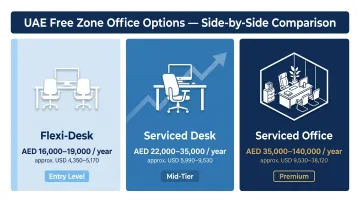
Once office space is contracted and approvals obtained, the trade licence is issued by the DED or free zone authority. Licence fees must typically be paid within 30 days of the payment notice.
Step 6 — Open a Corporate Bank Account and Apply for Residency Visas
Corporate bank account opening is typically the most time-consuming step. UAE banks apply strict KYC/AML requirements and will request:
- Trade licence and MOA
- Shareholder passports
- Business plan with projected cash flows
- Proof of source of funds
- Evidence of UAE physical substance (office lease, employees, contracts)
Approval takes 2–4 weeks on average, though complex structures can take longer.
Once banking is underway, you can simultaneously pursue residency visas. The standard investor visa grants 2-year residency and is linked to the company licence. Investors committing a minimum AED 2 million in capital may qualify for a Golden Visa (5–10 years).
Note that medical fitness tests (blood work, chest X-ray) and Emirates ID biometrics (iris scan, fingerprinting) must be completed in person inside the UAE — remote processing is not available.
Costs, Timelines, and Documents Required
Costs Overview
Free Zone Setup (DMCC - Official 2026 Schedule):
| Item | Cost (AED) | Cost (USD) |
|---|---|---|
| Basic package (registration + licence) | 35,484 | ~9,670 |
| Jump Start package (with flexi-desk) | 43,780 | ~11,920 |
| Residence visa (per person, 2 years) | 2,972–4,220 | ~810–1,150 |
| Medical fitness test | 800 | ~220 |
Mainland DED Licence (Dubai):
- Trade licence fee: AED 1,070
- Dubai Chamber membership: AED 300
- Total mainland costs vary by activity and office lease
Additional costs:
- Flexi-desk: AED 16,000–19,000/year
- Serviced office: AED 35,000–140,000/year
- Professional/advisory fees: Variable (typically USD 1,500–5,000)
Timeline Benchmarks
| Stage | Duration |
|---|---|
| Document attestation (Singapore → UAE) | 2–4 weeks |
| Trade name reservation | 1–3 days |
| Initial approval & MOA signing | 3–7 days |
| Licence issuance (free zone) | 1–2 weeks |
| Licence issuance (mainland) | 4–7 days |
| Corporate bank account opening | 2–8 weeks |
| Visa processing (medical + Emirates ID) | 2–3 weeks |
| Total end-to-end timeline | 4–12 weeks |
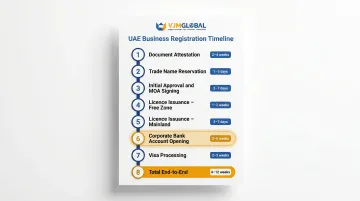
Bank account opening is typically the longest and most unpredictable step.
Documents Singapore-Based Founders Need to Prepare
- Valid passport copy (minimum 6 months validity)
- Singapore company registration documents (ACRA BizFile, if setting up a branch or subsidiary)
- Proof of address (utility bill or bank statement)
- Passport-sized photos (white background)
- Business plan with financial projections
- Source of funds documentation (for banking KYC)
Attestation requirement: Singapore-issued documents follow a four-step authentication chain:
Attestation requirement: Singapore-issued documents follow a four-step authentication chain:
- Notarise documents in Singapore
- Attest with the Singapore Ministry of Foreign Affairs
- Authenticate at the UAE Embassy in Singapore
- Final attestation by UAE MOFA
Professional support: Engaging a business setup advisory firm can cut delays by managing document preparation, liaising with UAE authorities, and keeping the process on track. For Singapore-based founders handling this remotely, having an experienced partner coordinate across time zones and jurisdictions makes a measurable difference — especially during the bank account opening stage, where KYC requirements vary by institution.
Common Mistakes Singapore-Based Founders Make When Registering in UAE
Choosing a Jurisdiction Without Matching It to the Business Model
Many founders default to the cheapest free zone without verifying whether it permits their intended activities or provides the market access they need. A company set up in a media-focused free zone, for example, may not be permitted to conduct commodity trading. Each free zone has specific permitted activities — verify before committing.
Underestimating Banking Timelines and Requirements
Corporate bank account opening is often the most challenging step. Singapore founders frequently underestimate the documentation depth required. A credible business plan with projected financials is non-negotiable — and the process typically takes 4–8 weeks.
Common rejection triggers:
- Incomplete or expired KYC documents
- Unverifiable source of funds
- High-risk business activities (crypto, overseas-only consultancy, trading)
- Lack of UAE physical substance (no local office, employees, or contracts)
- Mismatches between trade licence activities and actual business model

Attempting to operate without a UAE bank account is not viable for any commercial activity.
Assuming the Process Is Identical to Singapore's Company Registration
These banking hurdles are part of a broader pattern: UAE registration differs from Singapore's ACRA process in several concrete ways.
- Each emirate runs its own DED with distinct fee schedules and processes
- MOA notarisation is mandatory — a step Singapore's ACRA process skips entirely
- Virtual offices are not always accepted; physical address requirements vary by free zone
- Healthcare, education, and finance activities require additional regulatory clearances
Resubmissions for incomplete applications can add 2–4 weeks to the timeline — and in some free zones, restart the fee clock entirely.
Frequently Asked Questions
Can foreigners start a business in the UAE?
Yes, foreigners including Singapore nationals can fully own and operate a business in the UAE. Since 2021 reforms, 100% foreign ownership is permitted in most sectors on the mainland and in all free zones, with a local service agent only required for select strategic activities.
How much does it cost to set up a company in the UAE?
Free zone packages range from AED 14,900 to AED 50,000+ (approximately USD 4,050 to USD 13,600+), depending on the zone, office type, and visa requirements. Mainland setup fees typically start lower, but require separate office leasing and carry higher ongoing compliance costs.
Do I need to be physically present in the UAE to register my business there?
Most steps — trade name registration, document submission, licence application — can be completed remotely with proper power of attorney or through a registered agent. Physical presence is typically required only for visa processing: medical tests and Emirates ID biometrics must be completed in person in the UAE.
Can I run a UAE company from Singapore without relocating?
Yes, particularly for free zone companies focused on international trade or services. That said, an active UAE trade licence requires annual renewal, a valid physical address, and a UAE residency visa if the founder holds one linked to the company. Banks also increasingly scrutinise companies with no local physical presence when opening or maintaining accounts.
What is the difference between a UAE free zone company and a mainland company for Singapore foreigners?
Free zone companies offer simpler setup, lower costs, and sector-specific benefits — but cannot trade directly within the UAE domestic market. Mainland companies provide unrestricted UAE market access and government contract eligibility, though they involve more regulatory steps and higher office lease requirements.
Does the Singapore-GCC FTA offer any advantage when setting up a business?
The Singapore-GCC Free Trade Agreement (in force since 2013) provides duty-free access for goods traded between Singapore and the UAE, directly reducing import/export costs for Singapore businesses operating there. The FTA has supported SGD 27.9 billion in bilateral trade volume in 2025, making it a meaningful advantage for goods-oriented businesses.
Need help navigating UAE business registration from Singapore? VJM Global's cross-border advisory team supports foreign entrepreneurs with compliance structuring, document preparation, and coordination across jurisdictions. Contact our team to discuss your UAE expansion strategy.