Introduction
Sharjah's free zones offer a structured, cost-effective pathway for foreign investors and entrepreneurs to establish businesses in the UAE with 100% ownership and simplified regulatory requirements — and no local sponsor required.
Many entrepreneurs overlook Sharjah in favour of Dubai, assuming it offers fewer advantages. That's rarely the case. Sharjah borders Dubai directly, shares access to a major international airport, and its free zones typically cost less to enter than comparable Dubai alternatives.
The numbers back this up: Sharjah's free zones attracted over 1,600 international companies in 2024, and the emirate recorded a 45% jump in FDI project count in 2025.
This guide covers everything a prospective business owner needs to know: what Sharjah free zones are, how to choose the right one, how the setup process works, what it costs, and the compliance obligations and common pitfalls to plan for.
Key Takeaways
- Sharjah has six active free zones, each targeting specific industries — choosing correctly determines licensing eligibility and cost
- All six permit 100% foreign ownership with no UAE national sponsor required
- Setup costs are generally lower than comparable Dubai free zones, with entry-level packages starting from AED 5,500
- Incorporation can be completed in as few as 3–7 working days once all documents are in order
- Corporate tax, VAT, and UBO obligations apply to all free zone companies from day one — budget and register for them before operations begin
What Is a Sharjah Free Zone?
A Sharjah free zone is a designated economic zone with its own Free Zone Authority, operating under independent licensing frameworks, ownership protections, and simplified regulations — separate from UAE mainland rules.
On the UAE mainland, foreign investors historically needed a local Emirati sponsor holding 51% ownership to operate. Free zones eliminate that requirement. Full foreign ownership applies from incorporation, which is one of the primary reasons international businesses choose this route.
The Six Active Free Zones at a Glance
| Free Zone | Primary Focus | Best For | Distinguishing Feature |
|---|---|---|---|
| SAIF Zone | Trade, logistics, manufacturing | Importers, exporters, freight companies | 8,000+ companies from 160 countries; established 1995 |
| Hamriyah Free Zone (HFZA) | Heavy industry, maritime, oil & gas | Industrial manufacturers, food processing | 30M sqm zone; 6,500+ businesses from 163 countries |
| Sharjah Media City (Shams) | Media, digital, creative, e-commerce | Freelancers, consultants, online businesses | Up to 5 activities on one license; fully online setup |
| Sharjah Publishing City (SPC) | Publishing, content, trading | Publishers, content creators, educators | World's first publishing free zone; zero paid-up share capital |
| SRTIP | Technology, R&D, innovation | Tech startups, cleantech, smart manufacturing | Focus on water, energy, and digitalisation sectors |
| SHCC | Healthcare, medical, wellness | Clinics, pharma, medical services | Regulated by Sharjah Health Authority; additional SHA approvals required |
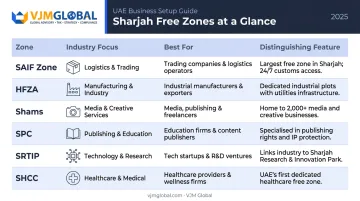
Each zone has a defined purpose, and choosing the wrong one is one of the most common setup mistakes. A technology consultant belongs in Shams or SRTIP — not HFZA, which is built for heavy industrial operations.
Why Entrepreneurs Choose Sharjah Free Zones
100% Foreign Ownership
Every Sharjah free zone permits full foreign ownership with no requirement for a UAE national partner or sponsor. You retain complete operational control and can repatriate profits freely. UAE government guidance confirms this applies across all licensed free zone entities.
Lower Entry Costs
Official starting figures from the free zone authorities themselves illustrate the cost advantage:
- SPC: from AED 5,750
- SRTIP: from AED 5,500
- HFZA: basic license from AED 11,000 / USD 3,000
For startups, solo consultants, and SMEs, these figures represent meaningful savings compared to higher-cost alternatives in other emirates. Packages vary by activity, office type, and visa quota, so request an official quotation directly from the relevant free zone authority before budgeting.
Strategic Location
Sharjah sits adjacent to Dubai with direct access to major logistics infrastructure:
- Sharjah International Airport: handled 19.48 million passengers and 204,323 tonnes of air cargo in 2025, connecting to 100+ global destinations
- Hamriyah Port and Port Khalid: deepwater and multipurpose ports adjacent to free zone areas
- Major highway access: direct road connections to Dubai, Abu Dhabi, and the wider UAE
For logistics, trading, and manufacturing businesses, this infrastructure combination is a real operational advantage — without paying Dubai rental premiums.
The Corporate Tax Reality
Free zone businesses are not automatically exempt from UAE corporate tax. Under Federal Decree-Law No. 47 of 2022, a Qualifying Free Zone Person (QFZP) pays 0% corporate tax on Qualifying Income and 9% on non-qualifying taxable income.
To qualify, a business must:
- Maintain adequate substance within a free zone
- Derive income that qualifies under the law
- Comply with arm's length and transfer pricing rules
- Not elect ordinary corporate tax treatment
The 0% rate is a real benefit, but it's conditional on meeting these requirements. Every free zone company must register for corporate tax and file annual returns regardless of qualification status.
Serving UAE Mainland Clients
A common misconception is that Sharjah free zone companies cannot work with Dubai or mainland UAE clients. In practice, free zone companies can invoice and deliver services to clients anywhere in the UAE without restriction.
Certain activities do require additional steps, including:
- Opening a physical retail presence on the mainland
- Supplying goods directly to mainland buyers without a licensed distributor
- Participating in UAE government contracts
For activity-specific clarity, confirm the requirements with the relevant free zone authority before proceeding.
Step-by-Step Guide to Setting Up in a Sharjah Free Zone
The end-to-end process — from selecting a zone to receiving a trade license — typically takes 3–7 working days with complete documentation. Some zones move faster: Shams claims license issuance in under 60 minutes, SPC in 45 minutes, and SRTIP within 30 minutes of payment.
Step 1: Choose the Right Free Zone
Your choice should be driven by:
- Business activity — each zone has an approved activity list
- Required infrastructure — virtual desk, shared office, warehouse, or industrial unit
- Budget — entry-level packages vary significantly by zone
- Visa requirements — office type determines how many visas you can obtain
Refer to the zone comparison table above as your starting point.
Step 2: Select Business Activity and License Type
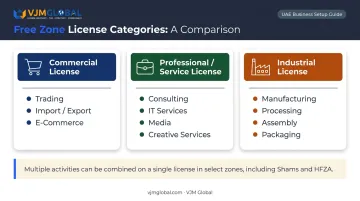
Three primary license categories apply across most Sharjah free zones:
- Commercial — trading, import/export, general trading, e-commerce
- Professional/Service — consulting, IT, media, creative services
- Industrial — manufacturing, processing, assembly, packaging
Several zones, including Shams and HFZA, permit multiple activities under a single license. The activity you declare determines which regulatory approvals are needed. Declaring the wrong activity — even by omission — creates compliance problems at renewal, so get this right from the start.
Step 3: Determine Your Legal Structure
| Structure | Shareholders | Notes |
|---|---|---|
| Free Zone Establishment (FZE) | 1 | Single-owner entity; most common for solo entrepreneurs |
| Free Zone Company (FZC) | 2+ | Suitable for partnerships or multi-investor setups |
| Branch of Existing Company | N/A | Operates under parent company liability; requires home jurisdiction documents |
Step 4: Reserve a Trade Name and Submit Application
Trade name rules apply across all zones: names cannot duplicate existing registrations, must avoid restricted terms, and must carry the appropriate legal entity suffix (FZE or FZC).
Standard documents required:
- Passport copies of all shareholders and directors
- Recent passport-sized photographs
- Proof of residential address
- Completed application form
- Business activity description
- Business plan (where required by the zone)
- No Objection Certificate (NOC) if currently on a UAE employment visa
Corporate shareholders must also provide a board resolution, certificate of incorporation, and memorandum/articles of association. Physical presence is not required during initial incorporation at most zones.
Step 5: Secure Office or Workspace
Workspace options and their implications:
- Flexi desk — lowest cost entry point with limited visa allocation; suitable for solo founders and early-stage startups
- Shared office — a step up in space and visa quota; works well for small teams of 2–4
- Private office — higher visa quotas and dedicated space for growing operations
- Warehouse/industrial unit — required for manufacturing, assembly, and logistics activities
SAIF Zone's standard Office package includes 3 visas; their Suite package allows 8 visas. Shams permits up to 50 visas per license. Confirm visa allocation for your chosen package before committing, as upgrading later adds cost.
Step 6: Receive Your License and Open a Corporate Bank Account
Once fees are paid and documents approved, the free zone issues your trade license. At that point, opening a UAE corporate bank account becomes the next immediate task — and it's where most new businesses encounter delays they didn't anticipate.
Banks require: trade license, incorporation documents, shareholder identification, and evidence of business operations. Approval timelines vary by institution, and free zone registration alone doesn't guarantee approval. VJM Global works with international investors through both the incorporation process and the bank account opening stage — handling documentation, regulatory coordination, and compliance requirements across the UAE setup journey.
Costs, Office Solutions, and Compliance Obligations
Understanding the Cost Components
A complete Sharjah free zone setup involves multiple line items beyond the headline license fee:
- Registration fee
- Trade license fee (annual)
- Establishment card
- Visa fees (per visa applied for)
- Office or flexi desk charges (annual)
- Immigration processing fees
Annual renewal costs cover the license, office arrangement, and any active visas. Missing a renewal deadline triggers penalties, so set calendar reminders well ahead of expiry dates.
For current fee breakdowns, request official quotations directly from the free zone authority. Published starting figures — often AED 5,500–11,000 — cover the license only and do not include the full cost stack.
Ongoing Compliance Obligations
Every Sharjah free zone company must meet the following obligations from day one:
- Corporate Tax registration and filing — mandatory even for businesses qualifying for the 0% rate
- VAT registration — mandatory once taxable turnover exceeds AED 375,000; voluntary registration available above AED 187,500
- UBO declaration — required under Cabinet Decision No. 109 of 2023
- AML compliance — governed by Federal Decree-Law No. 20 of 2018
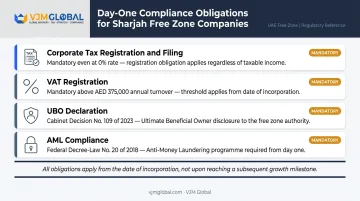
Each obligation applies from the moment of incorporation, not at a later growth stage. VJM Global supports free zone businesses with accounting and tax compliance to meet these regulatory requirements.
Common Mistakes and When Sharjah May Not Be the Right Fit
Most Common Setup Errors
- Wrong license type: selecting a Commercial license for a services business, or vice versa, creates activity mismatch issues at renewal
- Underestimated renewal costs — the first-year package price is often promotional; year-two costs can be noticeably higher
- Ignoring visa planning — not accounting for visa needs before choosing office type means paying more to upgrade later
- Assuming automatic tax exemption: the 0% corporate tax rate requires meeting QFZP conditions; failing substance requirements or transfer pricing rules eliminates the benefit
- Choosing a zone by price alone — a cheaper zone that doesn't support your business activity saves you nothing
When a Free Zone May Not Be the Right Structure
A Sharjah free zone is not always the optimal choice. Consider alternatives if:
- Your business requires frequent physical retail presence on the UAE mainland
- Your clients need you to hold a mainland trade license for contractual or tender purposes
- You are pursuing UAE government contracts, which typically require mainland licensing
- Your business is in a heavily regulated sector (healthcare, financial services, food and beverage) requiring federal approvals that sit outside the free zone framework
- Dubai brand recognition is a commercial necessity for your market positioning
Two operational realities catch many founders off guard. Free zone companies can serve UAE clients, but direct mainland trading without a licensed distributor or mainland branch is not permitted. On the banking side, free zone registration alone does not guarantee account approval — each bank evaluates applications on its own merits.
Frequently Asked Questions
How much does it cost to set up a Sharjah free zone company?
Costs vary based on the zone, license type, visa quota, and office solution. Some entry-level packages start from AED 5,500–5,750, but the full cost stack includes registration, visas, and office charges. Request an official quotation from the relevant free zone authority for accurate figures.
What is the minimum capital requirement for a Sharjah free zone company?
Most Sharjah free zones do not impose mandatory minimum share capital for standard FZE or FZC structures. SPC explicitly states zero paid-up share capital. Requirements vary by zone, and regulated activities may have their own thresholds — verify directly with your chosen zone.
How do I start a small business in Sharjah?
The core steps are straightforward:
- Identify your business activity and choose the right free zone
- Select a license type and legal structure
- Prepare your documents and submit the application
Most registrations complete within a few working days. A business setup consultant can speed up the process further.
Can foreigners own 100% of a Sharjah free zone company?
Yes. All six Sharjah free zones permit 100% foreign ownership with no requirement for a UAE national partner or sponsor. This applies to both FZE (single shareholder) and FZC (multiple shareholders) structures.
How long does company registration take?
With complete documentation and payment, most Sharjah free zone companies incorporate within 3–7 working days. Some zones move faster — Shams claims under 60 minutes, SPC 45 minutes, and SRTIP 30 minutes from payment for straightforward applications.
Can a Sharjah free zone company do business with clients in Dubai?
Yes. A free zone company can invoice and deliver services to clients anywhere in the UAE, including Dubai. Physical mainland retail or direct goods trading without a licensed distributor requires additional approvals. Confirm your specific activity requirements with the free zone authority before proceeding.