Introduction
Over 4,543 Indian-owned companies were registered in Dubai during Q1 2025 alone, placing India at the top of new business formations in the emirate. IFZA (International Free Zone Authority) draws a significant share of that activity—offering 100% ownership, remote setup capability, and zero paid-up capital requirements that appeal directly to Indian entrepreneurs.
This guide is written for Indian nationals, NRIs, and OCIs evaluating IFZA for their Dubai business. It covers the exact setup steps, all-in costs including often-overlooked fees, and the India-specific regulatory dimensions—FEMA compliance, RBI filings, DTAA structuring, and POEM risk—that most generic IFZA guides skip entirely.
Whether you're an IT consultant, e-commerce operator, or trading firm owner, understanding both the UAE and India sides of the equation is what separates a smooth setup from a costly one.
TL;DR
- IFZA offers 100% foreign ownership with no local sponsor or paid-up capital, making it highly accessible for Indian entrepreneurs
- Complete setup remotely in 3–5 working days without UAE travel for initial approval
- License packages reportedly start around AED 12,900; factor in Establishment Card, visa fees, and office space for total cost
- Indian nationals must comply with FEMA ODI regulations, including filing Form ODI through their bank
- India-UAE DTAA reduces withholding taxes, but POEM rules can trigger Indian tax residency if management stays in India
What Is IFZA and Why It Suits Indian Entrepreneurs
IFZA (International Free Zone Authority) is a Dubai free zone authority headquartered within Dubai Silicon Oasis, offering co-branded licenses with DSO Authority across 800+ business activities in professional, commercial, and holding categories.
Core features include:
- 100% foreign ownership with no local sponsor requirement
- Zero paid-up capital obligation
- Full profit repatriation without restrictions
- Multi-activity licenses (up to 3 activities under one license)
These features map directly onto what Indian entrepreneurs actually need. The UAE is geographically close, Dubai hosts a 100,000+ strong Indian business community, and bilateral trade under the India-UAE CEPA exceeded $100 billion in FY 2024-25. IFZA lets Indian founders service Middle Eastern and international clients while keeping overhead low.
Business activities supported:
- IT services and software development
- Consulting and professional services
- E-commerce and digital marketing
- Trading (import/export)
- Media production
- Holding company structures
How IFZA Differs from Mainland and Offshore Structures
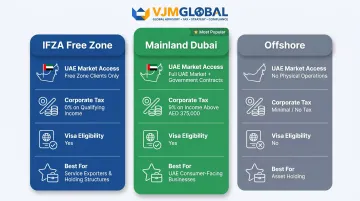
| Structure | UAE Market Access | Corporate Tax | Visa Eligibility | Best For |
|---|---|---|---|---|
| IFZA (Free Zone) | Free zone clients only; no mainland retail or govt contracts | 0% on qualifying income | Yes | Service exporters, consultants, holding structures |
| Mainland Dubai | Full UAE market + government contracts | 9% on income above AED 375,000 | Yes | Businesses selling directly to UAE consumers |
| Offshore | No physical operations permitted | Minimal/none | No | Asset holding, international transactions only |
For Indian SME owners operating across related verticals—say, IT consulting plus e-commerce plus trading—IFZA's multi-activity license structure reduces overhead compared to maintaining separate licenses for each business line.
Step-by-Step IFZA Setup Process for Indian Nationals
IFZA's virtual-first process allows Indian nationals to complete initial approval entirely from India—no UAE travel required until the visa stage.
Step 1: Choose Your Business Activity and License Type
Select from IFZA's approved activity list across two main license categories:
Professional License: Consulting, IT services, marketing, design, legal advisory, accounting
Commercial License: Trading, import/export, e-commerce, distribution
Indian entrepreneurs in IT, consulting, and e-commerce typically opt for professional licenses; traders lean toward commercial licenses. Note: Some activities (banking, insurance, certain regulated sectors) require additional regulatory approvals.
Verify your chosen activity against IFZA's official list and confirm whether additional approvals apply before moving forward.
Step 2: Reserve Trade Name and Submit Initial Application
The trade name reservation and initial approval stage requires:
- Valid Indian passport copy
- Recent photograph (passport-style)
- Proof of residential address (utility bill or bank statement)
Timeline: 24–48 hours for name approval — no physical presence required.
Ensure passport copies are legible and address proof is current — document quality is the most common cause of delays.
Step 3: Pay License Fee and Obtain IFZA Trade License
After fee payment, IFZA issues:
- Trade license certificate
- Memorandum of Association (MOA)
Timeline: 3–5 working days for standard applications — no physical presence required.
The license document specifies permitted activities, registered address, shareholder details, and validity period.
Step 4: Apply for Establishment Card and Visa (If Required)
The Establishment Card grants visa quota allocation. The UAE residence visa process involves:
- Entry permit — issued before travel
- Medical fitness test — mandatory in-person exam (approximately AED 752.50)
- Emirates ID registration — biometrics required at ICP center
- Visa stamping — Note: As of April 2022, visa stickers are no longer stamped in passports; Emirates ID serves as proof of residency
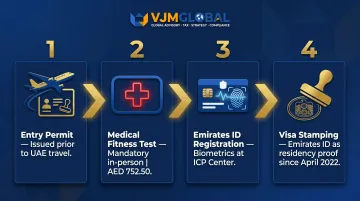
Physical presence required for the medical test and Emirates ID biometrics — Indian nationals should plan UAE travel around this stage.
Step 5: Open a Corporate Bank Account
Most UAE banks require authorized signatories to appear in person to open a corporate account.
Typical documentation:
- Trade license
- Memorandum of Association
- Passport copies of shareholders and signatories
- Business profile (company overview, nature of operations, expected turnover)
- Personal bank statements (6 months)
Indian nationals should expect enhanced due diligence. A well-prepared business profile — covering operations, revenue projections, and source of funds — makes a measurable difference in approval outcomes.
Timeline: Independent of the license process; typically 2–6 weeks depending on the bank.
VJM Global works with Indian entrepreneurs on bank-ready documentation packages that address both UAE compliance requirements and India-side FEMA obligations — covering the cross-border complexity that catches many applicants off guard.
Costs, Documents & Visa Requirements for Indian Applicants
License Package Costs
IFZA prices through Professional Partners rather than a public rate card. The table below reflects third-party–cited 1-year packages — confirm current rates directly with IFZA before budgeting.
| Package | Visa Quota | Approximate Cost (AED) |
|---|---|---|
| Zero-Visa | 0 | 12,900 |
| 1-Visa | 1 | 14,900 |
| 2-Visa | 2 | 16,900 |
| 3-Visa | 3 | 18,900 |
Additional Mandatory Costs
These costs sit outside the base license fee — factor them in before finalizing your first-year budget:
- Establishment Card: Approximately AED 2,000/year
- Medical test: AED 752.50 per applicant
- Residence visa (2 years): Approximately AED 3,750 per person
- Emirates ID: Included in visa processing fees
Document Checklist for Indian Nationals
For IFZA application:
- Valid Indian passport (minimum 6 months validity)
- Recent passport-style photograph
- Proof of residential address (utility bill/bank statement, dated within 3 months)
- Personal bank statement (sometimes required depending on package)
For India-side compliance:
- PAN card (for FEMA Form ODI filing)
- Aadhaar (for AD bank KYC)
- Indian bank account statements
Office Space Options
| Option | Description | Typical Cost (AED/year) | Visa Quota |
|---|---|---|---|
| Flexi-desk | Virtual office; shared workspace access | ~5,000 | 0-1 |
| Dedicated desk | Fixed desk in shared office | ~8,000 | 1-2 |
| Private office | Fully enclosed office | Varies by size | 2+ |
Most Indian startups and solo consultants begin with Flexi-desk to minimize first-year costs.
Once your workspace tier is set, the next number to lock in is your annual renewal cost — which arrives sooner than most founders expect.
License Renewal Costs
Annual renewal typically equals the first-year license fee. Since visa renewals fall due every 2–3 years and may overlap with license renewal cycles, map both dates at incorporation to prevent back-to-back cash outflows.
India-Specific Regulatory Considerations: FEMA, DTAA & Tax Compliance
Most guides cover UAE setup steps and stop there. For Indian entrepreneurs, ignoring India-side compliance is where serious legal and tax exposure begins.
FEMA and Overseas Direct Investment (ODI)
Indian residents establishing a foreign company must comply with RBI's Foreign Exchange Management (Overseas Investment) Rules, 2022.
Key requirements:
Form ODI Filing:
- Must be filed with your Authorized Dealer (AD) bank before or immediately after the investment
- Reports the nature, amount, and structure of overseas investment
- No prior RBI approval needed under automatic route (within limits)
Annual Performance Report (APR):
- Required annually (Form ODI Part II)
- Reports financial performance of the foreign entity
- Due by December 31 each year
ODI vs LRS distinction:
| Parameter | ODI | LRS |
|---|---|---|
| Who | Indian companies, LLPs, firms | Resident individuals |
| Limit | 400% of net worth (automatic route) | USD 250,000/financial year |
| Filing | Form ODI with AD bank | LRS declaration through bank |
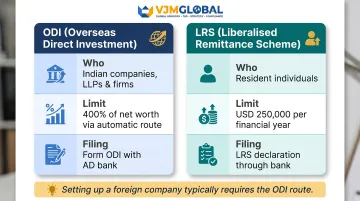
If you're an individual investing within USD 250,000/year, you may use LRS. However, setting up a foreign company typically requires the ODI route for proper compliance.
RBI approval required when:
- Investment exceeds 400% of net worth
- Investment in restricted sectors (real estate, banking)
- Investment in FATF-identified non-cooperative countries
VJM Global handles Form ODI filings, APR submissions, and RBI compliance for Indian entrepreneurs managing both FEMA requirements and UAE setup obligations at the same time.
India-UAE Double Taxation Avoidance Agreement (DTAA)
The India-UAE DTAA (effective September 22, 1993) prevents double taxation on income earned across both countries.
Key withholding tax rates:
| Income Type | DTAA Rate |
|---|---|
| Dividends | 10% |
| Interest (bank loans) | 5% |
| Interest (others) | 12.5% |
| Royalties | 10% |
| Fees for Technical Services | 10% |
How to claim DTAA benefits:
- Obtain Tax Residency Certificate (TRC) from UAE authorities
- Submit Form 10FA to Indian tax authorities
- Claim foreign tax credit in Indian ITR against tax paid in UAE
Note: The DTAA uses the credit method—tax paid in one country can be claimed as credit in the other, limited to domestic tax payable on that income.
POEM (Place of Effective Management) Risk
Under Section 6(3) of the Income Tax Act (amended 2015), a foreign company is deemed an Indian tax resident if its Place of Effective Management is in India.
What this means for IFZA companies:
If an Indian resident director makes all key management and commercial decisions from India—board meetings held in India, contracts signed in India, strategic decisions made in India—the UAE company could be deemed an Indian tax resident, subjecting its worldwide income to Indian taxation at rates up to 30%+.
Mitigation strategies:
- Hold board meetings in the UAE
- Maintain substantive decision-making in the UAE (not just on paper)
- Document where key commercial decisions are made
- Ensure UAE operations have genuine economic substance
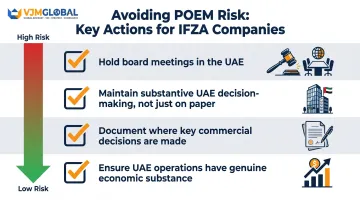
VJM Global's POEM risk assessment helps structure your operations so UAE tax residency holds up under scrutiny from Indian authorities.
Schedule FA Disclosure
Indian residents must disclose all foreign assets—including IFZA company shareholding—in Schedule FA (Foreign Assets) of their ITR.
Filing requirements:
- Use ITR-2 or ITR-3 (ITR-1 and ITR-4 do not have Schedule FA)
- Disclosure covers calendar year (Jan 1–Dec 31)
- Categories include foreign equity interests (Table A3) and financial interest in foreign entities (Table B)
Non-disclosure consequences:
- Tax assessments under Black Money Act 2015
- Financial penalties
- Criminal prosecution (non-disclosure is a criminal offense, not just a compliance gap)
UAE Corporate Tax Implications for IFZA Companies
Beyond India-side obligations, your IFZA company also operates within the UAE's corporate tax framework (effective June 1, 2023):
| Category | Tax Rate |
|---|---|
| Income up to AED 375,000 | 0% |
| Income above AED 375,000 | 9% |
| Qualifying Free Zone Person (QFZP) - qualifying income | 0% |
| QFZP - non-qualifying income | 9% |
IFZA companies can qualify for 0% tax if:
- They meet QFZP conditions (adequate UAE substance, qualifying income, arm's length pricing)
- Derive qualifying income (manufacturing, trading qualifying commodities, holding shares, HQ services, etc.)
- Non-qualifying revenue stays below lower of 5% of total revenue or AED 5 million (de minimis rule)
Indian entrepreneurs running their IFZA company remotely face a specific risk: without economic substance in the UAE, the 0% tax status doesn't hold. That means:
- Real UAE-based employees or service providers
- Genuine UAE office space (not just virtual)
- Key decisions documented as made in UAE
Audit requirement (new from Jan 1, 2025):
Under Ministerial Decision No. 84 of 2025, all QFZPs must maintain audited financial statements regardless of revenue size. This applies from year one for companies claiming 0% tax.
Common Mistakes and When IFZA May Not Be the Right Fit
Common Mistakes Indian Entrepreneurs Make
1. Choosing the wrong license activity
Selecting an activity that doesn't match your actual operations affects banking approvals—banks scrutinize activity vs. transaction patterns—and limits future expansion. Consult an advisor before finalizing.
2. Underestimating total first-year costs
The base license fee (AED 12,900) is only the start. Factor in:
- Establishment Card (~AED 2,000)
- Visa processing (~AED 3,750 per person)
- Medical tests (AED 752.50 per person)
- Office space (AED 5,000+)
- Bank account opening fees
- Total realistic first-year cost: AED 25,000–35,000
3. Neglecting India-side FEMA filings
Failing to file Form ODI or Annual Performance Reports can result in RBI penalties, freezing of foreign exchange transactions, and legal complications back in India—non-compliance here carries real consequences.
4. Assuming UAE setup eliminates Indian tax obligations
Indian tax residency rules, POEM provisions, and Schedule FA disclosure requirements still apply. You cannot assume the UAE setup provides full tax separation from India without proper structuring and ongoing compliance.
Understanding these mistakes helps you avoid costly missteps—but there are also situations where IFZA simply isn't the right structure regardless of how well you execute.
When IFZA May Not Be the Right Fit
Consider alternatives to IFZA if:
You need direct UAE mainland market access:
- Free zone companies cannot sell directly to UAE mainland retail customers or secure government contracts
- Local warehousing and distribution require a mainland license or a registered distributor
You operate in heavily regulated sectors:
- Banking, insurance, and certain financial services require mainland licenses
- Healthcare and educational services have specific licensing requirements
Your primary business model is UAE-domestic:
- IFZA is optimized for international trade, services exports, and holding structures
- If 90%+ of your revenue comes from UAE mainland customers, a mainland license is more appropriate
You want to avoid all compliance obligations:
- IFZA companies must register for UAE Corporate Tax, file annual returns, and (if claiming 0% rate) maintain audited accounts
- Indian entrepreneurs also face FEMA, DTAA, and Schedule FA obligations
- The compliance cost may exceed the license cost
Frequently Asked Questions
What is IFZA Free Zone?
IFZA (International Free Zone Authority) is a Dubai-based free zone authority operating within Dubai Silicon Oasis, offering business licenses with 100% foreign ownership, multi-activity flexibility, and full remote setup capability for initial approval stages.
Is IFZA a qualifying free zone?
Yes, IFZA is recognized as a qualifying free zone under UAE Corporate Tax law. Companies meeting Qualifying Free Zone Person (QFZP) conditions can benefit from 0% tax on qualifying income, provided they satisfy economic substance and income qualification criteria set by the Federal Tax Authority.
Are there any bans or restrictions on IFZA free zone visas?
IFZA visas are generally available to most nationalities including Indian passport holders, with no country-specific bans. Visa quotas depend on office package type, and applicants must meet standard UAE entry requirements including medical fitness and clean immigration record.
Do Indian entrepreneurs need RBI or FEMA approval before setting up in IFZA?
Yes. Indian residents must file Form ODI with their Authorized Dealer bank under RBI's ODI framework — approval is automatic within prescribed limits (400% of net worth), but filing is mandatory before investing. VJM Global's pre-setup FEMA compliance review identifies regulatory risks and ensures documentation is in order before you proceed.
Can an IFZA free zone company do business with clients in India?
Yes, but transactions must be structured correctly — foreign currency payments, proper UAE-entity invoicing, and compliance with India's GST import-of-services rules. Related-party transactions also attract transfer pricing obligations. VJM Global advises on GST treatment, transfer pricing documentation, and invoicing structures for IFZA companies serving Indian clients.
Is an annual audit mandatory for IFZA companies?
IFZA does not currently mandate annual audit for license renewal for most companies. However, under UAE Corporate Tax law (Ministerial Decision No. 84 of 2025), all companies claiming QFZP status (0% tax) must maintain audited financial statements from year one, regardless of revenue. Indian tax law also requires disclosure of foreign company ownership in Schedule FA regardless of UAE audit requirements.
Final Takeaway
IFZA offers Indian entrepreneurs an efficient, cost-effective path to establishing a Dubai presence with 100% ownership and remote setup capability. The real complexity lies not in the UAE setup — which is fast and well-structured — but in managing the India-UAE compliance intersection: FEMA filings, DTAA structuring, POEM risk, and ongoing tax reporting in both jurisdictions.
Success requires professional advisory support that understands both sides of the border. Whether you're filing Form ODI, preparing bank-ready documentation, or structuring operations to limit POEM exposure, working with experienced advisors from day one prevents costly compliance gaps down the line.