Introduction
For Indian companies eyeing global expansion, California is the entry point of choice. The state's economy hit $4.1 trillion in 2024, making it the world's fourth-largest, according to California's Governor's office.
Tech, SaaS, and export-import businesses all find California's ecosystem hard to ignore.
But here's what most US-focused registration guides leave out: Indian companies don't just answer to the California Secretary of State. You're also on the hook for RBI compliance, FEMA's overseas investment rules, and cross-border tax treaties that American attorneys rarely mention.
Add banking without a Social Security Number into the mix, and the "simple" LLC formation process suddenly gets complicated.
This guide covers the exact registration steps, entity selection, real costs, and the India-side compliance most guides skip entirely, plus the mistakes that trip up Indian founders most often.
Key Takeaways
- Indians can register a California LLC or Corporation without US citizenship, SSN, or residency
- California entities owe a minimum $800 Franchise Tax annually, regardless of profit
- RBI's ODI Rules require Form FC filing plus an Annual Performance Report every year
- LLC vs. Corporation changes how profits get taxed on both sides of the India-US DTAA
- Aligning US and Indian advisors early prevents double taxation and missed filings
How to Register a Business in California as an Indian Company
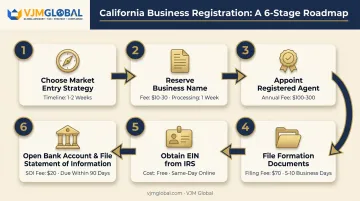
Step 1: Decide Your U.S. Market Entry Strategy
Two paths exist for Indian companies entering California:
- Form a new California subsidiary - incorporate a fresh LLC or Corporation as a standalone US entity
- Foreign qualify your existing Indian company - register the Indian entity itself to transact business in California
Most Indian companies choose the subsidiary route. It keeps Indian and US liability separate, isolates tax exposure between the two countries, and gives US clients, banks, and investors a domestic entity to deal with instead of a foreign one.
Step 2: Choose and Reserve a Business Name
Check name availability through the California Secretary of State's Bizfile Online portal before filing anything else. Your chosen name must be distinguishable from every existing registered entity in the state.
Key details:
- Reservations hold your name for 60 days for a $10 fee
- LLCs must include "LLC," "L.L.C.," or "Limited Liability Company" in the name
- Corporations don't face a blanket "Inc." requirement under California law, though most add it anyway for clarity
Step 3: Appoint a California Registered Agent
Every California entity needs a registered agent with a physical California street address - a P.O. box doesn't count. This agent receives legal notices and official mail on your entity's behalf.
Since Indian promoters have no local presence, this step almost always means hiring a professional registered agent service. Expect to pay $100 to $500 per year. It's not optional, and no, you can't list your Noida or Mumbai office instead.
Step 4: File Formation Documents with the CA Secretary of State
You'll file either:
- Articles of Organization for an LLC ($70 filing fee)
- Articles of Incorporation for a Corporation ($100 filing fee)
These documents cover your business purpose, share structure (for Corporations), and registered agent details. Most Indian applicants use a formation agent since standard processing queues run several days behind and in-person filing isn't practical from overseas.
Need it faster? Same-day service costs $750, while 24-hour service runs $350.
Step 5: Obtain an EIN from the IRS
Your California entity needs an Employer Identification Number before it can open a bank account, hire anyone, or file a single US tax return.
Here's the catch: the IRS's instant online EIN tool requires a US taxpayer ID, which Indian directors typically don't have. Instead:
- Complete Form SS-4, writing "foreign" on line 7b where an SSN or ITIN would normally go
- Submit by fax for a response in roughly 4 business days, or by mail for around 4 weeks
- Alternatively, call the IRS international line at 267-941-1099
Step 6: Open a US Bank Account and File the Statement of Information
Banks will typically ask for:
- Passport copies of directors and owners
- EIN confirmation letter
- Articles of Incorporation or Organization
- Proof of your registered California address
Expect extra scrutiny here. Federal rules let banks apply their own identity-verification standards for non-resident applicants, and some institutions still want an in-person visit or a US-based signer on file.
Separately, file your Statement of Information within 90 days of formation. Corporations refile annually for $25; LLCs refile every two years for $20. Miss it, and your entity risks falling out of good standing with the state.
LLC vs Corporation: Which Entity Type Should Indian Companies Choose?
Entity choice isn't a US formality you can decide later. It shapes your tax bill, your liability exposure, and how cleanly profits flow back to India.
Corporation (C-Corp)
A California C-Corp pays a flat 21% federal tax rate on profits, plus California's 8.84% corporate tax on net income. It's also the structure US venture capitalists and co-investors expect to see when writing a check.
S-Corp status isn't available to you. The IRS bars nonresident alien shareholders from S-Corps entirely, so as a non-resident Indian promoter, you're working with a standard C-Corp, full stop.
Limited Liability Company (LLC)
An LLC offers pass-through taxation and lighter compliance overhead than a Corporation. On the surface, it looks simpler. But foreign-owned single-member LLCs carry a specific trap: you must file Form 5472 attached to a pro forma Form 1120 every year, even with zero US business activity.
Skip it, and the penalty is steep: $25,000 for a late or incomplete filing, with another $25,000 added for every 30 days it stays unresolved after IRS notice.
The DTAA Angle
Entity type changes how India taxes your US income too:
- A Corporation is treated as a distinct foreign entity, making Indian tax credit claims under the India-US DTAA relatively straightforward
- An LLC's pass-through nature can create mismatches, since India may not treat the entity the same way the IRS does. This complicates how the promoter claims credit for tax already paid in the US
Get a US CPA and an Indian chartered accountant on the same call before you file anything. VJM Global's teams routinely coordinate exactly this kind of dual review for clients weighing entity structures across both countries. The wrong structure choice can trigger double taxation or conflicting compliance obligations that take years to sort out.
FEMA & RBI Compliance for Indian Companies Investing in California
Setting up a California entity isn't purely a US transaction. The moment an Indian resident or company invests in a foreign entity, FEMA's Overseas Direct Investment (ODI) framework applies automatically, governed by the RBI's ODI Rules, 2022.
The Automatic Route
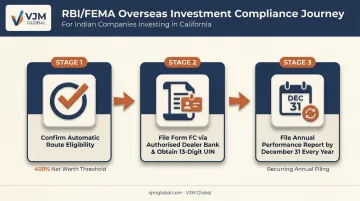
Most Indian companies won't need prior RBI approval. Under the Automatic Route, investments can proceed as long as:
- Total financial commitment across all foreign entities stays within 400% of your entity's net worth, per its last audited balance sheet, under RBI's 2022 Overseas Investment Rules
- The structure otherwise fits within ODI regulations
The Approval Route applies only to specific exceptions, such as certain public-sector undertakings investing in strategic foreign sectors.
Form FC and Your UIN
Before making your initial overseas investment, file Form FC through an Authorised Dealer Bank. This generates a 13-digit Unique Identification Number (UIN) for your California entity - the RBI's proof that the investment is officially on record.
Annual Performance Report (APR)
Every year, by December 31, you must file an APR reporting your California subsidiary's financial status back to the RBI. Skip this, and you risk more than a fine. You create a compliance backlog that only gets harder to unwind the longer it sits unresolved.
Non-compliance with FEMA/ODI norms rarely stops at a penalty. It usually means months of regularization paperwork before the RBI treats your structure as compliant again.
This is where cross-border expertise earns its keep. Firms like VJM Global, which work across Indian FEMA/RBI regulations and US business setup at the same time, help structure the ODI filing correctly from day one instead of fixing it after the fact.
Costs, Taxes & Ongoing Compliance in California
Budget for more than the initial filing fee.
Formation and Recurring State Costs
- LLC formation: $70; Corporation formation: $100
- Minimum $800 Franchise Tax annually to the California Franchise Tax Board, owed regardless of profit from your first taxable year onward
- Statement of Information: $25/year (Corp) or $20/two years (LLC)
- Registered agent fees: $100-$500/year
Tax Layers That Stack Up
Three tax exposures apply once you're operational:
- Federal corporate tax: Flat 21% rate for C-Corps
- California state tax: 8.84% on net income for Corporations, plus the $800 minimum
- US withholding tax on repatriated dividends: Normally 30%, though treaty relief often applies
Indian-resident companies owning at least 10% voting stock qualify for a reduced 15% withholding rate under Article 10 of the India-US tax treaty, provided Form W-8BEN-E is filed with the payer.
Don't Forget the Indian Side
Your India-side FEMA reporting runs in parallel to all of this. APR filings, ODI compliance checks, and DTAA-related tax credit claims don't pause just because your California entity is running smoothly.
Common Mistakes Indian Companies Make When Registering in California
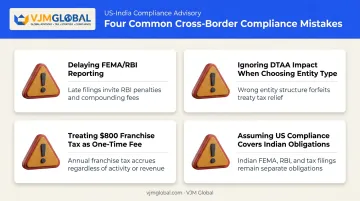
Indian companies expanding into California often clear the registration paperwork but stumble on cross-border compliance. These four mistakes cause the most costly setbacks:
- Delaying FEMA/RBI reporting– Skipping Form FC or the Annual Performance Report (APR) feels harmless until RBI penalties trigger a lengthy fix
- Picking an entity type without checking DTAA impact– An LLC's pass-through structure can complicate tax credit claims under India's Double Taxation Avoidance Agreement (DTAA), creating unexpected double taxation
- Treating the $800 Franchise Tax as one-time– It's an annual bill, not a formation fee, and missing it (or a Statement of Information deadline) can suspend your entity's good standing in California
- Assuming US compliance covers everything– Filing correctly with California's Secretary of State doesn't satisfy RBI obligations; both sides need annual attention
Frequently Asked Questions
Do you have to pay the $800 California LLC fee every year?
Yes. The $800 minimum Franchise Tax is owed annually to the California Franchise Tax Board for as long as your entity stays active, regardless of income earned.
Do foreign LLCs have to register in California?
Yes, if they're "doing business" in the state per California's sales, property, or payroll thresholds. That includes Indian-owned LLCs formed elsewhere but operating in California.
Can a non-resident register a company in the USA?
Yes. Non-US citizens and residents can form an LLC or Corporation in California without a Social Security Number, using an EIN obtained through Form SS-4 instead.
Is it better to have an LLC or corporation in California?
It depends on your funding plans. Corporations suit companies seeking US investors; LLCs suit those wanting pass-through taxation, though DTAA implications should factor into either decision.
Do Indian companies need RBI approval to set up a business in California?
Most don't. Investments under the Automatic Route need no prior approval, provided you stay within ODI financial limits and file Form FC and your APR on schedule.
How long does it take to register a business in California from India?
Realistically, 3-6 weeks total. Name reservation and formation typically take 1-2 weeks, and EIN issuance adds 4 days to 4 weeks depending on filing method. Bank account timing varies by institution.