Introduction
Picture a manufacturing business owner who hasn't filed a liability claim in six years. Yet their commercial premium jumped 20% at renewal, with the carrier citing "market conditions" rather than their own loss history.
It's a familiar frustration, and it's pushing more business owners to ask: why not insure ourselves?
A captive insurance company is a licensed insurer, wholly owned by the business (or its owners) it insures, formed to finance and manage that business's own risk.
Captive formation gets pitched constantly as a tax play. In reality, it's a regulated, multi-step corporate and insurance process that plenty of US businesses misunderstand.
This guide walks through what a captive actually is, why businesses form them, the formation steps involved, the real costs and structural decisions, and when a captive isn't the right tool.
Key Takeaways
- A captive is a licensed insurer, not a self-insurance fund or shell company
- Captives let businesses control coverage terms and retain underwriting profit
- Captive formation requires a feasibility study, domicile selection, and licensing
- Captives need genuine risk transfer; tax savings alone won't satisfy the IRS
- Smaller businesses can join through group, association, or cell captives
What Is a Captive Insurance Company?
A captive is a licensed insurance subsidiary that a parent business, or a group of businesses, creates specifically to insure its own risks instead of buying coverage from a commercial carrier. The parent capitalizes the entity, the entity issues policies, and the entity pays claims.
The goal is straightforward: turn an insurance expense into a controlled, potentially profit-generating risk-financing vehicle. Premiums that once left the business permanently now sit inside an entity the owners control.
That's different from two things people often confuse it with:
| Approach | Key Characteristic |
|---|---|
| Self-insurance | No licensed insurer exists, no formal risk pooling, and no access to reinsurance markets |
| Commercial coverage | Business pays premiums but owns nothing and retains none of the underwriting profit |
Common Types of Captive Structures
Not every captive looks the same. Structure depends on how many businesses participate and how much capital they're willing to commit.
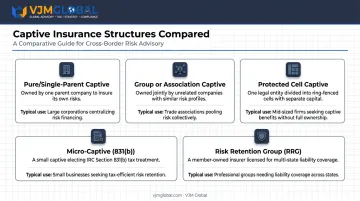
- Pure/Single-Parent Captive: Insures only the risks of one parent company and its affiliates
- Group or Association Captive: Multiple unrelated businesses pool risk together, often through a trade association
- Protected Cell Captive: A shared platform where each participant's "cell" has legally segregated assets and liabilities, which lowers entry costs considerably
- Micro-Captive (831(b)): Smaller captives eligible for a specific federal tax election, subject to heavy IRS scrutiny if not properly structured
- Risk Retention Group (RRG): A federally authorized captive form that can write liability coverage across multiple states, provided insureds are also owners
Why US Businesses Are Forming Captive Insurance Companies
Insurance markets move in cycles, and the current one is uneven by line. US property rates actually fell 10% in Q1 2026, while casualty rates rose 9%, according to Marsh's Global Insurance Market Index. That split matters: a captive decision should be evaluated coverage line by coverage line, not against a single market-wide assumption.
Beyond pricing, businesses form captives for control. A captive lets ownership set:
- Its own coverage terms and deductibles
- Its own claims handling process
- Coverage for risks commercial insurers exclude or price prohibitively, such as cyber, warranty, or emerging exposures
Profit retention is the other draw. Underwriting profit and investment income on reserves stay with the owner instead of a commercial carrier, and disciplined risk selection can improve loss performance over time when the owner also controls underwriting standards.
Tax treatment adds another layer of incentive. Premiums paid to a captive can be deductible business expenses, and reserve accounting works differently than self-insurance. But tax savings should never be the sole reason to form one: the IRS has ramped up scrutiny of micro-captives making 831(b) elections without genuine risk distribution, particularly following PATH Act rules that limit certain family ownership arrangements.
None of this is fringe. Roughly 90% of Fortune 500 companies operate captive subsidiaries, per the NAIC. Captives are an established, mainstream risk-management strategy used for legitimate risk transfer and retention across corporate America.
Step-by-Step: How to Form a Captive Insurance Company
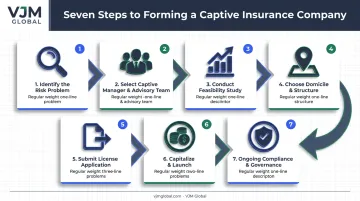
Formation moves through a predictable sequence: identify the risk problem, build an advisory team, run a feasibility study, choose a domicile, submit the application, capitalize the entity, and then govern it year over year.
Step 1: Identify the Risk Management Problem or Opportunity
Before anything else, pinpoint which risks the commercial market serves poorly. That could mean premiums that don't reflect a strong loss history, coverage gaps for specific exposures, or simply the desire to underwrite risk the business already understands better than an outside carrier.
Step 2: Select a Captive Manager and Advisory Team
A captive manager coordinates the day-to-day operations, but the full team includes actuaries, legal counsel, and tax advisors. Interview managers who represent multiple domiciles. A manager tied to one jurisdiction has an obvious incentive to steer you there, regardless of fit.
Step 3: Conduct a Feasibility Study
This is where the numbers get tested. The study models projected premiums, expected loss costs, capital needs, and domicile options to determine whether a captive actually makes financial sense, or whether the business is better off staying in the commercial market.
Step 4: Choose a Domicile and Captive Structure
Businesses weigh US domiciles, including Vermont, Delaware, and Utah, against offshore options like Bermuda and Cayman. The comparison usually comes down to regulatory responsiveness, capital requirements, and ongoing cost. Structure gets decided here too: pure, group, cell, micro-captive, or RRG.
Step 5: Develop a Business Plan and Submit the License Application
The application package typically includes projected financials, underwriting guidelines, reinsurance arrangements, and governance structure. It goes to the domicile's insurance regulator for review, and incomplete applications are the single biggest cause of delay.
Step 6: Capitalize and Launch the Captive
Once approved, the business funds the required minimum capital and surplus. Some captives also arrange fronting agreements with a traditional insurer to issue admitted paper. Only after capitalization and any fronting arrangement is finalized does the captive begin writing coverage.
Step 7: Maintain Ongoing Compliance, Actuarial Review, and Governance
Formation isn't the finish line. Captives need annual actuarial certification of reserves, regulatory reporting to the domicile, and active board governance.
This is also where most businesses realize they need dedicated tax, accounting, and audit support to keep captive financials compliant year after year. VJM Global works with US businesses on this kind of ongoing tax compliance and financial reporting, the governance work that determines whether a captive stays compliant long-term.
Key Considerations, Costs & Ownership Structure
Captive costs vary widely, but they generally fall into a few buckets:
- Feasibility study fees to assess whether a captive makes sense
- Legal and actuarial costs for formation and ongoing compliance
- Minimum capital funding required by the chosen domicile
- Annual management or fronting fees for ongoing operations
Smaller single-parent or cell captives tend to have lower upfront and ongoing costs than mid-sized group or RRG structures, largely because capital minimums and governance complexity scale with size.
Entity structure: Most captives form as a C-corporation, or an LLC electing C-corporation tax treatment, because the captive must remain a legally separate entity from its parent. Utah's 2025 statute update also permits nonprofit organizational forms, but availability still varies by domicile.
Ownership rules typically mirror the parent business: the same owners hold shares in the captive.
One nuance worth flagging: the PATH Act's diversification rules don't impose a flat 2% cap on family ownership. Instead, they generally prevent a specified holder, such as a spouse or lineal descendant, from owning a captive percentage more than 2 percentage points above their actual interest in the insured business's assets. This matters most for captives used alongside estate planning.
Domicile choice drives real variation in cost and regulation:
| Domicile | Pure Captive Minimum Capital | Notable Feature |
|---|---|---|
| Vermont | $250,000 | Largest US domicile; 677 active captives as of late 2025 |
| Delaware | $250,000 | Same-day conditional authority advertised |
| Utah | $250,000 | No premium tax on captives |
| Tennessee | Varies by filing | ~30-day review for complete applications |
Finally, many captives rely on a fronting partner, a traditional insurer that issues admitted paper, provides reinsurance access, and adds regulatory credibility in states where the captive itself isn't licensed to write directly.
Common Mistakes and When a Captive May Not Be Right for You
Captives aren't reserved for large corporations. Group, association, and micro-captive structures let smaller businesses participate without carrying the full capital burden alone.
That said, several mistakes show up repeatedly:
- Treating tax savings as the primary motivation. U.S. Tax Court records show the IRS has won nine consecutive micro-captive cases where arrangements lacked genuine risk distribution
- Skipping the feasibility study and jumping straight to an 831(b) election because a promoter recommended it
- Underestimating fixed costs relative to premium volume, which erodes any financial benefit
- Ignoring inconsistent loss history, since unpredictable losses make actuarial modeling unreliable
A captive likely isn't right for your business if:
- Profitability is inconsistent year to year
- Loss history is poor or highly unpredictable
- Premium volume is too small to offset fixed formation and management costs
- Ownership isn't prepared for ongoing governance responsibilities
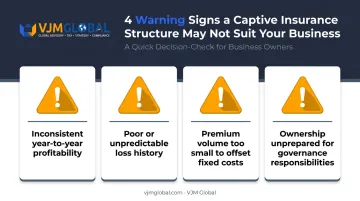
If a business is pursuing a captive because competitors have one, or because a promoter pitched it aggressively, that's a warning sign. A documented risk-management need, confirmed through a feasibility study, should always come first.
Conclusion
Captive insurance formation is a structured, multi-step process. It runs through feasibility analysis, domicile selection, licensing, and capitalization, but the work continues beyond that point. Ongoing actuarial review and governance carry on for as long as the captive operates.
That discipline extends to the numbers, too. Success depends on genuine risk transfer, proper capitalization, and disciplined compliance—not aggressive tax positioning. US businesses evaluating captive formation also need reliable tax, accounting, and compliance support to manage the entity correctly year after year. That's where a firm with cross-border advisory and back-office expertise, like VJM Global, can add real value for US-facing businesses navigating this process.
Frequently Asked Questions
How much does it cost to start a captive insurance company?
Costs include feasibility study fees, minimum capital (often $250,000 or more for pure captives), and annual management fees. Total costs vary widely by domicile, captive type, and complexity, so get domicile-specific quotes early.
Can a captive insurance company be an LLC?
Yes, most captives form as a C-corporation or an LLC electing C-corporation tax treatment. The parent and the captive must remain legally separate entities regardless of which form is chosen.
Who is the owner of a captive insurance company?
Owners are typically the same shareholders as the parent business. The PATH Act limits how much ownership can shift toward spouses or lineal descendants relative to their actual stake in the insured business.
What is the difference between a captive insurance company and self-insurance?
Self-insurance skips the licensed insurer, formal risk pooling, and reinsurance access that captives provide. A captive, by contrast, is a regulated insurance entity with reserve requirements and access to reinsurance markets.
Which US state is considered best for forming a captive insurance company?
Vermont has long led US captive licensing, with the largest active captive count in the country. Delaware, Utah, and Tennessee are also competitive, depending on your structure and capital preferences.
How long does it take to form a captive insurance company?
Timelines typically span several months. Regulator review alone can take as little as 30 days in some states, but feasibility study duration and application completeness usually drive the real timeline.