Introduction
Picture this: you're finally opening a business bank account for your new LLC. The banker asks for your "Certificate of Registration." You pause. Is that the same as your Articles of Organization? Your EIN letter? Something else entirely?
You're not alone. Every state uses a different name for this document: Certificate of Formation, Certificate of Incorporation, Certificate of Organization, among others. The inconsistency trips up new business owners constantly. Banks, landlords, and lenders often use "certificate of registration" as a catch-all term, even though no single federal document carries that exact name.
This guide breaks down what the certificate actually is, why it matters, and how to get one in any US state, with a close look at Illinois. It also covers what changes if you're expanding your business into India.
Key Takeaways
- No single national certificate exists: the document name depends on your state and entity type
- Banks and lenders commonly request formation evidence before approving accounts or credit lines
- Filing fees run $40 (Kentucky) to $500 (Massachusetts), with turnaround from same-day to weeks
- The certificate differs from your EIN letter and Good Standing certificate: each serves a distinct purpose
- US businesses expanding into India need a separate Certificate of Incorporation from India's Registrar of Companies
What Is a Certificate of Company Registration?
A Certificate of Company Registration is the official proof that your business legally exists, issued once your state reviews and files your formation paperwork.
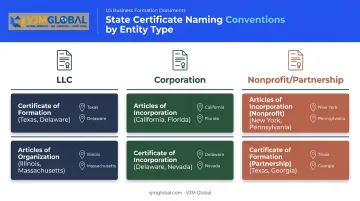
The catch: the name varies depending on where you form your business and what type of entity you choose.
- LLC: Certificate of Formation (Texas, Delaware) or Articles of Organization (Illinois, Massachusetts)
- Corporation: Certificate of Incorporation or Articles of Incorporation
- Nonprofit or Partnership: Certificate of Organization, depending on the state
What's Actually on the Certificate
Most certificates include:
- Legal business name
- Entity or file number assigned by the state
- Date of registration
- State/jurisdiction of formation
- Registered agent name and address
Delivery format varies by state, too: Texas lets you order certified copies through SOSDirect, by email, or by mail, while Delaware returns a stamped "Filed" copy, and New York offers electronic copies for qualifying records.
When You'll Actually Need It
You'll need this certificate well beyond initial filing. Expect to produce it when:
- Opening a business bank account
- Applying for local or state licenses and permits
- Securing a business loan or line of credit
- Signing a commercial lease
- Passing vendor or partner due diligence checks
This certificate proves your business is a separate legal entity, distinct from you personally — a distinction that matters more than most new owners realize.
Why This Certificate Matters for Your Business
Filing this document correctly lays the legal and financial foundation your business operates on.
It establishes legal existence. Without formal state filing, your LLC or corporation doesn't legally exist — you're just an individual doing business, personally exposed to liability. The SBA notes that corporations are treated as separate legal entities from their owners, and LLC owners are generally shielded from personal liability once the entity is properly formed.
It builds credibility with banks, investors, and partners. Enterprise clients and investors routinely request formation documents during due diligence before signing contracts or wiring funds. Showing up without one signals disorganization at best.
It's a prerequisite for financial operations. Most banks require proof of formation before they'll open a business account or approve credit. The SBA's own account-opening checklist lists formation documents among the standard requirements, though individual banks may ask for additional records depending on your entity type.
Skipping this step, or assuming it's optional, tends to cause delays exactly when you need speed most.
Certificate of Registration vs. Other Business Documents
New owners frequently confuse this certificate with three other documents, so here's how each one differs.
| Document | Issued By | Purpose |
|---|---|---|
| Certificate of Registration/Formation | State Secretary of State | Confirms your entity was legally formed |
| Articles of Incorporation/Organization | You (filed with the state) | The paperwork you submit to request formation |
| EIN Confirmation Letter (CP 575) | IRS (federal) | Confirms your federal tax ID number |
| Certificate of Good Standing | State Secretary of State | Confirms ongoing compliance with state requirements |
Articles vs. Certificate: Think of Articles of Incorporation or Organization as your application and the Certificate as the state's approval. You submit one; the state issues the other.
EIN Letter vs. Certificate: Your EIN letter comes from the IRS and proves your tax identity, while your Certificate comes from the state and proves your legal formation. Neither substitutes for the other — banks typically want both.
Good Standing vs. Certificate: A Certificate of Registration confirms you formed correctly on day one, while a Certificate of Good Standing confirms you're still compliant with annual reports, fees, and filings today. Lenders and out-of-state expansion often require the latter, not the former.
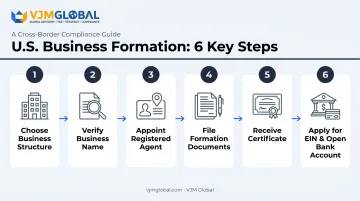
How to Obtain a Certificate of Company Registration in the US
The process follows a fairly consistent sequence across states, though details differ.
Choose your business structure. LLC, C-Corp, S-Corp, or partnership : this decision determines which certificate type you'll ultimately receive and how you'll be taxed.
Select and verify your business name. Search your state's Secretary of State database to confirm your desired name isn't already taken or too similar to an existing entity.
Appoint a registered agent. Nearly every state requires a registered agent with a physical street address (not a P.O. Box) in your state of formation. Illinois, Kentucky, and Massachusetts all explicitly reject P.O. Box-only addresses.
File your formation documents. Submit your Articles of Incorporation or Organization online or by mail, along with the filing fee. Fees vary widely:
| State | LLC Filing Fee |
|---|---|
| Kentucky | $40 |
| Illinois | $150 (standard) |
| Texas | $300 |
| Massachusetts | $500 |
Check your specific state's Secretary of State website for current fees, since these figures shift periodically.
Receive your certificate. Processing time depends on whether you pay for expedited service. Georgia, for example, processes online filings in 7-10 business days, with same-day and one-hour expedite options available for a fee. Certificates typically arrive by email, mail, or through an online business portal.
Apply for your EIN and open a bank account. Once your certificate is in hand, request your EIN from the IRS and use both documents to open your business bank account, completing your legal and financial setup.
State-Specific Registration Considerations (Including Illinois)
Filing requirements, fees, and turnaround times differ from state to state, sometimes dramatically. What's routine in one state might be rejected outright in another.
Illinois: What to Expect
Illinois businesses file through the Secretary of State's Department of Business Services, using the online LLC Articles of Organization portal.
- Form required: LLC-5.5 (Articles of Organization) for LLCs, or Articles of Incorporation for corporations
- Standard fee and timing: $150 with a 10-business-day turnaround
- Expedited option: $250 total for 24-hour processing
- Registered agent rule: Must maintain a physical Illinois office; a P.O. Box alone won't satisfy the requirement
Why You Should Always Check Your Own State
Names, forms, and fees differ across all 50 states. What applies in Illinois won't necessarily apply in California or New York. Before filing anything, visit your state's Secretary of State website directly to confirm current requirements. Fee schedules and forms are updated more often than you'd expect.
Expanding Your US Business to India? Registering a Company Abroad
If your US business is sourcing products, hiring talent, or opening operations in India, you'll encounter a completely separate registration system , one that doesn't map neatly onto US concepts.
India's equivalent document is the Certificate of Incorporation, issued by the Registrar of Companies (RoC) under the Ministry of Corporate Affairs (MCA). Like its US counterpart, it confirms legal registration. It also includes a unique identifier called the Corporate Identification Number (CIN), similar in spirit to a US state's entity file number.
Company incorporation in India runs through the SPICe+ system, a unified online form covering name reservation, incorporation, RoC registration, and CIN issuance in one linked filing process, according to India's Ministry of Corporate Affairs.
Where US Businesses Get Stuck
American owners typically hit friction in a few predictable places:
- Documentation gaps: Digital Signature Certificates, Director Identification Numbers, notarized passports for foreign directors
- Structure translation: there's no direct Indian equivalent to a US LLC; most US businesses end up choosing between a Private Limited Company or an LLP
- FEMA and FDI compliance: foreign investment rules dictate which sectors permit full ownership and which require prior approval
- Name approval delays: proposed names face a 3-5 business day review and must avoid conflicts with existing trademarks
This is where VJM Global comes in. With over 30 years of experience and a track record of helping 500+ American business owners register companies in India, VJM Global's team of CPAs, Chartered Accountants, and business setup specialists manages the entire process.
That includes choosing between a Private Limited Company and an LLP, handling Digital Signature Certificates and RoC filing, and securing the final Certificate of Incorporation, all within a minimum timeframe and full regulatory compliance.

Frequently Asked Questions
What is a company registration certificate?
It's official government proof that your business is legally registered, showing details like your business name, registration number, and formation date. The exact title depends on your state and entity type.
What's the difference between a certificate of registration and a certificate of good standing?
A certificate of registration proves your business was formed correctly, while a certificate of good standing confirms it remains compliant and active today. Lenders and licensing boards often require the good standing version specifically.
How to get a certificate of registration in Illinois?
File your Articles of Organization or Incorporation with the Illinois Secretary of State's Department of Business Services, either online or by mail. You'll receive your certificate upon approval, typically within 10 business days or 24 hours with expedited service.
How long does it take to get a certificate of registration in the US?
Timelines vary widely by state, from same-day expedited processing to several weeks for standard filing. Illinois offers 24-hour or 10-business-day options, while other states may take longer without paying an expedite fee.
Is a certificate of registration the same as a business license?
No. A registration certificate proves your business is legally formed, while a business license is a separate permit required to operate certain activities, often issued at the city or county level.
Can a US company get a certificate of registration to operate in India?
Yes, US companies obtain a Certificate of Incorporation through India's MCA and RoC system, not a US-style certificate. Firms like VJM Global assist with this end-to-end, from entity selection through final filing.