Introduction
Just as every Singapore company receives a Unique Entity Number (UEN) from ACRA to operate legally, every business registered in Dubai receives a Company Registration Number (CRN) — and without it, no banking, contracts, or government transactions can proceed.
For Singapore businesses expanding into Dubai, the CRN is your company's legal identity in the UAE. Whether you're vetting a local partner or setting up your first entity, you'll need to understand how it works.
This guide covers what the CRN is, how it differs from related identifiers like the Trade License and Tax Registration Number (TRN), and what changes depending on whether you register on the mainland, in a free zone, or offshore.
Key Takeaways
- The CRN is Dubai's equivalent to Singapore's UEN — a unique legal identity number for every registered business
- CRN issuing authority depends on structure: mainland companies go through the DET, free zone companies through their respective free zone authority
- Dubai uses three separate numbers — CRN, Trade License, and TRN — each serving a different compliance purpose
- Singapore businesses can establish mainland, free zone, or offshore entities, each with different registration pathways
- The CRN is mandatory before opening bank accounts, signing contracts, sponsoring visas, or registering for VAT
What Is a Dubai Company Registration Number?
The Company Registration Number (CRN) is a unique identifier assigned to every legally incorporated business in the UAE. It authorizes commercial activities and appears in all official government records.
The CRN is generated after completing the registration process and appears on the Trade License certificate. Format varies by jurisdiction:
- Mainland companies: Typically receive an 8–10 digit numeric code from DET
- Free zone companies: Receive alphanumeric codes specific to their issuing authority
The CRN stays with the company for its entire life. It doesn't change during routine renewals, shareholder changes, or office relocations — so Singapore businesses verifying UAE partners or registering a subsidiary will encounter this same number at every stage of the process.
Dubai CRN vs. Singapore UEN: Key Parallels and Differences
Conceptual Similarity
Both the UAE's CRN and Singapore's UEN serve as the single identifier linking a company to all government systems. Singapore's UEN (issued by ACRA) connects businesses to national regulatory databases, while the Dubai CRN links companies to the UAE's Ministry of Economy, DET, Federal Tax Authority, and immigration systems.
Key Structural Difference
| Entity Type | Registering Authority |
|---|---|
| Singapore company | ACRA — single national registrar |
| UAE mainland company | DET of the relevant emirate |
| UAE free zone company | Respective free zone authority (e.g., DMCC, DIFC, JAFZA) |
Singapore businesses must confirm which authority governs their Dubai entity before proceeding with verification.
Verification Complexity
Unlike the UEN, which is centrally searchable via BizFile+, verifying a Dubai company's CRN may require checking multiple portals depending on registration jurisdiction:
- DET Dubai for mainland companies
- DMCC, DIFC, or JAFZA portals for respective free zone entities
- National Economic Register (Nomu) for cross-emirate searches
Dual Entity Structure
Singapore companies establishing a Dubai subsidiary will hold two separate identifiers:
- Singapore UEN for the parent entity
- Dubai CRN for the UAE subsidiary
These are legally distinct entities for banking, tax, and compliance purposes. That separation has direct implications for due diligence.
Due Diligence Best Practice
Always request a partner's CRN and verify it on the relevant official portal before signing contracts or making payments. The CRN confirms legal standing and the company's permitted activity scope — especially relevant for Singapore businesses conducting B2B deals with UAE counterparts.
Dubai Business Setup Options for Singapore Companies
Singapore companies have three primary routes for establishing a Dubai presence: mainland, free zone, or offshore. Each path generates its own Company Registration Number (CRN) and suits different business goals.
Mainland Setup
Singapore companies wanting full access to the UAE domestic market can establish a mainland LLC or branch through Dubai's Department of Economy and Tourism. The CRN is issued by DET upon incorporation.
Key Update: Since 2021, Federal Decree-Law No. 32 of 2021 permits 100% foreign ownership in most mainland business activities, removing the previous requirement for a local Emirati partner. Certain strategic sectors (oil and gas, telecommunications, defense) may still require a UAE national shareholder.
Free Zone Setup
Dubai's 26 free zones — including DMCC, DIFC, DAFZA, and IFZA — are popular among Singapore businesses in trading, fintech, and professional services because they offer:
- 100% foreign ownership
- Full profit repatriation
- Streamlined registration
- Business-focused regulatory environment
Each free zone issues its own CRN, and the format and process differ by zone. Singapore businesses should match their business activity to the most appropriate free zone, as each has restrictions on permitted activities.
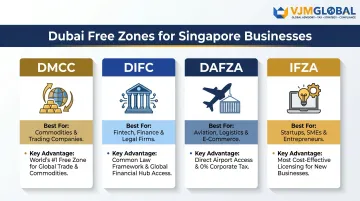
The table below highlights the most common choices for Singapore businesses, along with their standout advantages:
| Free Zone | Best For | Key Advantage |
|---|---|---|
| DMCC | Trading, commodities | 1,000+ activities; 100% digital setup |
| DIFC | Financial services, fintech | Common-law legal framework |
| DAFZA | Logistics, manufacturing | Strategic airport location; 3,300+ registered businesses |
| IFZA | Professional services, startups | Flexi-desk registration options |
Offshore Setup
Offshore companies (registered through authorities like JAFZA Offshore or RAK ICC) receive a CRN from the relevant offshore registry. These entities cannot conduct business within the UAE mainland but serve purposes such as:
- Holding structures
- Asset management
- International trading
- Tax planning
How Singapore Businesses Obtain a Dubai CRN: Registration Process
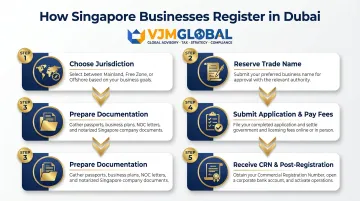
Step 1 — Choose Jurisdiction and Business Activity
Determine whether mainland, free zone, or offshore best suits your goals. Research which business activities are permitted in your chosen jurisdiction, as the activity classification directly determines the licensing authority that will issue the CRN.
Step 2 — Reserve Trade Name and Obtain Initial Approvals
Submit a trade name application to DET (for mainland) or the relevant free zone authority. Ensure the name complies with UAE naming conventions and doesn't include restricted words.
Activities requiring additional ministerial approvals:
| Activity Sector | Approving Authority |
|---|---|
| Banking, Insurance, Exchange | Central Bank of UAE |
| Financial Consultation/Broking | Securities and Commodities Authority |
| Telecommunications | TDRA |
| Auditing/Foreign Branches | Ministry of Economy |
| Publishing/Media/Advertising | National Media Council |
| Healthcare | Ministry of Health and Prevention (MOHAP) |
| Recruitment/Manpower | Ministry of Human Resources & Emiratisation |
Step 3 — Prepare Documentation
Singapore businesses typically need:
- Passport copies of all shareholders and directors
- Singapore company's Certificate of Incorporation and M&AA (attested and apostilled)
- Business plan (where required by authority)
- Proof of address
- No Objection Certificate from relevant bodies (where applicable)
Attestation Note: Since both Singapore and the UAE are parties to the Apostille Convention (effective for Singapore from September 16, 2021, and for UAE from August 14, 2022), Singapore incorporation documents can be apostilled by the Singapore Academy of Law for acceptance in the UAE.
Step 4 — Submit Application, Secure Business Address, and Pay Fees
Most Dubai authorities offer online registration through platforms like Bashr, which enables business establishment in as little as 15 minutes for straightforward local setups.
Business address requirements:
- Mainland: Physical office required; rental agreement must be registered with Ejari
- Free zones: Flexi-desk options accepted for registration (IFZA and DMCC offer shared desk packages for startups)
Registration costs range from approximately AED 10,000–15,000 for free zone setups to AED 20,000+ for mainland licenses, depending on activity type and share capital requirements. Check current fee schedules directly with DET or your chosen free zone authority before finalizing your budget.
Step 5 — Receive CRN and Complete Post-Registration Requirements
Once fees are paid and the application is approved, the Trade License is issued with the CRN printed on it. This number activates your ability to open a UAE corporate bank account and sponsor employee visas.
Singapore businesses should then proceed with:
- UAE corporate bank account opening (requires CRN)
- VAT registration if applicable
- Immigration establishment card setup for visa sponsorship
Working with a cross-border advisory firm at this stage is particularly valuable for Singapore businesses navigating UAE banking requirements, which often involve additional KYC documentation for foreign-owned entities.
How to Find and Verify a Dubai Company Registration Number
Finding and verifying a CRN is straightforward once you know which portal or authority to approach. For Singapore businesses dealing with UAE counterparts, this process is also your first line of due diligence before committing to any contract or transfer.
Where to Find Your Own CRN
The CRN appears on:
- Trade License certificate (primary source)
- Chamber of Commerce membership certificate
- Government portal accounts
- Bank account documentation
- Official company correspondence
Store a digital copy of the Trade License as the primary reference.
How to Verify a Dubai Company's CRN Online
Different portals serve different jurisdictions:
| Jurisdiction | Verification Portal | URL |
|---|---|---|
| Dubai Mainland | DET eServices Portal | https://eservices.dubaided.gov.ae |
| DMCC | Public Register of DMCC Entities | https://dmcc.ae/public-register |
| DIFC | DIFC Public Register | https://www.difc.ae/business/public-register |
| JAFZA | Dubai Trade EDV | https://www.dubaitrade.ae/en/edv-introduction |
| Multi-emirate | National Economic Register (Nomu) | https://www.growth.gov.ae/G2C/ |
Verification confirms legal name, registration status, license validity, and permitted activities. Always verify before signing contracts or transferring funds to UAE counterparts.
If You Cannot Locate Your CRN
Contact the issuing authority (DET or free zone) directly with the company's trade name and original registration details to request a duplicate certificate. Banks and incorporation agents typically retain copies as well — a cross-border advisory firm familiar with both Singapore and UAE frameworks can also coordinate retrieval on your behalf if the original paperwork is inaccessible.
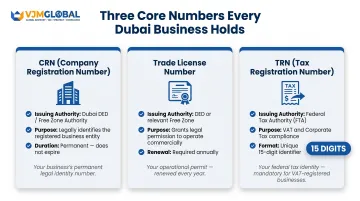
CRN, Trade License, and TRN: Understanding the Three Core Numbers
All three numbers serve distinct legal purposes — and confusing them is one of the most common compliance mistakes Singapore businesses make when entering Dubai.
| Identifier | Issuing Authority | Purpose | Duration |
|---|---|---|---|
| CRN | DET (mainland) or Free Zone Authority | Legal identity of company; links all official records | Permanent for company's life |
| Trade License Number | DET or Free Zone Authority | Authorizes specific commercial activities | Annual renewal required |
| TRN | Federal Tax Authority (FTA) | 15-digit identifier for VAT and corporate tax compliance | Active while tax obligations exist |
The Practical Sequence
A Singapore company setting up in Dubai will:
- Receive the CRN at incorporation
- Receive the Trade License (which may carry a different number)
- Obtain the TRN once VAT registration is triggered
VAT Registration Thresholds:
- Mandatory: AED 375,000 in taxable supplies over the previous 12 months
- Voluntary: AED 187,500
- Foreign businesses: Must register regardless of threshold
Corporate Tax Note: UAE corporate tax became effective for financial years starting on or after June 1, 2023. Corporate tax registration requires a separate TRN from the VAT TRN — they are not interchangeable.
Due Diligence Best Practice
Knowing these three numbers also shapes how you verify UAE partners. When conducting due diligence, request the CRN, Trade License, and TRN together — each confirms a different dimension of the entity's legal and tax compliance standing.
Frequently Asked Questions
Do Dubai companies have a registration number?
Yes, every legally registered company in Dubai and across the UAE receives a Company Registration Number (CRN) upon incorporation, regardless of whether it's a mainland, free zone, or offshore entity. This number is mandatory for all official transactions.
How to find Dubai company registration number?
The CRN is printed on the company's Trade License certificate and appears on Chamber of Commerce documents and bank records. You can verify it through the DET Dubai portal (for mainland companies) or the relevant free zone's online directory.
How is a Dubai CRN different from a Singapore UEN?
Both serve as the official business identifier in their respective jurisdictions. The key difference: Dubai's CRN is issued by different authorities depending on business type (DET for mainland, free zone authority for zones), while Singapore's UEN is issued centrally by ACRA for all company types.
Can a Singapore company set up in a Dubai free zone without a local partner?
Yes, free zones in Dubai allow 100% foreign ownership with no requirement for a UAE national partner. Mainland setups also permit 100% foreign ownership in most activity categories since the 2021 UAE Commercial Companies Law amendments.
How long does it take to receive a Dubai company registration number?
Timelines vary by jurisdiction and activity type. Free zone registrations can be completed in a few business days for straightforward applications, while mainland setups or activities requiring additional ministerial approvals may take several weeks.
What documents do Singapore businesses typically need to register a company in Dubai?
Core requirements typically include:
- Passport copies of all shareholders and directors
- Singapore Certificate of Incorporation and constitutional documents (attested and apostilled)
- Completed application form
- Proof of business address in Dubai
- Additional ministerial approvals for regulated activities
Requirements differ between mainland and free zone authorities, so confirm the current checklist with the relevant issuing body before applying.